
100% Focus on Your Recovery,
Chicago Auto Accident Lawyer
Chicago Auto Accident Lawyer
Our Team of Attorneys Are Committed to Maximizing the Value of Your Case





Federal law requires every commercial driver, in Illinois and nationwide, to speak and understand English well enough to talk with the public, read road signs, respond to a safety inspector, and fill out required paperwork. Since June 2025, a driver who can’t may be pulled out of service on the spot.
The CDL English requirement is a long-standing safety rule that applies to drivers operating commercial vehicles in Illinois and throughout the United States. The purpose is straightforward: drivers must be able to communicate clearly, read signs, and respond to safety situations on public roads.
When this requirement is ignored or unevenly enforced, the risk to other motorists increases, especially in serious crashes involving large trucks. Our Chicago truck accident lawyers regularly evaluate these issues when representing people injured in commercial vehicle collisions.
Illinois participates fully in the federal motor carrier safety framework, meaning state enforcement aligns with federal law. These rules apply to commercial truck drivers engaged in interstate commerce as well as many intrastate operations.
English language proficiency is required so professional drivers can understand instructions, warnings, and emergency communications. Commercial drivers must be able to understand highway traffic signs, road signs, and traffic signs and signals that control speed, lane use, and hazards. They must also be able to respond to official inquiries during inspections, accident investigations, or roadside stops.
The requirement is not about fluency or accent. The standard is whether a driver can speak English and understand it well enough to safely perform their duties. This includes the ability to sufficiently read safety materials and communicate verbally when safety is at stake.
Federal law, specifically 49 CFR 391.11(b)(2), requires a commercial driver to be able to read and speak English well enough to talk with the public, understand highway traffic signs and signals, respond to an inspector’s questions, and fill out required reports and records. This rule is enforced by the Federal Motor Carrier Safety Administration (FMCSA) and applies to every state, including Illinois.
In Illinois, it’s the Illinois Secretary of State’s office, not the Illinois Department of Transportation, that applies this standard when issuing and renewing CDLs. Drivers who cannot meet this proficiency requirement may be placed out of service under established out-of-service criteria, meaning they cannot continue operating until the issue is resolve
Enforcement personnel evaluate language ability during roadside inspections, audits, and post-accident reviews. Revised inspection procedures emphasize observation and practical communication, not formal English language proficiency testing. Inspectors look for ELP violations such as inability to understand traffic signs, failure to respond to questions, or confusion during safety instructions, especially when someone is injured by a dump truck and compliance issues become part of an accident investigation.
New guidance issued through a guidance document clarified how inspectors should apply the rule consistently. The goal is common-sense English language enforcement that protects the general public without unfairly targeting drivers, similar to how liability issues are evaluated in cases such as rear-end collision claims.
Non-domiciled drivers operating under non-domiciled CDLs are subject to the same English language standards as U.S.-based drivers. At border patrol or agricultural checkpoints, the ability to communicate clearly is especially important. Drivers must be able to answer questions, follow directions, and understand safety instructions.
Drivers with a speech disability are not automatically disqualified from holding a CDL. Some deaf or hard-of-hearing drivers hold a CDL under a separate federal hearing exemption (49 CFR 391.41(b)(11)). How that exemption applies during a roadside English-proficiency check is still an open question in the trucking industry, and it isn’t a documented, formal accommodation for a roadside stop, just as specific procedures may apply when filing a pedestrian injury claim after an accident.
The timeline for how this rule is enforced has changed significantly in the past year.
From 2016 until 2025, federal guidance told inspectors not to place a driver out of service for an English proficiency violation alone. That changed on June 25, 2025, when English proficiency violations were formally added back to the North American Standard Out-of-Service Criteria used at roadside inspections. In February 2026, Congress went a step further, requiring the FMCSA to write that out-of-service consequence directly into federal regulation rather than leaving it as enforcement guidance alone.
In practice, this means a driver found not to meet the English proficiency standard during a roadside inspection can be placed out of service immediately, unable to continue operating until the issue is resolved. Out-of-service orders are documented as part of compliance records, and multiple or repeated violations can lead to broader enforcement actions against a motor carrier, similar to the documentation required when filing an Uber accident claim.
For employers, ensuring compliance means verifying that drivers are properly qualified, including reviewing a driver’s driver qualification file, before allowing them to operate. For drivers, it means understanding that language ability is a non-negotiable safety requirement, not a paperwork issue, especially when violations contribute to serious cases such as a motorcycle accident wrongful death.
On April 28, 2025, President Trump signed an executive order titled “Enforcing Commonsense Rules of the Road for America’s Truck Drivers.” The order directed the Department of Transportation and FMCSA to rescind the 2016 guidance that had discouraged out-of-service enforcement and to issue new, stricter inspection procedures. This is a separate order from the one that made English the official language of the U.S. government generally, and the two shouldn’t be conflated with requirements such as electronic logging device rules.
U.S. Transportation Secretary Sean Duffy has addressed these changes in public statements, emphasizing safety while supporting the trucking industry.
This isn’t just a settled federal rule sitting quietly in the background. Illinois is at the center of an active, fast-moving dispute over commercial licensing right now.
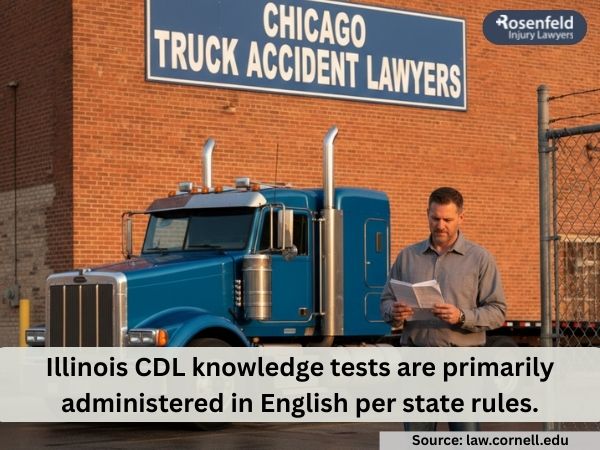
Illinois currently lets CDL applicants take the written knowledge exam in Spanish, with translated study materials, a policy the Secretary of State’s office introduced in 2024. No matter what language the written test was taken in, the skills test, road test, and pre-trip inspection must always be done in English.
In February 2026, the federal government sharply increased pressure on Illinois over commercial licensing. A federal audit found that nearly one in five of the state’s non-domiciled CDLs (licenses issued to foreign nationals authorized to work in the U.S.) had not been properly verified for lawful presence. Illinois was warned it could lose roughly $128 million in federal highway funding if it didn’t pause new issuances and fix the problem.
Around the same time, federal officials pushed for CDL knowledge tests to be given in English only, nationwide. Florida and Texas both made that change in 2026. Illinois has not, as of this writing.
This is an unresolved dispute between the state and federal government, not a settled outcome. Illinois Secretary of State Alexi Giannoulias has stated that the state’s CDL practices are substantially compliant with federal requirements, and the state has indicated it plans to review the federal findings, much like reviewing evidence in a head-on collision case to determine responsibility.
When an automobile accident involves a commercial vehicle, language compliance often becomes a key issue. Investigators may examine whether the driver could understand traffic signs, follow instructions, or communicate after the crash. Failures in this area can affect determinations of truck accident liability.
Our traffic accident law firm in Chicago reviews these cases carefully. We believe FMCSA and state licensing agencies must apply the rules consistently to protect everyone on Illinois roads. English language proficiency requirements exist to prevent harm, not after-the-fact excuses.
For commercial drivers, understanding and meeting the requirements protects careers. For the public, it protects safety. And when accidents happen, compliance with this rule can make a meaningful difference in accountability and outcomes.
No. Federal law only requires “sufficient” English ability, not fluency. A driver needs to be able to talk with the public, read traffic signs and signals, answer an inspector’s questions, and fill out required paperwork.
Yes. Since June 25, 2025, an English proficiency violation found during a roadside inspection can lead to an immediate out-of-service order, meaning the driver can’t keep driving until the issue is resolved.
Yes, currently. Illinois lets applicants take the written knowledge exam in Spanish, but the skills test, road test, and pre-trip inspection must always be done in English regardless of which language the written test was taken in.
Yes. A non-domiciled CDL, issued to a foreign national authorized to work in the U.S., carries the same English language requirement as any other CDL.
Yes. If a driver’s inability to understand a road sign, safety warning, or instruction contributed to a crash, that can support a negligence claim against both the driver and the company that put them on the road.
If distracted driving is also a factor in your case, our cell phone policy for CDL drivers page explains the rules governing mobile phone use behind the wheel.
 Legally Reviewed By
Attorney Jonathan Rosenfeld
Content legally reviewed by Jonathan Rosenfeld This page has been reviewed for legal accuracy by Jonathan Rosenfeld, a Chicago personal injury attorney with nearly 25 years of experience representing people injured in car, truck, motorcycle, pedestrian, and rideshare accidents. Jonathan has recovered more than $450 million in settlements and verdicts for injured clients and families in Chicago. He holds a 10/10 rating on Avvo, is a member of the Million Dollar Advocates Forum, and has been repeatedly recognized by Super Lawyers. Jonathan leads the firm’s approach to holding insurance carriers and corporate defendants accountable for serious traffic injuries.