
100% Focus on Your Recovery,
Chicago Auto Accident Lawyer
Chicago Auto Accident Lawyer
Our Team of Attorneys Are Committed to Maximizing the Value of Your Case






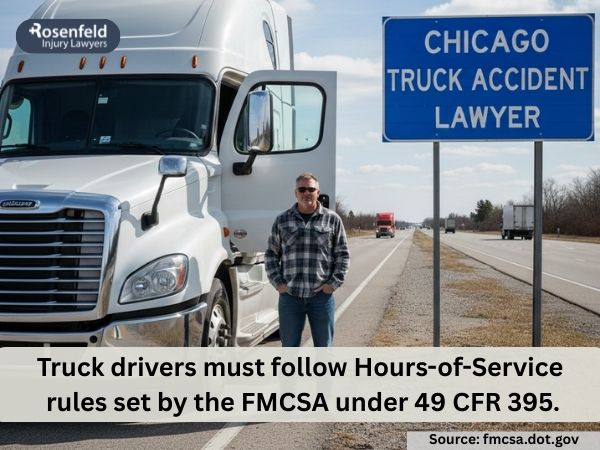
Truck drivers are required by federal law to record their hours of service, tracking driving time, rest breaks, and duty status, either on paper or through an electronic logging device. These records help enforce limits on how long a driver can be on the road without rest, and they become critical evidence when a fatigued or overworked driver causes a crash.
Trucking laws and regulations require commercial drivers to meticulously track their activities to prevent serious accidents on major highways like the Dan Ryan Expressway. Understanding Chicago DOT driver log book rules matters both for compliance and for building a truck accident case. If a driver has failed to follow truck driving log book rules, we can prove negligence and ensure that all responsible parties are held accountable for the crash. Contact us today for a free consultation about your legal rights after a truck crash.
Electronic logging devices were mandated by the Federal Motor Carrier Safety Administration starting in December 2017. These logbooks are harder for truck drivers to falsify, preventing companies from hiding hours-of-service (HOS) violations or missing pre-trip inspections.
Commercial motor vehicles with a gross vehicle weight restriction over 10,001 pounds, transporting hazardous materials, or carrying more than 8 passengers must use electronic documentation of their hours of driving and total miles driven (49 CFR Part 395 Subpart B).
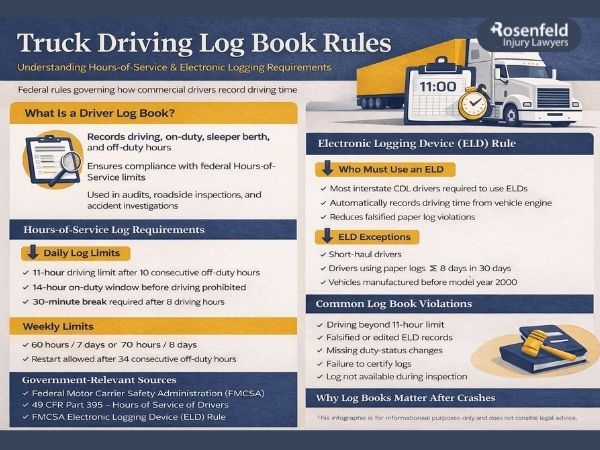
The primary purpose of electronic logging devices in the trucking industry is to ensure compliance with hours-of-service (HOS) regulations (49 CFR Part 395). FMCSA regulations state that drivers must limit their driving hours to prevent excessive fatigue. The HOS rules are as follows for drivers hauling cargo.
Driving Hours: Drivers may complete only 11 hours of driving after 10 consecutive hours off duty.
14-Hour Limit: Drivers cannot continue driving after 14 hours of consecutive on-duty time. Rest breaks or off-duty time do not extend this time.
Rest Periods: After eight hours of driving time, truck drivers must take a 30-minute break.
60/70 Rule: Drivers must not drive after 60 hours of service in seven days, or 70 hours in eight days. They then must take at least 34 consecutive hours off duty.
Sleeper Berth: Drivers can split their 10 hours off-duty time into two periods, but at least 7 hours must be spent in the sleeper berth.
There are exceptions for drivers who remain entirely within state lines or who do not drive more than 150 air miles from their primary work location, but they must request the exception.
Illinois has adopted the federal FMCSA hours-of-service rules for commercial drivers (625 ILCS 5/18b-105). One narrow exception exists for contract carriers transporting employees in vehicles built for 15 or fewer passengers, such as company shuttle vans, which follow a separate 12-hour driving, 15-hour on-duty, 70-hour weekly limit instead (625 ILCS 5/18b-106.1). This exception does not apply to typical freight trucks or semi-trucks, which follow the standard federal HOS rules described above.
Staying compliant with these rules is essential for road safety, but certain operators may be permitted to continue using paper logs.
Commercial drivers working within a 150-air-mile radius of their primary location may claim an exception to the electronic log rule. Drivers who complete their shipment and return to the depot within 14 hours may also use a paper log to record their trip.
Drivers who maintain a log sheet for no more than eight days within a 30-day period may continue to use paper logbooks. However, they are still required to comply with HOS regulations.
Trucks manufactured before 2000, as evidenced by the engine’s VIN, are exempt from electronic documentation requirements.
Drivers must keep their logbook current with the last change in duty status, such as when moving from off-duty to on-duty status. Each entry must include the following information:
There are four duty statuses, and a driver must identify the status when they move between them.
Off-Duty is when the driver is relieved of all duties, such as when they are at home or in a hotel. They are prohibited from performing any work-related tasks during this period. However, some employers may pressure their drivers to perform vehicle maintenance or inspections.
Sleeper Berth status means they are resting or waiting at a receiver. The driver must remain in their berth for at least seven hours, whether sleeping or engaging in downtime.
Driving hours are the periods during which the driver operates the vehicle. On Duty Not Driving means they are inspecting, loading, fueling, completing paperwork, or any other responsibility not performed behind the wheel.
Truck drivers must retain their time records for the previous seven days and provide them to enforcement authorities if asked. The employer must receive each entry within 13 days of the end of the 24-hour period.
Supporting documentation includes items such as fuel receipts, toll receipts, bills of lading, and invoices related to the driver’s work, including hotel reservations. These must be consistent with the logbook to confirm locations, dates, and times.
Their employer must retain all records, including logbooks and supporting documentation, for at least six months. If there are any errors, these must be quickly corrected, and the error must be identified.
Companies may attempt to disregard the trucking hours-of-service regulations to meet quotas and expedite deliveries. However, excessive driver fatigue is a common cause of serious accidents, particularly in crowded urban conditions, such as along the Eden Expressway.
A tired driver has slower reaction times, poorer judgment, and decreased focus. This can cause them to make simple errors, such as failing to signal a lane change or failing to yield (9-24-070). While dangerous in a passenger vehicle, this could lead to catastrophic injuries or wrongful death when combined with the weight and speed of a commercial vehicle.
Our Chicago trucking accident lawyers will subpoena the driver’s electronic logging devices and examine all available logbooks to identify discrepancies that may suggest falsified recordkeeping. For example, if the logbook records that the driver spent 10 hours off duty, but there is a fuel receipt for the O’Hare Oasis during that period, this indicates the driver was not resting as required.
We will use this evidence to demonstrate that the driver was negligent, but also that their employer prioritized delivery over public safety. According to the Illinois Supreme Court case McQueen v. Green, employers may be held liable, both vicariously and directly, for negligence in truck-crash cases. This would mean they are vicariously liable for their driver’s unsafe driving practices, and that they either failed to supervise their employees or even encouraged them to break the law.
Another common factor in logbook issues is that the FMCSA permits drivers to extend their driving time under adverse conditions, such as when they must stop and wait for a snowstorm to pass along Lake Michigan (49 CFR Part 395). Employers may exploit this by claiming there were adverse conditions, thereby pressuring their drivers to continue. We can use contemporaneous evidence, such as weather reports, witness statements, and dashcam footage, to demonstrate that this was not true.
Our team will consult with expert witnesses who can explain trucking industry regulations and the impact of fatigue on driver decisions, ensuring that a judge and jury recognize the gravity of non-compliance. This provides our team with a stronger negotiating position and increases your chance of recovering full compensation.
The Illinois personal injury statute of limitations is two years after the date of the accident (735 ILCS 5/13-202). Due to the complexity of truck accident cases, particularly the need to thoroughly investigate logbooks, you must contact a skilled attorney as soon as possible. We offer free, no-obligation consultations and work on a contingency fee basis, meaning there are no out-of-pocket legal expenses to cover.
Truck drivers must record their hours of service either through paper records or an electronic logging device, showing when they are driving, off duty, in the sleeper berth, or on duty but not driving. Federal rules limit drivers to 11 hours of driving after 10 consecutive hours off duty, a 14-hour on-duty limit, and a 30-minute break after 8 hours of driving.
Yes, in limited situations. Drivers who stay within a 150-air-mile radius of their home base and finish within 14 hours may use a paper log, as may drivers who need a paper log on no more than 8 days in a 30-day period or who operate trucks made before 2000. These exceptions allow paper logs instead of an electronic logging device.
Logbook violations can be strong evidence of negligence in a truck accident case. Investigators can compare electronic logs with other records, such as fuel receipts and toll records, and if those records do not match, that discrepancy may support a finding that the driver was violating hours-of-service requirements. This evidence can help establish potential negligence by the driver or by the trucking company that employed them.
Our Chicago motor vehicle crash lawyers have secured over $450 million in positive verdicts and settlements over the past 25 years. This has earned us a spot in the prestigious Million Dollar Advocates Forum, reserved for top-rated attorneys who win a million-dollar verdict for a client.
We are members of the Illinois Trial Lawyers Association, renowned for our exceptional court representation and thorough investigations. Through our work, we assist victims in reclaiming their lives and recovering in comfort, with a fair settlement that covers all their medical needs.
You pay nothing unless we win, thanks to our contingency fee model. Contact our caring commercial accident attorneys today for a free consultation about your legal rights.
 Legally Reviewed By
Attorney Jonathan Rosenfeld
Content legally reviewed by Jonathan Rosenfeld This page has been reviewed for legal accuracy by Jonathan Rosenfeld, a Chicago personal injury attorney with nearly 25 years of experience representing people injured in car, truck, motorcycle, pedestrian, and rideshare accidents. Jonathan has recovered more than $450 million in settlements and verdicts for injured clients and families in Chicago. He holds a 10/10 rating on Avvo, is a member of the Million Dollar Advocates Forum, and has been repeatedly recognized by Super Lawyers. Jonathan leads the firm’s approach to holding insurance carriers and corporate defendants accountable for serious traffic injuries.