
100% Focus on Your Recovery,
Chicago Auto Accident Lawyer
Chicago Auto Accident Lawyer
Our Team of Attorneys Are Committed to Maximizing the Value of Your Case





Illinois requires a commercial driver’s license (CDL) to operate a vehicle weighing 26,001 pounds or more, a vehicle built to carry 16 or more passengers, or any vehicle hauling hazardous materials that require placards. Drivers must be at least 18 to drive within Illinois or 21 to cross state lines, and must complete a permit period, a written test, and a skills test before they’re licensed.
After a commercial vehicle crash along Chicago’s busy roadways, like the Dan Ryan Expressway or Western Avenue, it’s essential to understand the laws and regulations pertaining to truck drivers in Illinois. CDL requirements can help determine the driver’s or company’s liability, ensuring you receive fair compensation for your injuries.
If you’ve been in an accident with a commercial motor vehicle, our team can help. Contact us today to schedule a free consultation about your legal rights.
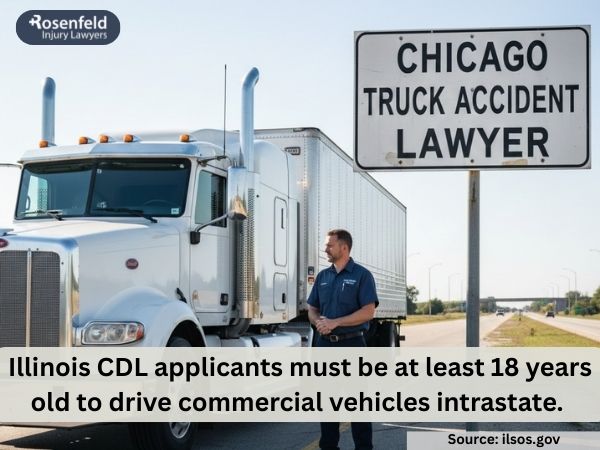
Per the Illinois Vehicle Code, Illinois requires commercial vehicle operators to have a commercial driver’s license (CDL) issued by the Illinois Secretary of State (Driver Services) (625 ILCS 5/6-500 et seq.).
Illinois CDL holders must follow Federal Motor Carrier Safety Administration regulations (49 C.F.R. Part 383), though there are some specific guidelines for those operating entirely within state lines. The Illinois Secretary of State is responsible for ensuring compliance with federal standards, administering CDL tests, and ensuring that all CDL holders have the requisite training to operate vehicles safely.
CDLs are not based on job title but on vehicle weight, type, and cargo. A CDL holder must have the appropriate endorsement for the vehicle, regardless of what type of load they are carrying.
To apply for an Illinois CDL, applicants must have a valid Illinois driver’s license; that is, they must already hold a non-CDL license from the state.
They must be at least 21 to operate interstate under federal rules (49 C.F.R. § 383.71). Illinois has a lower age requirement of 18 years for those operating entirely within the state (625 ILCS 5/6-507). The applicant should provide proof of identity and residency, and they must be physically capable of operating a commercial vehicle (625 ILCS 5/6-508).
Illinois also requires CDL applicants to demonstrate sufficient English proficiency to read road signs, communicate with law enforcement, and complete required reports.
The FMCSA requires Entry-Level Driver Training (ELDT), which prepares operators for the written knowledge test and skills test (49 C.F.R. Part 380). Employers require their drivers to complete specific courses or use certain training programs.
Failure to complete this basic training significantly increases the risk of serious accidents, as drivers lack the skills needed to protect other drivers.
Those applying for a commercial driver’s license (CDL) must pass a written exam before they can begin practicing (49 C.F.R. § 383.111). This knowledge test covers vehicle operation, safety statutes, and specific knowledge like passenger transport.
The Illinois Secretary of State offers free study guides that cover the entire exam, but applicants may not use these materials during the written test.
Before obtaining a CDL, Illinois drivers must first obtain a commercial learner’s permit (CLP), which they must hold for at least 14 days before applying for a commercial driver’s license (49 C.F.R. § 383.25).
While practicing, the CLP holder must always be supervised by an Illinois CDL holder with the proper credentials for the type of vehicle being operated (625 ILCS 5/6-507).
Before receiving a commercial driver’s license, applicants must pass a practical skills test. This includes walking through the pre-trip inspection process, demonstrating the basic vehicle controls, and driving the vehicle on the road (49 C.F.R. § 383.113). If they pass, they complete DOT medical certification from a certified medical examiner to confirm they have no medical conditions that would prevent them from driving. They can then obtain the Illinois CDL and begin their careers.
The typical IL license is a Class D, which is the standard for personal vehicles, but there are different types for CDL licenses. A driver must have the appropriate type for the vehicle, or they may be subject to fines or CDL revocation (49 C.F.R. § 383.91).
A Class A CDL covers combination vehicles, such as tractor-trailers, with a combined weight of 26,001 pounds or more when the vehicle being towed weighs more than 10,000 pounds.
B includes single vehicles with a gross vehicle weight rating over 26,001 pounds. This would include dump trucks, garbage trucks, and large buses.
C generally covers a single vehicle between 16,001 and 26,000 pounds that does not qualify as Class A or Class B. It also covers any vehicle, regardless of weight, that is built to carry 16 or more passengers, including the driver, or that carries hazardous materials requiring placards. In many cases, holders of a Class C license need additional endorsements, such as for passenger vehicles or hazardous materials.
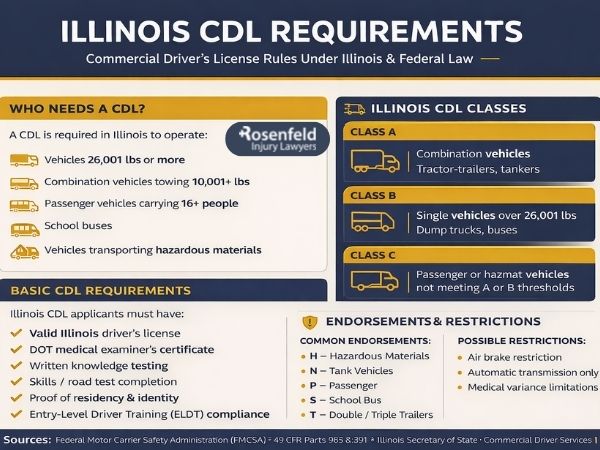
Endorsements cover specialized commercial vehicle types that require additional training and testing. The specific types include double- and triple-trailer, passenger vehicle, school bus, air brakes, tanker, and hazardous materials (49 C.F.R. § 383.93).
Hazardous materials (H): Required to transport materials that must be placarded under federal law.
Tanker (N): Required to operate a vehicle designed to transport liquid or gaseous materials in bulk.
Passenger (P): Required to transport passengers in a vehicle designed to carry 16 or more people, including the driver.
School bus (S): Required in addition to the passenger endorsement to operate a school bus.
Double/triple trailer (T): Required to pull more than one trailer at a time.
Combined tanker/hazmat (X): Required for drivers who transport placarded hazardous materials in tank vehicles.
Hazardous materials endorsements have a higher threshold for approval. The truck driver must pass a written knowledge test and a federal TSA background check (49 C.F.R. § 383.71(a)(9)).
Improper licensing or testing directly impacts truck accident liability, including whether the trucking company can be held liable for negligent training, hiring, or supervision.
A Chicago truck accident lawyer will check the truck driver’s license and endorsements to determine whether they had the legal authority to drive the specific vehicle type, and then review their medical certificate to assess whether they were medically cleared to drive.
Using guidance from the Illinois Supreme Court case McQueen v. Green, 2022 IL 126666, which addresses when an employer can be held liable for negligent hiring, training, supervision, or entrustment, and the Illinois Joint Tortfeasor Contribution Act (740 ILCS 100/2), we can make claims against multiple parties who may have contributed to the crash.
For example, if we determine that the trucking company knew the driver lacked the appropriate CDL and the trucker agreed to proceed with the dispatch anyway, both may potentially be held responsible for a breach of duty, depending on the facts of the case. If the company contracted with a third-party cargo loader, we may also be able to hold the cargo loader liable for failing to determine whether the trucker was legally allowed to transport the load.
Our team will also review the driver’s DQ file to determine whether they previously violated any CDL restrictions, which can be evidence of negligent supervision.
You must be at least 18 years old to drive a commercial vehicle within Illinois. You need to be 21 to drive across state lines, transport passengers for hire, or haul hazardous materials.
Illinois has three CDL classes. Class A covers combination vehicles like tractor-trailers weighing 26,001 pounds or more combined. Class B covers single vehicles of 26,001 pounds or more, like straight trucks and large buses. Class C covers smaller vehicles, generally 16,001 to 26,000 pounds, or any vehicle that carries 16 or more passengers or placarded hazardous materials.
At least 14 days. Illinois requires drivers to hold a CLP for a minimum of 14 days and complete Entry-Level Driver Training before taking the CDL skills test.
No. A hazmat endorsement requires a written knowledge test and a federal TSA background check, not a separate skills or road test.
Yes. If a trucking company knowingly puts an unlicensed or improperly licensed driver behind the wheel, the driver and company may potentially be held responsible for a resulting crash, depending on the facts and applicable law. This is something our team checks in every truck accident investigation.
A truck accident can be overwhelming, especially as you try to navigate insurance claims while recovering from your injuries. Our Chicago traffic crash lawyers will handle the investigation and negotiation so you can focus on healing.
With a flawless 10/10 AVVO rating, we are well-respected professionals who have secured over $450 million in positive verdicts and settlements across the past 25 years. You can be guaranteed personalized service, caring legal advice, and passionate advocacy while you navigate the Circuit Court of Cook County.
We work on a contingency fee basis: no legal fees unless we win. Contact us today for a free consultation about CDL license accidents.
 Legally Reviewed By
Attorney Jonathan Rosenfeld
Content legally reviewed by Jonathan Rosenfeld This page has been reviewed for legal accuracy by Jonathan Rosenfeld, a Chicago personal injury attorney with nearly 25 years of experience representing people injured in car, truck, motorcycle, pedestrian, and rideshare accidents. Jonathan has recovered more than $450 million in settlements and verdicts for injured clients and families in Chicago. He holds a 10/10 rating on Avvo, is a member of the Million Dollar Advocates Forum, and has been repeatedly recognized by Super Lawyers. Jonathan leads the firm’s approach to holding insurance carriers and corporate defendants accountable for serious traffic injuries.