
100% Focus on Your Recovery,
Chicago Auto Accident Lawyer
Chicago Auto Accident Lawyer
Our Team of Attorneys Are Committed to Maximizing the Value of Your Case






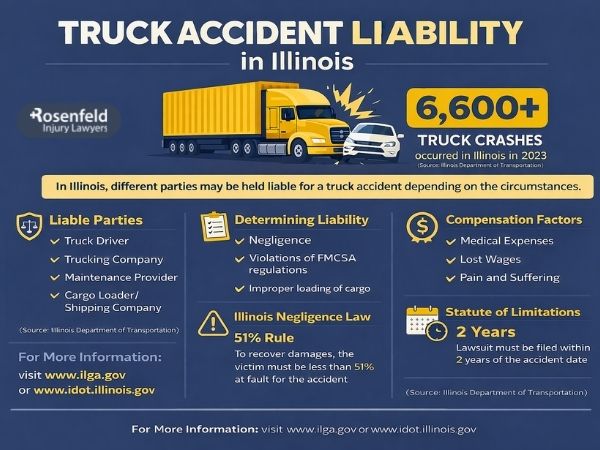
If you are asking who is liable in a truck accident, responsibility may fall on the truck driver, trucking company, freight broker, shipper or cargo loader, maintenance provider, or vehicle or parts manufacturer. More than one party may be responsible depending on who caused or contributed to the crash and the circumstances surrounding the shipment.
Potentially liable parties include:
Truck accident liability in Illinois is determined by state and federal regulations, as well as the truck driver’s relationship with the trucking company.
When evaluating truck accident liability Illinois law, it is important to consider every party involved in the trucking operation rather than assuming that only the driver is responsible.
If you’ve been in a truck crash along dangerous corridors like the Dan Ryan Expressway or Michigan Avenue, our personal injury law firm can determine liability and negotiate for fair compensation. Contact us today for a free consultation about liability in truck accidents.
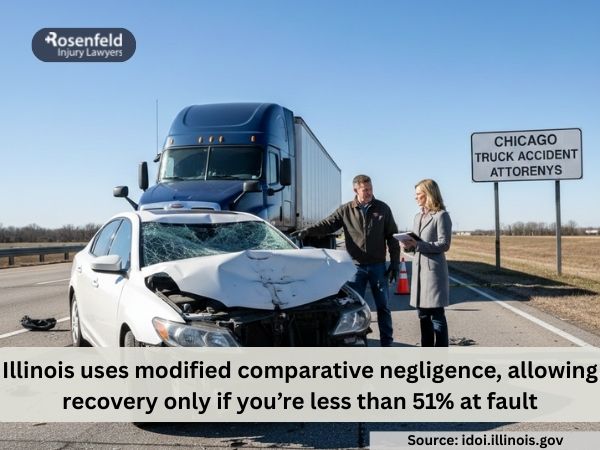
Commercial truck accident cases are different than the typical car accident case. These lawsuits can be very complex due to the interplay of state and federal laws.
Liability in a Chicago accident depends on proving negligence from multiple parties, such as the truck driver, trucking companies, manufacturers, and cargo loaders. Each party may carry its own insurance policies, and each insurer will attempt to limit its liability.
Illinois uses fault-based liability in truck accidents. As such, the plaintiff must prove that the defendant owed them a duty of care, breached the duty, caused the accident, and that the accident resulted in damages. This becomes more complex for parties that weren’t directly involved in the crash, like cargo loading companies or repair companies.
While standard car accidents may involve multiple vehicles, there are typically no layers of liability, which makes the legal process straightforward. Additionally, truck accidents often result in severe injuries, leading to higher medical bills and lost wages. These more serious damages mean more negotiation.
Fault and liability are not the same. Fault generally identifies who physically caused or contributed to the crash, while liability identifies who is legally responsible for paying damages. For example, a fatigued driver may be at fault, while the carrier that dispatched the driver beyond his permitted hours may also face liability and have the insurance policy that responds to the claim.
Truck accident cases typically involve multiple parties, including the truck driver, the trucking company, and other third parties such as vehicle manufacturers or maintenance companies.
In most truck accidents, the truck driver is the first party to be held liable for negligence. Common forms of driver negligence include speeding, distracted driving, fatigue, or drunk driving.
The Illinois Vehicle Code (625 ILCS 5/) provides additional points of liability in truck accidents, such as failure to yield or improper lane changes. Accident reconstructionists can analyze vehicle damage and vehicle black box data to identify the driver’s actions before the crash.
Federal Motor Carrier Safety Regulations (FMCSA) regulations can provide a valuable framework for identifying negligence in truck accidents. One commonly cited federal regulation is hours of service, which mandates regular breaks for drivers (49 CFR Part 395). If the trucking company failed to track driver hours or encouraged them to skip mandatory breaks, this could be negligence.
The hours-of-service rules provide additional information about the federal requirements that apply to commercial truck drivers.
In some cases, truck manufacturers are held liable in a truck accident using the Product Liability Act (735 ILCS 5/2-621) for issues like brake malfunctions, tire blowouts, or broken gear shifts.
Faulty maintenance can make commercial vehicle maintenance companies liable. For example, if worn brakes caused the driver to rear-end you, this could suggest poor truck maintenance. The maintenance company would then be held liable for contributory negligence.
Finally, commercial trucking companies use cargo loaders to ensure loads are properly balanced, preventing rollovers. Accident reports can explain whether improper cargo loading contributed to the crash.
Proper cargo securement requirements can also help investigators determine whether improperly secured cargo contributed to a truck accident.
Freight Broker and Shipper Liability in a Truck Accident
A freight broker arranges a shipment between a shipper and a motor carrier but generally does not own or operate the truck. Freight broker liability truck accident claims have historically raised questions about whether federal law prevented state-law negligence claims against brokers. In Montgomery v. Caribe Transport II, LLC, decided 14 May 2026, the U.S. Supreme Court unanimously held that the FAAAA’s safety exception does not preempt a state-law negligent hiring claim against a freight broker.
The underlying crash occurred on an Illinois highway, and the Supreme Court decision reversed the Seventh Circuit, the federal appellate court that covers Illinois. The ruling therefore has direct relevance to Illinois truck accident claims involving the selection of a motor carrier.
For an injured person, identifying the broker can be important when investigating liability. For example, if a broker hired a carrier with a poor FMCSA safety rating, evidence concerning that selection may become relevant to a negligent hiring claim. A broker may also have insurance coverage different from that of a smaller carrier, so identifying every potentially responsible party early can affect the recovery available.
Shippers and companies that load cargo may also face liability when their own conduct contributes to a crash. A shipper’s role in arranging or preparing a shipment and a loader’s role in distributing or securing cargo can create separate questions of responsibility. The specific contracts, records, and circumstances of the shipment determine whether either party can be held liable.
To determine whether a freight broker was involved, investigators may review the bill of lading, load confirmation, and dispatch records. These documents can help identify the parties in the transportation chain, including the shipper, freight broker, and motor carrier.
The same analysis applies when evaluating semi-truck accident liability, because a serious collision may involve several businesses and individuals beyond the person operating the tractor-trailer.
Truck accident negligence can be established by proving duty of care, breach of duty, causation, and damages.
Federal law also establishes minimum financial responsibility requirements for many interstate motor carriers under 49 CFR Part 387. For-hire interstate carriers transporting nonhazardous property in qualifying vehicles generally must maintain at least $750,000 in financial responsibility under 49 CFR § 387.9, while certain hazardous-material and other operations have different requirements. Identifying every liable party matters because one policy may not be sufficient to cover catastrophic injuries.
Liability in truck accidents is determined by negligence, which requires proving duty of care, breach of duty, causation, and damages.
The Illinois Supreme Court case McQueen v. Lavonta M. Green showed that companies can be both directly and vicariously liable for the actions of their employees. Direct negligence would include negligent training, hiring, or supervision, as well as negligent maintenance.
Vicarious liability in truck accidents is established through respondeat superior, a legal concept meaning “let the master answer.” This means that the truck driver’s negligence is also the company’s negligence, even if they weren’t aware of the act.
This can create vicarious liability trucking company claims when an employee’s conduct occurs within the scope of employment.
The trucking industry is regulated by both federal and state law. The Federal Motor Carrier Safety Act establishes minimum standards for large trucks. However, it notes that if state law is stricter than federal law, then trucking companies must adhere to the state regulations instead (49 CFR 390.9).
In other words, a trucking company cannot use the FMCSA as a defense against liability if Illinois standards are higher.
Illinois uses a modified comparative negligence rule. A plaintiff can recover damages only if their fault is determined to be 50% or less, with awards reduced by the percentage of blame (735 ILCS 5/2-1116).
A truck accident lawyer can sue multiple parties, and all entities would then be jointly and severally liable for the damages (735 ILCS 5/2-1117). This means that all parties are collectively responsible for the damages, but the plaintiff can collect the full payment from any entity responsible for at least 25% of the blame allocated to the defendants. That party would then have to seek repayment from the other liable parties.
An attorney must determine the potentially liable parties as soon as possible. This enables them to preserve evidence and prevent the responsible parties from shifting blame, either to another defendant or to the victim.
Evidence can disappear or become more difficult to obtain as time passes. Driver logs, electronic records, surveillance footage, vehicle data, maintenance records, and shipment documents may need to be preserved promptly to remain available during liability investigations.
For example, in a collision involving improperly loaded cargo, the loading company may insist that the truck owner was responsible for checking the load before leaving. Our lawyers would then review contracts to determine whether this was part of the agreement.
For information about filing a truck accident lawsuit, you can understand filing a truck accident lawsuit.
Our Chicago truck accident attorneys will gather evidence to establish liability, such as driver logs, safety records, and maintenance records. We will identify the applicable safety standards and determine whether regulatory violations were involved, as this can shift legal responsibility.
Through our professional network, we will locate experts in vehicle maintenance and FMCSA regulations who can provide testimony.
If there are multiple liable parties, we will coordinate with each responsible entity to negotiate a fair settlement. These complex insurance disputes require expertise to navigate, which is why it is crucial to work with a law firm that has experience handling similar cases.
The Illinois statute of limitations for a personal injury claim is typically two years (735 ILCS 5/13-202). If the truck accident victim is a minor, the statute of limitations is tolled, or paused, until they turn 18 (735 ILCS 5/13-211).
If the accident resulted in fatal injuries, family members of deceased victims have two years to file for wrongful death damages (740 ILCS 180/).
Evidence to prove liability in truck accidents includes:
With over 100 years of combined legal experience in handling these claims, our team will smoothly coordinate evidence collection and document management. This ensures you have a strong case that clearly demonstrates how each factor contributed to the accident and your subsequent injuries.
Yes, a freight broker may potentially be sued after a truck accident when the facts support a negligent hiring claim. The U.S. Supreme Court’s decision in Montgomery v. Caribe Transport II, LLC confirmed that the FAAAA’s safety exception does not preempt this type of state-law claim. A claimant would generally need to show that the broker knew or should have known that the carrier it hired was unsafe.
You will generally pursue both the truck driver and the trucking company when the facts support claims against each. The trucking company may face vicarious liability for the driver’s conduct through respondeat superior, while direct claims may arise from negligent hiring, training, supervision, or maintenance. For more information, see the existing respondeat superior section above.
A traffic accident attorney in Chicago is essential to proving liability and ensuring that you are not unfairly blamed for a truck crash. We will secure strong evidence, consult with expert witnesses, and handle all negotiations so that you can focus on your recovery.
As members of the American Association for Justice, our attorneys are highly experienced in these complex claims. The existing “98% success rate” and Million Dollar Advocates Forum claims should be source- or date-qualified before publication.
We work on a contingency fee basis: no fees unless we win. Contact us today for a free, no-obligation consultation about the legal process.
 Legally Reviewed By
Attorney Jonathan Rosenfeld
Content legally reviewed by Jonathan Rosenfeld This page has been reviewed for legal accuracy by Jonathan Rosenfeld, a Chicago personal injury attorney with nearly 25 years of experience representing people injured in car, truck, motorcycle, pedestrian, and rideshare accidents. Jonathan has recovered more than $450 million in settlements and verdicts for injured clients and families in Chicago. He holds a 10/10 rating on Avvo, is a member of the Million Dollar Advocates Forum, and has been repeatedly recognized by Super Lawyers. Jonathan leads the firm’s approach to holding insurance carriers and corporate defendants accountable for serious traffic injuries.