
100% Focus on Your Recovery,
Chicago Auto Accident Lawyer
Chicago Auto Accident Lawyer
Our Team of Attorneys Are Committed to Maximizing the Value of Your Case






Proving negligence in a truck accident means showing that a party owed a duty of care, breached that duty, the breach caused the crash, and the crash caused measurable losses. In trucking cases, breach is often established through violations of federal safety regulations documented in the carrier’s own records.
Proving truck accident negligence requires a detailed investigation, substantial evidence, and legal knowledge to hold the right parties accountable. These cases involve more than just driver error; they may include failures by the trucking company, maintenance crews, or cargo loaders. With extensive experience in truck accident cases across Cook, Will, DuPage, and surrounding counties, our legal team works to determine liability and pursue the compensation you’re owed. From driver logs to inspection records, we focus on gathering evidence that helps prove negligence and supports your right to recover compensation for medical bills, lost wages, and other losses.
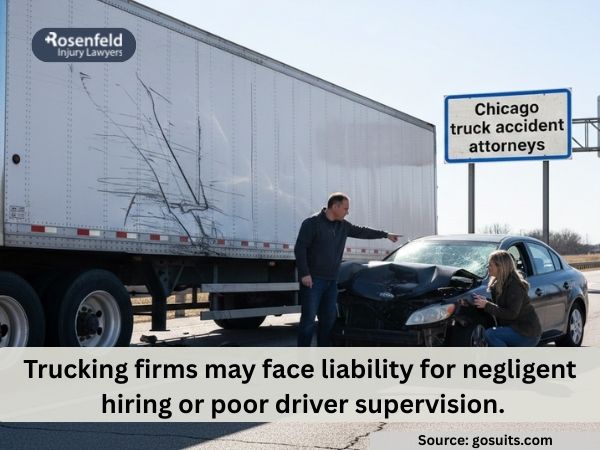
Truck accident negligence refers to the failure to act with the level of care that a reasonable person would under similar circumstances. In the context of a truck accident, this means that a person or entity acted or failed to act in a way that created an unreasonable risk of harm to others on the road.
Negligence in a truck accident doesn’t always rest with just one person. While a truck driver’s negligence is often a factor, other parties such as the trucking company, cargo loader, or maintenance provider may also share responsibility. Each has specific duties related to safety and compliance. For example, a truck driver’s negligence might include reckless driving or driver fatigue, while the company could be responsible for inadequate training, unsafe schedules, or poor maintenance. A mechanic who failed to detect a safety issue, or a third party that improperly loaded cargo, could also share fault.
To establish negligence in a truck accident, the behavior of each potentially at-fault party is measured against the standard of what a reasonable person would do under similar conditions. This process involves comparing the conduct to state and federal traffic rules, hours-of-service limits, speed limits, inspection records, and industry safety regulations.
For example, if a driver exceeded legal driving hours or ignored traffic signs and an accident resulted, this may clearly indicate negligence.
Proving negligence in a truck accident claim requires establishing four elements:
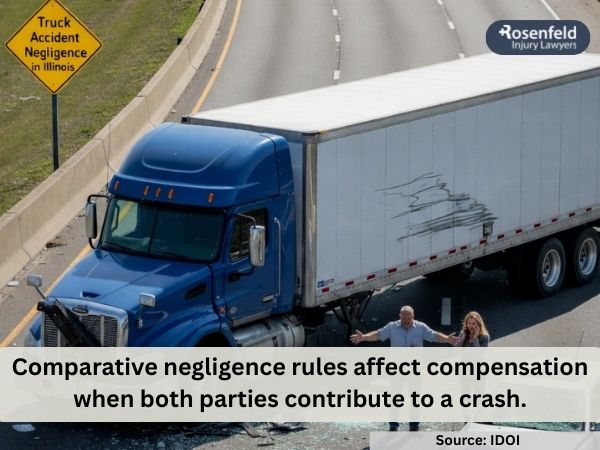
Truck crashes in Chicago can involve multiple parties. Identifying the negligent conduct requires examining the truck driver’s actions, the trucking company’s practices, and the way cargo was loaded. The investigation may also involve safety regulations, inspection records, and other evidence showing how the crash occurred.
Understanding who may be responsible starts with examining the truck accident causes and the specific conduct that contributed to the crash.
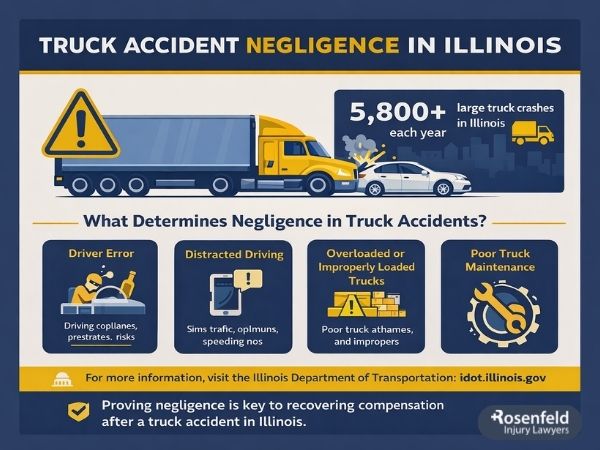
Truck drivers may be negligent when they operate while distracted or fatigued, speed, drive recklessly, or violate federal hours-of-service requirements. Common examples include:
Even one mistake by a truck driver can cause a severe accident involving multiple other vehicles. Driver error remains one of the leading truck accident causes, especially when combined with bad weather, heavy traffic, or poor road conditions.
A trucking company may contribute to a crash through inadequate driver training, hiring unqualified drivers, failing to address known safety violations, or failing to maintain commercial vehicles properly. Maintenance problems may include:
Carriers are required to comply with Commercial Driver’s License training regulations and ensure their drivers are prepared to handle a wide range of driving situations. Failing to train drivers properly–or continuing to employ someone with a history of crashes or safety violations–can amount to apparent negligence. In some cases, companies knowingly put unsafe drivers on the road, putting others at risk.
Federal law also requires regular inspections of commercial trucks to ensure they are safe to operate. When maintenance and inspection records are ignored or falsified, serious mechanical failures can occur. Common issues include:
Neglecting maintenance responsibilities or failing to act on problems discovered during inspections can directly lead to accidents. Many trucking companies fail to follow their own inspection reports, choosing to keep delivery schedules on track instead of fixing known hazards.
Cargo loaders can contribute to a truck crash when cargo is overloaded, unevenly distributed, improperly balanced, or inadequately secured. Shifting cargo can affect the truck’s stability and may cause the driver to lose control or the trailer to jackknife.
FMCSA cargo securement standards are designed to reduce these risks. When cargo is improperly loaded or secured and that conduct contributes to a collision, the loading process should be investigated.
For the full breakdown of who can be held liable in a truck accident, see our truck accident liability page.
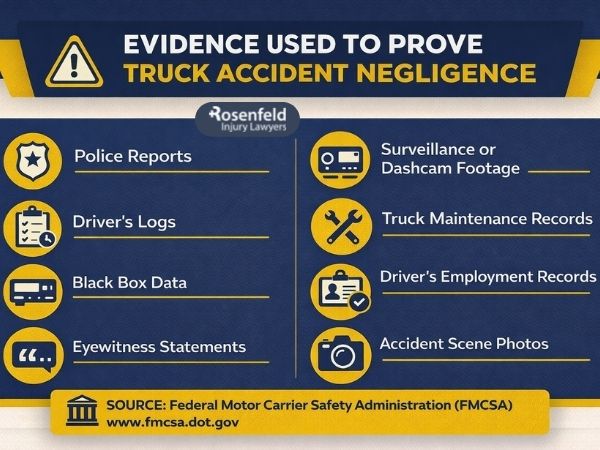
To prove negligence in a truck accident claim, the proper evidence must be collected, preserved, and analyzed. Strong documentation helps connect the actions of the at-fault party to the injuries and losses suffered by the victim. Several types of evidence are critical in showing how negligence is established in a truck accident case.
The official crash report created by responding officers offers a neutral summary of the accident scene. It often includes observations about road conditions, driver statements, traffic violations, and any citations issued. If the truck driver appeared impaired, fatigued, or was violating traffic laws like speed limits or traffic signs, this may be noted. Police reports can also include diagrams and witness contact information, which can support a case for negligence.
To show the connection between the crash and the injuries, medical records are essential. They help establish that the victim suffered serious injuries and incurred medical expenses directly resulting from the collision. These records also help calculate damages like lost income, future care needs, and pain and suffering, key factors in determining fair compensation.
Tangible proof from the accident scene often plays a significant role in proving truck accident negligence. This can include:
Each piece of physical evidence helps support the claim that a reasonable person in the truck driver’s position would have acted differently, and that the failure to do so directly caused the crash.
Much of the evidence needed to prove truck accident negligence may be stored in the carrier’s own systems. This can include electronic logging device (ELD) data, dispatch records, driver qualification files, maintenance logs, and in-cab video. Some records are subject to routine retention limits, so evidence may be overwritten before a claim is filed.
A preservation letter, also called a spoliation letter, puts the trucking company on notice that relevant evidence should be preserved. Under 49 CFR 395.8(k)(1), motor carriers must retain records of duty status and supporting documents for at least six months from the date of receipt. 49 CFR 395.8 . A preservation request can therefore be important when relevant records may otherwise be subject to routine deletion or overwriting. Destruction of relevant evidence after a preservation duty arises can have consequences in litigation, including potential consequences at trial.
Important records may include electronic logging device records and driver qualification files, which can help show whether federal safety requirements were followed.
Truck accident cases are often more complex than standard car crashes. When a truck accident occurs, the trucking company and its insurers may act quickly to protect themselves, often at the expense of the injured. That’s why it’s essential to have an experienced legal team on your side who knows how to investigate and prove negligence. Our truck accident attorneys in Chicago have the experience and resources to take on large trucking companies, protect your rights, and pursue full compensation on your behalf.
One of the most critical steps after a crash is securing the evidence needed to prove fault. Our legal team takes immediate action by collecting key evidence, including the police report, medical records, photos from the accident scene, and physical evidence from the vehicles involved. We also secure driver logs and event data recorders to determine whether hours-of-service limits, traffic laws, or safety regulations were violated.
Thoroughly investigating truck accidents often involves working with accident reconstruction experts, interviewing witnesses, and reviewing maintenance and inspection records kept by trucking companies. We examine whether inadequate training, mechanical failures, or driver fatigue played a role. Our team also identifies all responsible parties, which may include the truck driver, the trucking company, or third-party contractors like cargo loaders.
In any legal claim, it’s essential to know the full extent of damages. This includes current and future medical expenses, lost wages, reduced future earning capacity, as well as non-economic damages like pain and suffering. We collaborate with medical professionals, vocational experts, and economists to accurately value the full extent of your losses. We also work to make sure truck accident victims are not pressured into low settlements and instead pursue fair compensation based on the real impact of the crash.
Trucking companies may have routine retention periods during which certain records can be overwritten or deleted. A preservation letter, also called a spoliation letter, puts the carrier on notice that relevant evidence should be preserved. If relevant evidence is destroyed after a duty to preserve arises, that destruction can have consequences in the litigation.
Negligence per se may apply when a driver or carrier violates a safety regulation intended to prevent the type of harm that occurred. For example, violating hours-of-service requirements may help establish the breach element when driver fatigue contributes to a crash. See the section above on negligence per se for more information.
Under 735 ILCS 5/13-202, the statute of limitations for personal injury claims in Illinois including truck accident cases is two years from the date the accident occurred. Failing to file within this time may result in losing your right to pursue compensation. To protect your claim, it’s essential to speak with an attorney as soon as possible.
Truck accidents often lead to severe injuries, which can affect nearly every aspect of a person’s life. Damages commonly recovered in these cases include:
Illinois follows a modified comparative fault system under 735 ILCS 5/2-1116. This law allows injured parties to recover compensation as long as they are less than 51% at fault for the accident. However, any compensation awarded will be reduced in proportion to the victim’s share of responsibility.. However, any compensation awarded will be reduced in proportion to the victim’s share of responsibility.
If you or a loved one has been injured in a truck accident, having a skilled legal team by your side can make a significant difference in your case. We offer a free case evaluation to help you understand your rights and determine which party’s negligence played a role in the accident. Our team will review your case details, answer your questions, and explain your legal options, all at no cost.
During the consultation, we can assess which parties’ conduct may be in play and identify what records may need to be preserved immediately.
Contact us today to schedule a free consultation with an experienced traffic accident attorney.
 Legally Reviewed By
Attorney Jonathan Rosenfeld
Content legally reviewed by Jonathan Rosenfeld This page has been reviewed for legal accuracy by Jonathan Rosenfeld, a Chicago personal injury attorney with nearly 25 years of experience representing people injured in car, truck, motorcycle, pedestrian, and rideshare accidents. Jonathan has recovered more than $450 million in settlements and verdicts for injured clients and families in Chicago. He holds a 10/10 rating on Avvo, is a member of the Million Dollar Advocates Forum, and has been repeatedly recognized by Super Lawyers. Jonathan leads the firm’s approach to holding insurance carriers and corporate defendants accountable for serious traffic injuries.