
100% Focus on Your Recovery,
Chicago Auto Accident Lawyer
Chicago Auto Accident Lawyer
Our Team of Attorneys Are Committed to Maximizing the Value of Your Case




It depends on who caused the crash and what the Lyft driver was doing in the app. If the driver had accepted a ride or was transporting a passenger, Illinois requires $1 million in primary liability coverage; if the app was off, the driver’s personal auto insurance generally applies.
What happens if a Lyft driver gets in an accident depends on the available insurance, who was at fault, and the injuries involved. Whether you were a passenger, another driver, or a pedestrian, more than one insurer may become involved in the claim. Lyft accidents often involve multiple insurance companies, overlapping coverage, and disputes about fault, especially because rideshare drivers are classified as independent contractors rather than traditional employees.
As a Chicago-based personal injury law firm, we help people across the city who suddenly face medical bills, missed work, and uncertainty after an accident. From Loop intersections and Lake Shore Drive to neighborhood streets on the North, West, and South Sides, we see how confusing rideshare accidents can become. We stand with you, and we believe in your case.
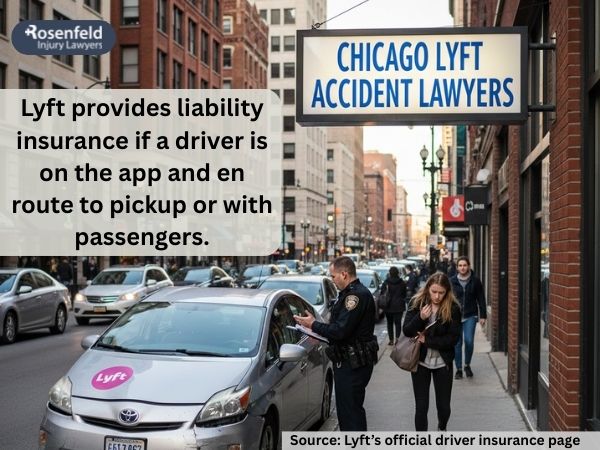
Insurance coverage in a Lyft accident depends heavily on the driver’s status in the Lyft app at the time of the accident. Understanding the Lyft driver accident insurance rules helps clarify which policy may apply. As outlined on Lyft’s official website, coverage changes based on the driver’s app status.
In this situation, a Lyft driver car accident is usually handled through the driver’s personal auto insurance policy. However, personal policies may exclude rideshare activity, so coverage depends on the policy’s terms. If the app was off, Lyft’s rideshare liability coverage generally does not apply. For details, see our Lyft insurance requirements page.
When a driver is logged into the Lyft app and waiting for a ride request, Lyft’s contingent liability coverage may apply if the driver’s personal policy excludes coverage or does not provide the required limits. Under Illinois law, the required limits are $50,000 for injury or death per person, $100,000 per incident, and $25,000 for property damage. The applicable policy and circumstances determine which insurer pays. Illinois law, 625 ILCS 57/10, sets out these insurance requirements.
If you were in a Lyft when an accident happened, you may be able to seek compensation through applicable Lyft insurance coverage, depending on the circumstances of the crash and your injuries. Once a ride request is accepted, Illinois requires $1 million in primary liability coverage for death, personal injury, and property damage. These are required coverage amounts, not a cap on Lyft’s potential liability if the company is independently found at fault. The $1 million applies to the crash as a whole, so multiple injured people may need to share the available coverage. Learn more about Lyft insurance requirements.
Because rideshare insurance operates in layers, determining whether there is enough coverage often requires a detailed investigation. Our role is to identify all applicable insurance policies and make sure Lyft’s and the driver’s insurance are properly applied.
After a Lyft driver accident, the next steps usually involve reporting the crash, reviewing the driver’s app status, investigating fault, documenting injuries, and seeking payment from the appropriate insurer.- The crash is reported. The driver can report the collision to Lyft, and passengers or others involved can report it as well.
If another motorist injures a Lyft driver in an accident, the driver may bring a claim against that motorist’s auto insurer. If the other driver has little or no insurance, uninsured motorist coverage or underinsured motorist coverage may apply, depending on the circumstances and the applicable policy.
If the Lyft driver caused the crash, Lyft’s third-party liability coverage generally does not cover their own injuries. The driver’s personal policy or optional injury coverage may provide benefits, but personal insurance may exclude rideshare activity when the app is on.
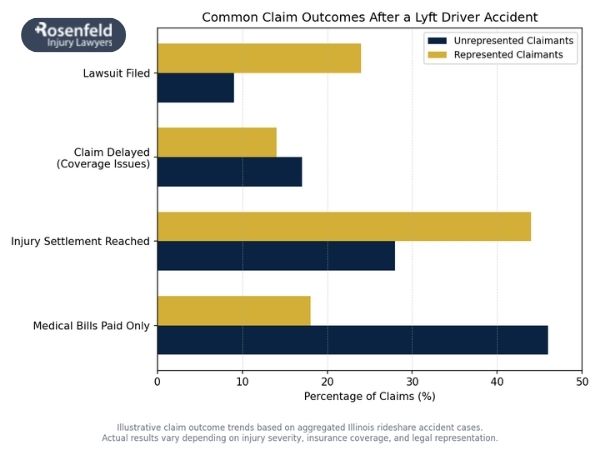
Determining liability after a Lyft crash requires reviewing driver actions, insurance policies, vehicle information, and accident scene evidence. Liability may extend beyond the rideshare driver to include several liable parties, depending on how the crash happened and who contributed to the harm. Determining who pays if a Lyft driver causes an accident requires reviewing the evidence and each party’s role. Whether Lyft itself may be liable depends on the facts and applicable law. Learn more about when Lyft may be liable for an accident.
Liability may include:
We investigate every case to determine how the accident happened, what actions or failures led to the crash, and whether the injuries stemmed from negligence, distraction, or unsafe driving decisions. This step is critical to recovering full compensation, especially when multiple insurance policies are involved.
When calculating damages in a Lyft-related accident, we look at how this traumatic event has changed your daily life and future. Damages in a personal injury claim may include medical attention costs, ongoing treatment, lost income, reduced earning capacity, and the physical and emotional toll of the injuries. In the most severe cases, damages may also reflect permanent disability or losses suffered by families after fatal accidents.
Every Lyft accident claim is different, and its value depends on factors such as liability, injury severity, medical expenses, lost income, and supporting evidence. Read more about Lyft accident settlements.
Negotiating with insurance companies is one of the most challenging parts of Lyft accident claims. Insurers may argue about coverage, dispute injuries, or attempt to minimize payouts. We handle these negotiations directly and push back against unfair tactics so our clients are not pressured into accepting less than fair compensation.
Some cases resolve through settlement, while others require filing a Lyft accident lawsuit. If insurers refuse to act reasonably, we are prepared to pursue legal action and present the case in court. In limited situations involving corporate negligence or systemic failures, injured victims may explore whether they can sue Lyft directly.
Illinois law changed effective January 1, 2024, removing the former statutory language stating that rideshare companies are not common carriers. Whether Lyft can be held directly liable still depends on the facts and applicable law. Learn more about when Lyft may be liable.
Throughout the process, we keep our clients informed and involved so they understand all of their options and feel supported at every stage of the claim.
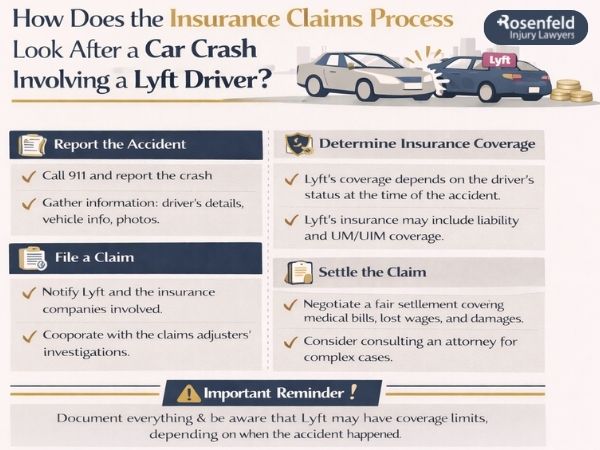
It depends on the driver’s app status and the circumstances of the crash. If the app was off, the driver’s personal insurance generally applies. If the driver was waiting for a ride request, contingent coverage may apply. After a ride is accepted, $1 million in primary liability coverage is required under Illinois law. See our Lyft insurance requirements page.
You may be able to seek compensation through the applicable Lyft liability coverage because your ride was in progress. The available coverage and recovery depend on the facts, the injuries, and any other applicable insurance.
The other driver’s auto insurance is usually the first source of potential compensation. If that driver has little or no insurance, uninsured motorist coverage or underinsured motorist coverage may apply, depending on the circumstances and policy terms.
No. When the app is off, the driver’s personal auto insurance generally applies. Coverage depends on the policy’s terms and any applicable exclusions.
It depends on who caused the crash and what insurance applies. If another driver was at fault, that driver’s insurer may cover eligible medical expenses and other losses. If the Lyft driver caused the crash, their own policy or optional injury coverage may be relevant. Lyft’s third-party liability coverage is meant to cover others’ injuries, not the at-fault driver’s own.
Yes, if you were not more than 50% at fault. Your compensation is reduced by your share of fault. If you are more than 50% at fault, Illinois law bars recovery under its modified comparative negligence rule. See 735 ILCS 5/2-1116.
Depending on the circumstances, damages may include medical bills, lost wages, property damage, pain, emotional distress, and loss of normal life. In fatal crashes, eligible family members may pursue damages through a wrongful death claim. Learn more about Lyft wrongful death claims.
Most Illinois personal injury lawsuits must be filed within two years of the date the claim accrues, often the crash date. Wrongful death claims generally have a two-year deadline measured from the date of death. Exceptions may apply, so seek legal advice promptly. See the specific statute, 735 ILCS 5/13-202.
If you were injured in a crash involving a Lyft vehicle, speaking with a Chicago traffic accident lawyer can help you understand your rights and options. We offer a free consultation and handle cases on a contingency fee basis, meaning there are no upfront costs and no legal fees unless we recover compensation for you.
We know how stressful these situations can be. Our team can help you understand the insurance process, identify potentially responsible parties, and pursue compensation for your losses. Contact us today to schedule your consultation.
 Legally Reviewed By
Attorney Jonathan Rosenfeld
Content legally reviewed by Jonathan Rosenfeld This page has been reviewed for legal accuracy by Jonathan Rosenfeld, a Chicago personal injury attorney with nearly 25 years of experience representing people injured in car, truck, motorcycle, pedestrian, and rideshare accidents. Jonathan has recovered more than $450 million in settlements and verdicts for injured clients and families in Chicago. He holds a 10/10 rating on Avvo, is a member of the Million Dollar Advocates Forum, and has been repeatedly recognized by Super Lawyers. Jonathan leads the firm’s approach to holding insurance carriers and corporate defendants accountable for serious traffic injuries.