
100% Focus on Your Recovery,
Chicago Auto Accident Lawyer
Chicago Auto Accident Lawyer
Our Team of Attorneys Are Committed to Maximizing the Value of Your Case






When someone comes to our Chicago-based firm after a Lyft accident on the Kennedy, on Lake Shore Drive, or on a neighborhood street in Logan Square or Hyde Park, one of the first issues we walk through together is how Lyft insurance requirements work in Illinois. Many of our clients feel overwhelmed by medical bills, lost income, and uncertainty about which insurance provider has to pay.
We stand with you from day one. As Chicago Lyft accident attorneys, our role is to help you understand your legal options, the available insurance coverage, and the steps you can take to protect yourself under Illinois law.
Lyft, like other rideshare companies, operates under a specific regulatory framework in Illinois that determines what insurance applies at each stage of a Lyft ride. Knowing how these coverage periods work can make a life-changing difference for injured passengers, drivers, and anyone else involved in a crash.
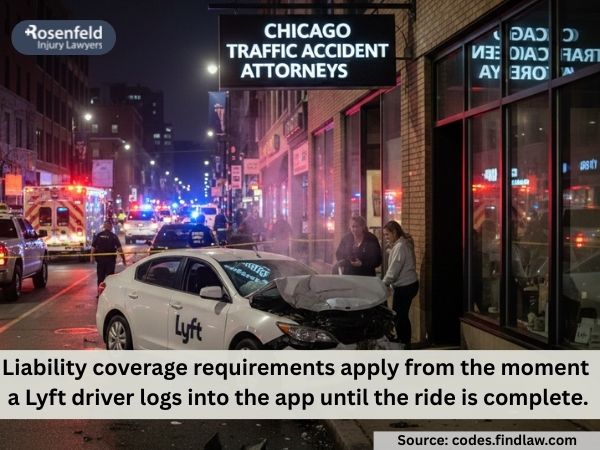
Yes, under the Illinois Transportation Network Provider Act (625 ILCS 57/), Lyft must provide liability coverage when a driver is using the Lyft app for commercial activity. Illinois classifies Lyft drivers as Transportation Network Providers (TNPs), meaning they are not taxi drivers or commercial livery operators; instead, their insurance coverage depends entirely on their app status at the moment of the accident.
In other words, Lyft insurance coverage is not constant. It only applies when the driver is:
Lyft’s coverage structure mirrors the tiers required for rideshare platforms under Illinois law. These rules are similar to Uber’s insurance framework but operate independently through Lyft’s insurance provider.
Lyft publicly outlines its policies at its official website. We rely on this official source when evaluating a Lyft insurance policy, filing Lyft insurance claims, or addressing disputes between insurers. Lyft’s page also clarifies when contingent collision coverage, comprehensive coverage, and personal auto insurance policy exclusions apply.
We will outline this information throughout the sections below.
When a Lyft driver is fully offline, meaning the app is closed and the driver is not available for ride requests, Lyft provides no insurance coverage whatsoever. Illinois law treats this as ordinary personal driving, and only the driver’s personal auto insurance policy applies.
However, many personal policies contain express commercial insurance exclusions. That means they may refuse to cover accidents caused while the driver was:
If the insurer believes the driver was engaged in any type of commercial use, they may deny coverage, which creates complications for anyone injured in the accident.
Because of these risks, we regularly help clients navigate disputes between Lyft’s insurer and the driver’s insurance company about whether the app was actually on or off at the moment of impact. These disputes can determine whether there is access to liability insurance, personal injury protection, medical payments, or collision protection.
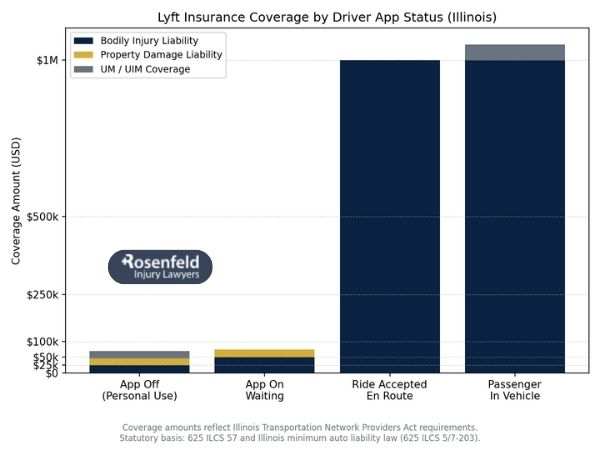
This stage is known as “Period 1.” The Lyft driver is logged into the app and available for trips but has not yet accepted a ride request.
Illinois requires reduced liability insurance during this period, and Lyft follows the state’s minimum structure:
This is basic coverage only. It is not enough to fully compensate many victims who suffer serious injuries, especially in high-speed crashes.
If a Lyft accident occurs during Period 1:
Because Period 1 has lower available coverage, disputes over fault, coverage triggers, and the driver’s app status are common. We frequently step in when two insurance providers argue about who must pay.
Once the Lyft driver accepts a request and is driving to pick up a passenger, “Period 2” begins. During this stage, Illinois law and Lyft’s policies provide much higher policy limits, reflecting the increased risk to the public.
Period 2 coverage includes:
This is when Lyft’s policy becomes primary, meaning the victim does not have to exhaust the rideshare driver’s personal policy first.
If someone is hurt while the driver is on the way to a pickup, such as a driver of another car, pedestrian, cyclist, or anyone in other vehicles:
We help our clients document fault, evaluate available sources of coverage, and challenge any attempt by insurers to avoid paying fair compensation.
This is “Period 3,” the highest form of insurance coverage under Illinois law and the Transportation Network Provider Act. During an active ride, when a passenger is in the vehicle, Lyft must provide:
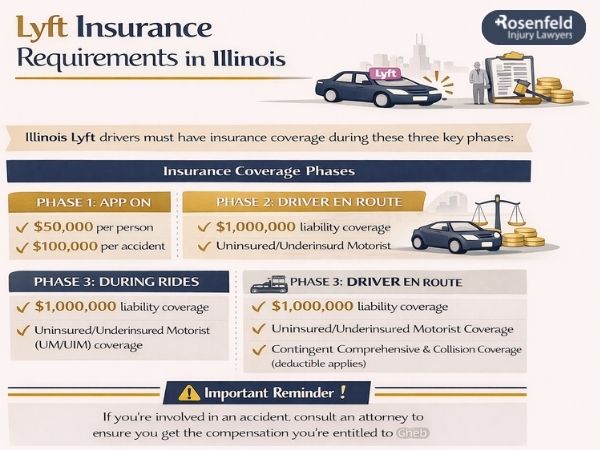
If you are a passenger during a Lyft ride and an accident occurs, Lyft’s $1M policy is designed to step in immediately. You may be entitled to compensation for:
We guide clients through this process and help them hold the responsible insurance companies accountable.
If you drive for Lyft, understanding your own insurance can be just as important as understanding the coverage available to passengers and other people injured in a crash. Insurance for Lyft drivers generally involves both the driver’s personal auto policy and Lyft’s coverage, and which policy applies depends on what the driver was doing when the accident occurred.
The biggest gap is often between a driver’s personal policy and Lyft’s coverage. Most personal auto insurance policies exclude commercial or “for hire” use, which means your personal policy may not provide coverage while you are using your vehicle for rideshare activity. For a Lyft driver, the coverage that applies can change as you move from being offline, to waiting for a request, to accepting a trip, and finally to transporting a passenger.
For example, when the Lyft app is on and you are waiting for a ride request, Lyft provides lower liability limits than it provides after you accept a ride. This Period 1 coverage can help protect against liability claims, but drivers should not assume it provides the same protection as a full personal auto policy. The coverage available after accepting a ride is substantially higher, as explained above.
Your own vehicle can also present a coverage gap. Lyft’s contingent collision and comprehensive coverage is generally available only when you carry collision and comprehensive coverage on your personal auto policy. If you do not carry those coverages, damage to your own vehicle may not be covered through Lyft’s contingent program. When contingent coverage applies, a deductible can also reduce the amount paid toward vehicle damage.
Drivers should also understand that liability coverage for an injured driver is different from liability coverage for other people. Lyft’s liability insurance is designed primarily to cover claims for which the driver is legally responsible. It does not automatically mean that the driver’s own injuries or every loss involving the driver’s vehicle will be fully covered.
For many drivers, a practical way to close the personal-policy gap is a rideshare endorsement. A rideshare endorsement can be added to certain personal auto policies to provide coverage associated with rideshare driving that may otherwise be excluded. Drivers should review their individual policy and ask their insurer what coverage applies while the Lyft app is on, while waiting for a request, and while transporting passengers.
In short, Lyft driver insurance is not one single policy that applies in every situation. Coverage for Lyft drivers changes with the driver’s app status, and understanding those differences before an accident can help drivers avoid unexpected coverage problems.
When you pursue a Lyft accident claim, the insurance process can feel overwhelming. Many clients come to us after dealing with multiple insurers, each trying to shift responsibility to someone else. We stand with you throughout the process, helping you understand your options and move forward with clarity.
You must notify Lyft through the app or website as soon as possible. Lyft will route the claim to its insurer.
Depending on the driver’s app status, you may need to file with:
Strong supporting evidence may include:
Insurers look at:
Multiple insurers may argue about fault, policy limits, or who must pay first. We help our clients push back against unfair denials and seek maximum compensation.
Because Lyft’s policy changes depending on whether the driver was:
Insurers often dispute which insurance policy applies. These disputes affect access to full compensation for serious injuries, lost income, or long-term medical care.
Our firm routinely investigates app data, phone logs, digital timestamps, and location history to confirm the driver’s status at the exact moment of the crash.
Lyft drivers need a personal auto insurance policy that satisfies Illinois requirements, along with Lyft-provided coverage that changes according to their status in the app. A rideshare endorsement may provide additional protection where a personal policy excludes rideshare activity.
Generally, no. Personal auto policies commonly exclude accidents involving commercial or “for hire” driving. Lyft offers different levels of protection based on app activity, while a rideshare endorsement may help address coverage gaps.
Lyft insurance policy limits vary by the driver’s activity. While the app is on and no trip has been accepted, coverage includes $50,000 per person, $100,000 per accident, and $25,000 for property damage. After a driver accepts a trip or has a passenger, coverage can reach $1 million.
Lyft may cover damage to a driver’s vehicle through contingent collision and comprehensive coverage when the driver also carries those coverages on their personal policy. A deductible applies, and drivers without the required personal coverage may have to pay for their vehicle damage themselves.
Yes. Lyft’s coverage can protect passengers when they are being transported during an active trip. The applicable $1 million liability coverage can address covered injuries and property damage, while uninsured and underinsured motorist coverage may apply in qualifying crashes.
The insurance coverage available after a Lyft crash generally depends on the driver’s app status and the circumstances of the collision. Although Lyft drivers are independent contractors, Illinois law does not automatically prevent a Transportation Network Company from having liability beyond its required insurance coverage when applicable.
If you were injured in a Lyft crash, you don’t have to navigate this process alone. As Chicago traffic accident attorneys, we help clients understand their legal options, protect their rights, and pursue the compensation they deserve after rideshare collisions. We believe in your case, and we stand with you every step of the way.
Our experienced attorney team helps with:
We handle these matters on a contingency fee basis, meaning you owe no upfront costs and no attorney fees unless we recover compensation for you.
If you or a loved one has been involved in a Lyft accident anywhere in Chicago or Cook County, contact us for a free consultation. We’re here to help you rebuild, protect your rights, and move forward with clarity and support.
 Legally Reviewed By
Attorney Jonathan Rosenfeld
Content legally reviewed by Jonathan Rosenfeld This page has been reviewed for legal accuracy by Jonathan Rosenfeld, a Chicago personal injury attorney with nearly 25 years of experience representing people injured in car, truck, motorcycle, pedestrian, and rideshare accidents. Jonathan has recovered more than $450 million in settlements and verdicts for injured clients and families in Chicago. He holds a 10/10 rating on Avvo, is a member of the Million Dollar Advocates Forum, and has been repeatedly recognized by Super Lawyers. Jonathan leads the firm’s approach to holding insurance carriers and corporate defendants accountable for serious traffic injuries.