
100% Focus on Your Recovery,
Chicago Auto Accident Lawyer
Chicago Auto Accident Lawyer
Our Team of Attorneys Are Committed to Maximizing the Value of Your Case



At our Chicago-based truck accident law firm, we help people injured in commercial truck crashes understand the insurance coverage that may be available to pay for their injuries and losses. Knowing the Illinois commercial truck insurance requirements can help an injured person understand the minimum coverage a trucking company may be required to carry and why identifying all available insurance policies matters after a crash.
If you’ve been involved in a truck accident, the available insurance coverage can affect how your injury claim is handled. A trucking company may carry more coverage than the applicable legal minimum, and multiple insurance policies or potentially liable parties may need to be identified before the full value of a claim can be evaluated.
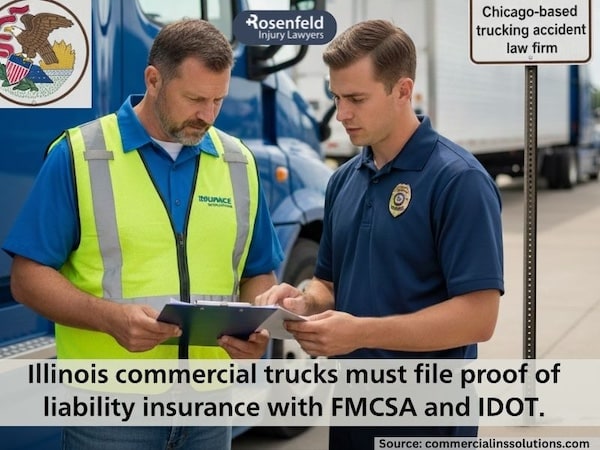
In Illinois, commercial truck insurance minimums can depend on factors such as the vehicle’s weight, the type of cargo being transported, and whether federal or state requirements apply. For interstate carriers subject to federal financial responsibility rules, 49 CFR Part 387 establishes minimum levels of liability coverage based on the type of vehicle and cargo.
The Illinois Department of Transportation and federal rules can both affect the requirements that apply, particularly when a carrier operates across state lines or is subject to FMCSA authority. For an injured person, understanding these requirements can provide an important starting point for determining what insurance coverage may be available after a truck crash.
According to the Federal Motor Carrier Safety Administration (FMCSA), for-hire property carriers operating vehicles with a GVWR of 10,001 pounds or more generally must maintain at least $750,000 in public liability coverage for non-hazardous property. Carriers operating qualifying vehicles under 10,001 pounds generally have a $300,000 minimum, subject to federal exceptions and the type of operation.
Higher minimums apply to certain hazardous materials. Depending on the cargo and the applicable federal classification, the minimum can be $1 million or $5 million. These figures should be reviewed against the current requirements in 49 CFR Part 387 because the applicable limit depends on the specific cargo and operation.
For a quick reference, the federal minimums commonly relevant to property carriers include:
| Vehicle or cargo category | Minimum liability coverage | Federal regulation |
| For-hire property carrier, GVWR under 10,001 lbs., non-hazardous property | $300,000 | 49 CFR § 387.9 |
| For-hire property carrier, GVWR 10,001 lbs. or more, non-hazardous property | $750,000 | 49 CFR § 387.9 |
| Certain hazardous materials | $1 million | 49 CFR § 387.9 |
| Certain highly hazardous materials | $5 million | 49 CFR § 387.9 |
These are federal minimum financial responsibility requirements, not necessarily the total insurance coverage available for a particular accident claim. The applicable limit depends on the cargo, vehicle, and operation. Attorney review should confirm the current requirement under 49 CFR Part 387 before publication.
At a minimum, applicable commercial truck insurance may include liability coverage addressing bodily injury and property damage. The exact requirements depend on the carrier, vehicle, cargo, and type of operation.
Depending on the operation, a policy may also include:
If you are an owner operator or the truck is operating under another company’s authority, determining which company owns the vehicle, employs the driver, or provides the operating authority can also help identify the insurance policies and potentially liable parties involved in an accident.
An owner operator may own the truck while operating under its own authority or under another motor carrier’s authority. For an injured person, identifying that relationship can help determine which company or insurance policy may be involved in the claim. See our employee vs. independent contractor insurance information for more on this distinction.
Motor carriers may be responsible for maintaining required financial responsibility and may also have commercial insurance policies that provide coverage beyond the applicable minimum. Identifying the carrier and its relationship with the driver can be important when investigating a truck accident claim.
A vehicle used for commercial purposes may involve different insurance considerations from a personal automobile policy. After a crash, determining how the vehicle was being used, who employed or contracted with the driver, and which policies applied can help identify potential sources of coverage.
For an injured person, the more important question is often not which policy a trucking company should purchase, but which insurance policies may apply to the accident. Investigating the carrier, driver, vehicle ownership, operating authority, and available coverage can help determine what insurance may be available for an injury claim.
Before a truck accident claim is resolved, it may be important to determine whether the applicable policy:
The applicable minimum does not necessarily represent the total insurance available after a commercial truck crash.aterials or running a large fleet, you can’t afford gaps in coverage or surprises after a major truck accident.
When a truck accident happens, things escalate quickly. Unlike standard car crashes, these collisions often involve severe injuries, complex liability issues, and multiple potentially responsible parties. Insurance coverage can become an important part of determining how an injured person’s claim may be paid.
Our traffic accident attorneys can help investigate the crash, identify potentially liable parties, and determine what insurance coverage may apply. This can include reviewing the trucking company, driver, vehicle owner, cargo arrangements, and other businesses connected to the accident.
An insurance company may dispute liability, question the extent of an injury, or offer less than an injured person’s claim may be worth. If a trucking company’s insurer denies or underpays an injury claim, the available policy limits and the reasons for the insurer’s decision should be reviewed carefully.
In some cases, there may be additional sources of compensation beyond the first insurance policy identified. Depending on the facts, potentially responsible parties can include a trucking company, vehicle owner, shipper, broker, maintenance contractor, or another business involved in the operation. Your own underinsured motorist coverage in Illinois may also be relevant when available coverage is insufficient.
The insurance minimum is a required floor, not necessarily the maximum amount of coverage available for a truck accident claim. A trucking company may carry coverage above the applicable minimum, and some claims may involve multiple policies or potentially liable parties. If severe injuries exceed the available coverage from one policy, investigating other potentially responsible parties may be important. Depending on the circumstances, those parties could include the trucking company, shipper, broker, maintenance contractor, or another business connected to the crash. An injured person’s own underinsured motorist coverage may also provide another potential source of compensation when its requirements are met. Identifying available policies and responsible parties early can help determine what options may exist for pursuing an injury claim.
If you were injured in a commercial truck accident and are concerned that the available insurance will not cover your losses, our Chicago truck accident lawyers can review the circumstances of your claim and the potential sources of coverage.
After a commercial truck accident, understanding the applicable insurance coverage can be just as important as determining who caused the crash. Our Chicago truck accident lawyers can help injured people investigate the accident, identify potentially liable parties, review available insurance coverage, and pursue compensation for qualifying injuries and losses.
If you’ve been injured in a truck accident and need help understanding the insurance coverage that may apply to your claim, contact us for a free consultation.
The required minimum depends on the type of carrier, vehicle, cargo, and operation. For example, federal rules generally require $750,000 in public liability coverage for for-hire property carriers operating vehicles with a GVWR of 10,001 pounds or more and carrying non-hazardous property. Certain hazardous materials require $1 million or $5 million. These are minimums, and a carrier may have additional coverage.
If your losses exceed one policy’s available limits, the investigation may need to consider other potentially liable parties and insurance policies. Depending on the facts, this could include the trucking company, shipper, broker, maintenance contractor, or another responsible business. Your own underinsured motorist coverage may also be relevant. Identifying all potentially available coverage early can help determine what options may exist for your claim.
For carriers subject to federal operating authority, proof of financial responsibility is filed with the FMCSA, and certain proof-of-insurance information is publicly available. Additional policy information may need to be obtained through the insurance claim process or litigation discovery. The specific information available should be confirmed before relying on a public filing to determine the full amount of coverage.
For an injured person, understanding Illinois commercial truck insurance requirements can help identify the coverage that may be available after a crash. At our Chicago-based firm, we help people injured in truck accidents investigate the crash, identify potentially liable parties, and understand the insurance coverage that may apply to their claims.
If you’ve been injured in a truck accident, need help understanding your potential insurance coverage, or believe a trucking company’s insurer is not fairly handling your claim, reach out to us. We’re here to advocate for your rights and help you pursue the compensation available under the law. Contact us for a free consultation today.
 Legally Reviewed By
Attorney Jonathan Rosenfeld
Content legally reviewed by Jonathan Rosenfeld This page has been reviewed for legal accuracy by Jonathan Rosenfeld, a Chicago personal injury attorney with nearly 25 years of experience representing people injured in car, truck, motorcycle, pedestrian, and rideshare accidents. Jonathan has recovered more than $450 million in settlements and verdicts for injured clients and families in Chicago. He holds a 10/10 rating on Avvo, is a member of the Million Dollar Advocates Forum, and has been repeatedly recognized by Super Lawyers. Jonathan leads the firm’s approach to holding insurance carriers and corporate defendants accountable for serious traffic injuries.