
100% Focus on Your Recovery,
Chicago Auto Accident Lawyer
Chicago Auto Accident Lawyer
Our Team of Attorneys Are Committed to Maximizing the Value of Your Case



If you are dealing with injuries or vehicle damage after being hit from behind, you may be asking who is at fault for a rear-end car accident under Illinois law. In Illinois, these crashes are among the most common car accidents, especially in congested areas like Chicago, Aurora, and along major interstates.
Rear-end accidents often lead to disputes with an insurance company, even when fault seems obvious. Understanding how Illinois assigns fault can protect your right to compensation and help you make informed legal decisions after an accident.
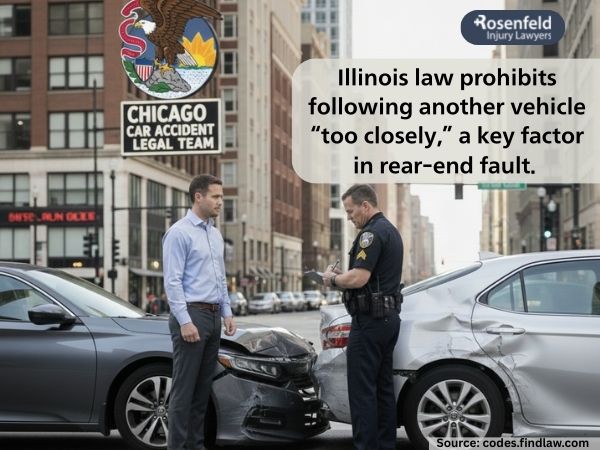
In most rear-end collision cases, the rear driver is presumed to be responsible. Illinois drivers have a legal duty to maintain control of their vehicle and keep enough space to stop safely. When a crash happens because a car is struck from behind, it often indicates the trailing driver failed to maintain a safe following distance.
Illinois Vehicle Code 625 ILCS 5/11-710 requires drivers not to follow another vehicle more closely than is reasonable and prudent. Violating this rule and following too closely is among the most common causes for assigning fault in a rear-end collision, particularly when speeding or delayed braking is involved.
Mechanical problems can shift responsibility in a rear-end collision. Faulty brakes may prevent one vehicle from stopping in time, even when the driver reacts appropriately. If poor maintenance caused the failure, the driver or owner of that vehicle may be held accountable.
Investigators also examine whether brakes were worn, improperly serviced, or recalled. These issues are common in accidents in Illinois involving older vehicles or high-mileage commuter cars.
Yes, fault in a rear-end accident is not automatic. The lead driver may share fault if their actions contributed to the collision. Examples include distracted driving, brake checking, stopping suddenly without reason, or failing to provide adequate warning to traffic behind them.
Issues with brake and hazard lights are also significant. If the lead vehicle has faulty brake lights or electrical failures that prevent brake lights from activating, this can limit the rear driver’s ability to react. In those cases, investigators may assign partial fault to the other driver or front vehicle owner under 735 ILCS 5/2-1116 (Illinois Comparative Negligence Law).
This means an injured driver can still recover compensation as long as they are less than 51% at fault. However, the total compensation is reduced by their percentage of fault. For example, if a driver is found 20% responsible for a rear-end collision, their compensation is reduced by 20%. This makes proving fault especially important in disputed rear-end cases.
Determining fault starts at the accident scene. Police reports document vehicle positions, visible damage, and initial statements from each driver. Officers may note whether a car was stopped at a light, moving with traffic, or struck while slowing.
Insurance adjusters later review this information along with photos, witness statements, and repair estimates. They analyze contact points, skid marks, and whether the rear-end damage aligns with the reported events.
While failing to maintain a safe distance from the car in front is the most common type of negligence in such collisions, road hazards, failure to follow traffic laws, and lead drivers being distracted by mobile phones can also cause rear-end accidents.
Rear-end accidents frequently cause serious injuries that are not immediately obvious. Whiplash, back injuries, and soft tissue damage are common, even at lower speeds. More severe crashes can result in herniated discs, head trauma, and long-term mobility issues.
Medical records and consistent medical treatment are critical for linking injuries to the accident. Without proper documentation, insurers may argue that injuries were minor or unrelated.
Even though most rear-end crashes seem straightforward, insurance companies often challenge fault to reduce payouts. They may argue sudden stopping, shared responsibility, or pre-existing injuries.
Insurance adjusters also scrutinize medical expenses, vehicle damage, and treatment timelines. Without strong evidence, they may undervalue claims involving rear-end accidents, even when injuries are legitimate.
After a rear-end accident, seek medical care immediately, document injuries, and report the crash to the police. Avoid speculating about fault at the scene, and be cautious when speaking with insurers.
Rear-end collisions may look simple, but fault disputes are common. Understanding how Illinois law applies to rear-end accidents can make a meaningful difference in the outcome of your claim and your ability to move forward after a serious crash.
An experienced Chicago rear-end car accident attorney can protect your rights in the claims process by collecting evidence, analyzing fault, and negotiating with the insurance company. We help collect police reports, medical records, dashcam footage, parking lot video footage, and expert opinions needed to prove liability.
We will also explain your legal options and work to secure compensation for medical expenses, lost income, vehicle repairs, and pain caused by the accident.
If you were injured in a rear-end collision in Illinois and are unsure how fault will be determined, getting legal guidance early can protect your claim. Our Chicago motor vehicle accident attorneys can review the facts of your crash, deal directly with the insurance company, and pursue fair compensation for medical bills, lost income, and ongoing injuries.
Do not let questions about fault delay your recovery. Speaking with an experienced attorney can give you clarity, confidence, and a clear path forward after a rear-end accident. Contact us for a free consultation today!