
100% Focus on Your Recovery,
Chicago Auto Accident Lawyer
Chicago Auto Accident Lawyer
Our Team of Attorneys Are Committed to Maximizing the Value of Your Case



Memory loss after a car accident can turn a person’s life upside down–interrupting work, relationships, and basic daily routines. Our law firm represents individuals throughout Chicago who are suffering from memory problems caused by serious injuries.
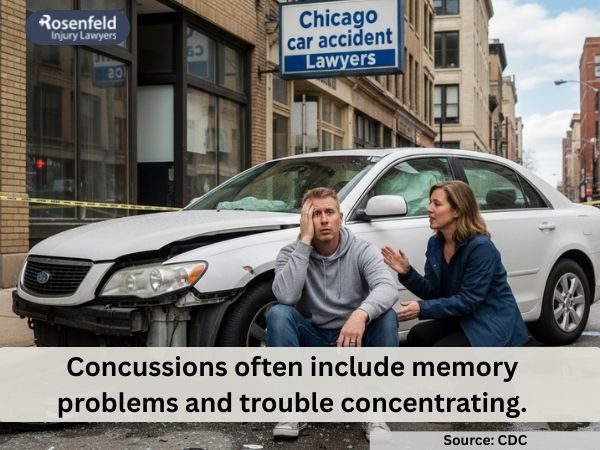
Memory loss after a car accident can affect people in different ways. Some struggle to recall what happened before or after the crash, while others have ongoing memory problems that interfere with everyday tasks. Below are the most common types of memory issues linked to a car accident.
Retrograde amnesia refers to the inability to remember events leading up to the car crash. This often includes the minutes, hours, or even days before the impact. It’s typically a direct result of head trauma and may signal a more serious injury, such as a traumatic brain injury.
Anterograde amnesia makes it difficult to form new memories after the accident. A person may struggle to remember conversations, instructions, or anything that happened recently. This condition affects cognitive function and can be especially distressing for both the injured person and their family members.
Short-term memory loss often shows up as trouble remembering things that just happened. This can include forgetting names, recent events, or details of daily life. It’s one of the most common symptoms of a head injury and may require long-term medical care and a structured treatment plan.
Long-term memory loss involves gaps in a person’s personal history, such as childhood memories or significant life events. While less common than short-term memory problems, it may indicate extensive brain damage and usually requires ongoing medical treatment and professional support.
Some people recall the car accident in scattered or incomplete pieces. Fragmented memories may come and go or feel out of order. This kind of memory loss often points to a traumatic event and may be linked to both physical injury and mental trauma, like post-traumatic stress disorder.
Memory gaps involve missing chunks of time–usually right before, during, or after the car accident. A person might not remember the impact or how they got out of the vehicle. These lapses are often tied to post-traumatic amnesia and can seriously affect the ability to give a clear account of the event.
Traumatic brain injuries, including concussions, often lead to short-term memory problems, post-traumatic amnesia, or difficulty forming new memories. In more severe cases, a person may fall into a coma, and memory loss may extend well before or after the collision.
Injuries such as whiplash or a serious neck injury can affect blood flow and oxygen supply to the brain, disrupting cognitive function. Even without a diagnosed brain injury, the trauma of a forceful impact can interfere with how the brain processes and stores memories. This can lead to symptoms such as memory gaps, confusion, and trouble remembering things related to the accident or everyday tasks.
Post-traumatic stress disorder (PTSD), anxiety, and depression are common psychological responses to a car accident. These conditions can interfere with focus, sleep, and memory, making it difficult to remember events or form new memories. In some cases, the brain may block out painful moments as a protective response, contributing to fragmented memories or memory gaps. Mental trauma may require treatment from both a medical professional and a therapist to support full recovery.
Medical treatment after a car accident that leads to memory loss is rarely one-size-fits-all. The type and extent of care often depend on how the brain was affected during the crash. Neurologists, neuropsychologists, and other specialists may use diagnostic tools like CT scans or MRIs to evaluate where and how the brain was injured.
Medications might be used to support brain activity or manage conditions like anxiety or depression, which can worsen memory issues. Cognitive rehabilitation therapy is also common, involving structured exercises to help rebuild memory, attention, and thinking skills. Ongoing evaluations are typically needed to track progress and adjust the treatment plan as recovery continues.
These forms of care can lead to significant medical bills over time. For those pursuing a personal injury claim, it’s essential to include all related costs–from diagnostic imaging to long-term therapy–as part of the compensation sought for memory loss after a car accident.
According to Law.com’s VerdictSearch, the average award in cases involving brain injuries–including those causing memory loss–is approximately $3,966,114, while the median award is $500,000. The value range spans from $7,232 on the low end to nearly $29.5 million in the most severe cases.
Several factors can influence the outcome of a personal injury claim:
Personal injury claims involving memory loss after a car accident often result in both economic and non-economic damages. Economic damages may include medical expenses such as hospital stays, CT scans, cognitive therapy, medications, and long-term rehabilitation. If the person can’t return to work or has to take a lower-paying job due to memory loss, they may also recover lost wages and future earning capacity. Non-economic damages often reflect the pain and suffering, mental trauma, and reduced quality of life caused by brain injury. These cases may also include compensation for loss of personal relationships, especially if memory loss or cognitive decline interferes with family life. In more serious injury cases, compensation may include the cost of ongoing medical care or assistance from a caregiver to help manage daily tasks and ensure well-being.
Marc C. Jacobs, a 44-year-old real estate attorney, suffered a TBI after the Yellow Cab he was riding in careened off a highway ramp and slammed into a concrete barrier. Jacobs spent several weeks in a coma, followed by months of hospitalization and rehabilitation. Despite attempts to return to legal practice, cognitive impairments–including memory loss, difficulty organizing, and communication issues–ended his ability to work at a high level in his field.
Jacobs sued the driver, Cornelius Ezeagu, and Yellow Cab Affiliation (YCA), alleging negligence and apparent agency. The defense argued Jacobs retained cognitive ability and was partly at fault. The jury found YCA and the driver 88% liable and awarded $29,487,831 in damages, reduced to $25,949,291 due to Jacobs’ 12% comparative fault.
Francoise Gordon, a 20-year-old Duke University student, was struck by a Cadillac after exiting a CTA bus in Chicago. The impact threw her over 100 feet, leaving her with a TBI, multiple fractures, and permanent neurological deficits. She spent a month in a coma and underwent numerous surgeries. Gordon was left with short-term memory loss, tremors, disfigurement, and lifelong physical disability. Despite her injuries, she eventually completed her degree.
She sued the driver, Margaret Munster, and the CTA. The jury found Munster 53% at fault, Gordon 47% at fault, and the CTA not liable. Her total damages were $11,433,190.33, reduced to $6,059,590.87 due to comparative fault.
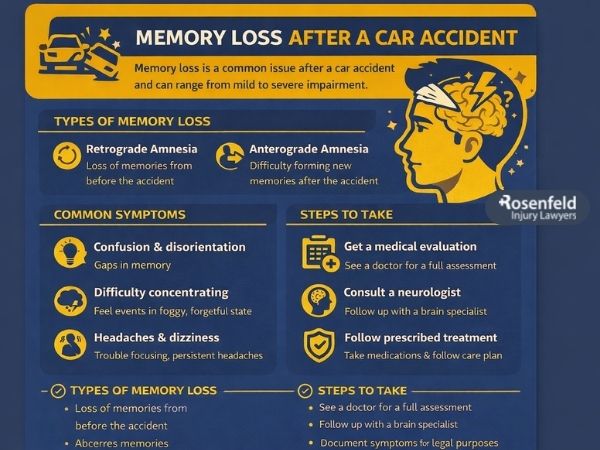
If you or a loved one is experiencing memory loss after a car crash, it’s essential to seek medical attention right away to diagnose any potential brain injury. Keep detailed records of your symptoms, medical treatment, and how the memory issues are affecting your daily life. Don’t speak with insurance companies before consulting an experienced Chicago car accident lawyer.
An experienced Chicago personal injury attorney can play a key role in protecting your legal rights after memory loss caused by a car accident. These cases often involve proving a traumatic brain injury or other cognitive damage that isn’t always visible on the surface. Our skilled lawyers can work with medical experts to document your memory problems, gather witness statements, and build a strong case. They also handle negotiations with insurance companies, which may try to downplay the seriousness of memory loss. Whether you’re facing medical bills, lost wages, or long-term care needs, legal support can make a significant difference in your recovery.
If you or a loved one is experiencing memory loss after a car accident, you don’t have to face the aftermath alone. Memory issues can be challenging to prove without the proper legal assistance–our attorneys work closely with medical professionals to document your condition and build a strong case. Contact us today to schedule a free consultation.