
100% Focus on Your Recovery,
Chicago Auto Accident Lawyer
Chicago Auto Accident Lawyer
Our Team of Attorneys Are Committed to Maximizing the Value of Your Case



Depression after a car accident can affect every part of a person’s life – from sleep and work to relationships and self-worth. At our Chicago law firm, we represent individuals who are suffering emotionally after being injured in a crash, especially when another driver is at fault.
Our legal team understands how emotional injuries like anxiety, PTSD, and major depression often follow a serious accident. These conditions can be just as disruptive as bodily injuries, leading to lost wages, ongoing pain, and the need for long-term medical treatment.
If you’re feeling depressed after a traumatic event on the road, we’re here to help you seek compensation for therapy, medical care, and other related costs.
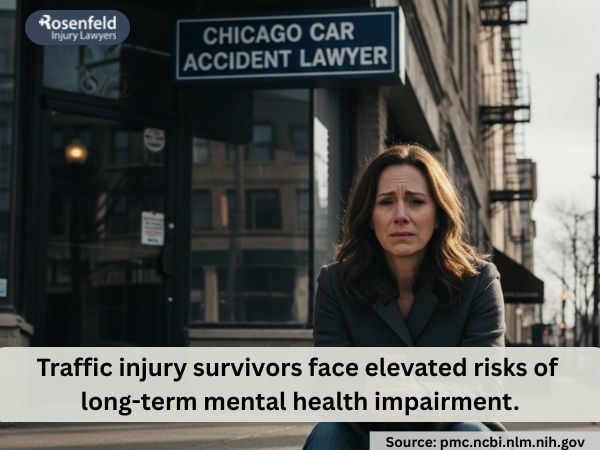
Depression is a medical condition that goes beyond temporary sadness. It affects how a person thinks, feels, and functions day to day – often for weeks or months at a time.
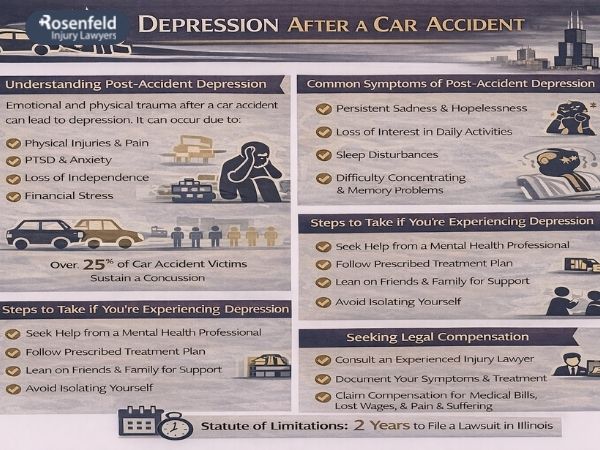
Unlike brief emotional dips, clinical depression can lead to sleep disturbances, a loss of interest in daily life, extreme fatigue, and difficulty concentrating. It may also include persistent feelings of hopelessness, worthlessness, or emotional numbness. These symptoms can make even simple tasks feel impossible.
There is a strong connection between physical trauma and mood disorders. After a serious car accident, the body’s physical injuries and pain can directly impact the brain’s chemical balance, triggering depression symptoms.
Mental trauma after a car accident should never be dismissed and requires immediate medical attention.
Depression and post-traumatic stress disorder (PTSD) can develop from the same traumatic event, but they are not the same condition. Many people experience both at the same time, especially after a serious accident that results in bodily injuries and emotional distress.
Depression often involves deep, ongoing sadness, hopelessness, fatigue, and a loss of interest in things that once brought joy. It can affect sleep, appetite, concentration, and energy. The focus tends to be internal – a person may feel worthless, numb, or unable to move forward.
Post-traumatic stress disorder is more tied to fear and survival. It may involve flashbacks, nightmares, panic attacks, or a constant sense of being on edge. PTSD after a car accident can make someone avoid driving or riding in a car, and even small reminders of the crash can trigger intense anxiety.
Both conditions are severe, and both can interfere with every part of a person’s life – from work to relationships to daily routines.
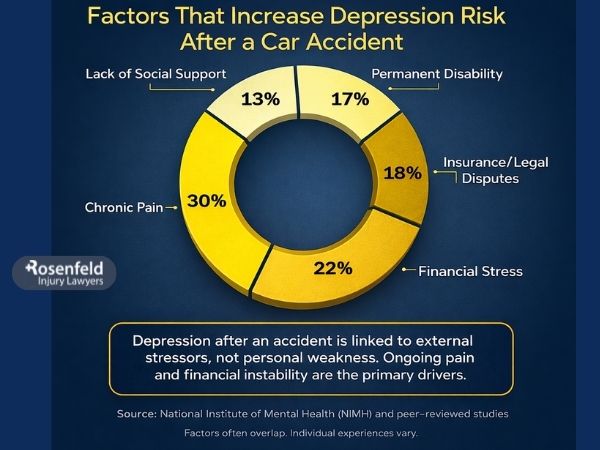
A car accident can have lasting effects on both the body and mind. Some survivors develop depression as a direct emotional response to the shock, fear, and helplessness they felt during or after the crash.
Chronic pain after injuries is another major factor. Living with ongoing discomfort or physical limitations makes it difficult to stay positive, especially when recovery is slow or incomplete.
Difficulty returning to normal activities, including work, hobbies, or time with family, can lead to isolation and loss of purpose. If a person faces a long-term recovery or uncertainty about their prognosis, that uncertainty can deepen feelings of hopelessness.
Financial strain from missed work only adds pressure, especially if the person is the primary earner or lacks adequate insurance coverage.
Many people also experience anxiety while driving or riding in cars, making it hard to maintain routines or independence. This loss of independence can be especially upsetting for those used to being active or self-reliant.
Sleep disturbances are common and can make everything worse. Lack of sleep impacts mood, focus, and resilience.
In some cases, a person may already have a previous mental health history, which increases the risk of developing depression after a car accident. Others may suffer brain injuries during the crash, which can directly affect mood regulation and increase the chances of developing depression or other mood disorders.
Together, these factors can create a lasting emotional toll that no one should have to carry alone.
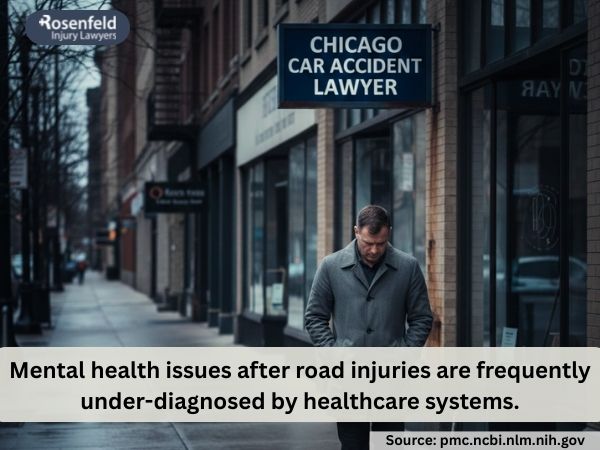
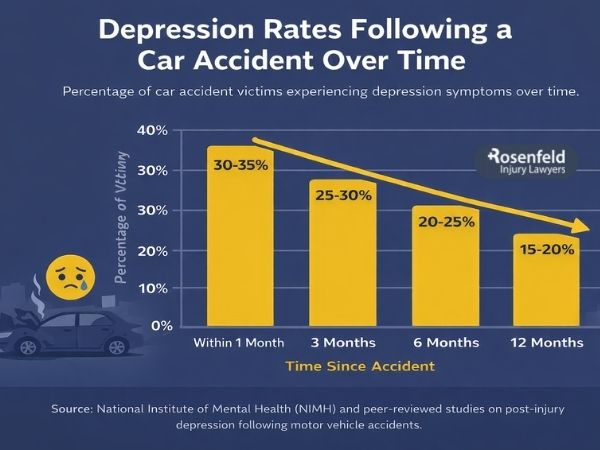
Depression doesn’t always appear right away after a car accident. For many people, the symptoms develop slowly and begin to affect how they think, feel, and function. Recognizing the warning signs early can make a difference in getting the proper support.
The following red flags should never be ignored:
If you or someone you care about is experiencing these symptoms, it’s critical to seek medical help right away.
Diagnosing depression after a car accident involves more than asking how someone feels. Medical professionals use a combination of physical exams, screening tools, and psychological evaluations to understand what a person is going through.
The process often begins with a primary care evaluation, where a doctor may check for physical causes of depression-like symptoms, such as chronic pain, sleep disturbances, or the effects of a brain injury. From there, many patients are referred to mental health professionals for a more in-depth assessment.
A formal psychological evaluation looks at a person’s mood, behavior, thoughts, and functioning. Clinicians often rely on the DSM-5 criteria for major depressive disorder, which outlines specific symptoms, their duration, and how they affect daily life. To support diagnosis, providers may use screening tools like the PHQ-9, a short questionnaire that measures the severity of depression symptoms.
It’s essential to recognize the connection between depression and physical symptoms – such as fatigue, appetite changes, and pain – which are common after a car accident but may be overlooked as signs of emotional distress.
Doctors also monitor for delayed onset, since depression after a car accident doesn’t always appear right away. In some cases, symptoms may not become clear until weeks or even months after the traumatic event.
Early diagnosis can make a significant difference in a person’s ability to recover and get the support they need.
Treating depression after a car accident often requires a combination of approaches – and the costs can add up quickly. For many injured individuals, these treatments become part of a long-term care plan that should be factored into any claim for damages.
Medical treatment after a car accident doesn’t end with emergency care or physical rehabilitation. Psychotherapy is one of the most common and effective treatments. Talking regularly with a trained therapist helps many people process trauma and manage symptoms. Cognitive-behavioral therapy (CBT) is often used to address negative thinking patterns and emotional responses that can follow a traumatic event.
For those with overlapping symptoms of PTSD after a car accident, trauma-focused therapy may be recommended. Antidepressant medication is another key option, especially when depression symptoms are severe or persistent. Medication can help regulate mood and make it easier to engage in therapy and daily activities.
Sleep treatment or behavioral therapy may be necessary when insomnia, nightmares, or irregular sleep cycles are part of the problem. In many cases, lack of rest makes recovery more difficult and deepens emotional distress.
When depression is tied to bodily injuries, pain management and physical rehabilitation can play a significant role in improving overall function. As pain decreases and mobility improves, mood often stabilizes as well.
Finally, support groups or counseling offer a space to connect with others going through similar experiences, which can ease feelings of isolation and provide emotional relief.
Each of these treatments carries financial, emotional, and time-related costs. Our legal team works to ensure emotional well-being is treated as a legitimate, compensable part of your injury claim.
According to Law.com’s VerdictSearch, recovery amounts in emotional injury claims – including those involving major depression, PTSD after a car accident, and other psychological injuries – range from $6,770 to over $54 million. The average award is $8,262,548, while the median is $1,684,000.
Compensation for depression after a car accident can vary widely depending on several factors:
James Denton, 53, was rear-ended by a commercial truck on I-65 after traffic slowed due to a wrong-way driver. He sustained life-altering injuries, underwent nine surgeries, developed chronic pain, depression, anxiety, and PTSD, and became unable to work. The lawsuit focused on negligent hiring and retention of the truck driver, who had a troubling driving record. The jury found 60% fault on Universal Am-Can and awarded Denton and his wife $54,155,900, including $35 million in punitive damages. Damages included compensation for medical expenses, lost wages, pain and suffering, and emotional injuries.
Kayla Neese, 33, suffered spinal fractures and required spinal fusion surgery after a negligent driver struck the passenger side of her car. She developed chronic pain, depression, anxiety, and an adjustment disorder, requiring ongoing psychiatric and neurological care. Her future treatment plan includes a spinal cord stimulator and continued psychotherapy. The jury awarded her $21,059,014, covering past and future medical costs, pain and suffering, emotional distress, and loss of normal life.
William Hickey Jr., a Lockport city worker, was struck by a Pace transit bus that made a left turn into his path. He suffered devastating leg injuries, leading to a below-the-knee amputation, multiple surgeries, and complications. Hickey also developed PTSD, depression, and long-term physical and emotional limitations. The jury found him 45% contributorily at-fault, reducing his total $14.564 million award to $8,010,000. Damages included pain and suffering, emotional injuries, lost income, and necessary home assistance.
Miriam Bragar, 33, was broadsided by a CTA bus in Chicago and suffered multiple fractures, a traumatic brain injury, and vision impairment. Though she had a pre-existing mental health history, her team argued that her emotional and cognitive decline was directly caused by the crash. She could not complete nursing school and required supervision due to memory loss and functional impairments. The jury found Bragar 20% liable and awarded $9,962,000, reduced to $7.97 million. Damages included future caregiving costs, pain and suffering, and emotional distress.
If you’re starting to feel emotionally overwhelmed after a car accident, it’s essential to take steps that protect both your health and your legal rights.
Depression isn’t just “in your head” – it’s a serious outcome of trauma that deserves recognition, medical treatment, and compensation.
If you’re experiencing depression after a car accident, proving the emotional and psychological injuries can be just as important as documenting physical harm. A Chicago personal injury attorney knows how to gather evidence, work with medical and mental health experts, and present a clear picture of how the car accident has affected your life. This includes connecting your depression symptoms to the traumatic event, calculating the long-term costs of treatment, medication, and lost wages, and making sure those damages are fully represented in your claim. Our skilled legal team will also handle all communication with the insurance company to protect you from tactics that may undervalue your emotional injuries. Our experienced lawyers can help you build a case that holds the at-fault driver accountable–not just for the crash itself, but for the emotional suffering that followed. With the proper legal support, you can focus on recovery while your attorney fights for the compensation you deserve.
If you’re experiencing depression after a car accident, you don’t have to face it alone. Your emotional well-being matters – and it deserves the same legal protection as any physical injury. Our legal team understands how trauma can affect every part of your life, from relationships and work to your sense of identity and peace of mind.
Contact a Chicago personal injury attorney at our law firm today to schedule your free consultation. We’ll review your case, explain your legal rights, and help you take the next step toward protecting your future.