
100% Focus on Your Recovery,
Chicago Auto Accident Lawyer
Chicago Auto Accident Lawyer
Our Team of Attorneys Are Committed to Maximizing the Value of Your Case



When someone comes to our Chicago law firm after a car accident, they’re often overwhelmed by medical bills, lost wages, and pressure from the insurance company. One of the first things we do is walk our clients through the Illinois car accident laws that shape every car accident claim, because understanding these rules empowers you to make informed decisions about your recovery, your legal options, and your path forward.
Illinois law affects everything, from whether a crash must be reported, to how liability insurance works in an at-fault state, to how long an injured individual has to file a personal injury lawsuit. As a Chicago-based firm focused on helping injured people rebuild, we help our clients navigate these accident laws with clarity and compassion.
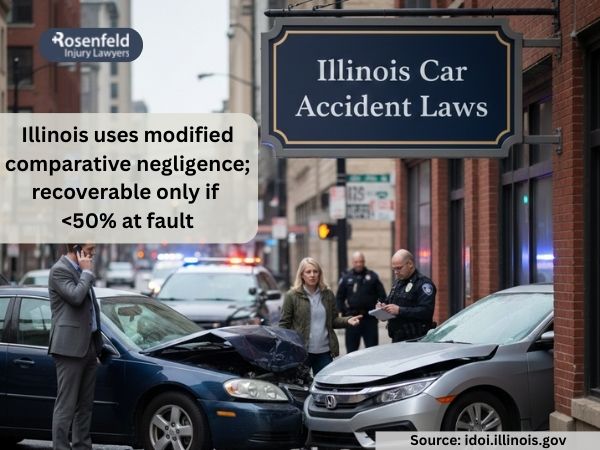
In accordance with Illinois car accident laws, many crashes must be reported, both to law enforcement and, separately, to the insurance provider.
Under 625 ILCS 5/11-407 of the Illinois Vehicle Code, state law requires drivers to report a motor vehicle accident to police when the crash involves:
The report must be submitted “within 10 days” to the Illinois Department of Transportation (IDOT). If a driver fails to file the written accident report, their driver’s license may be suspended. This rule ensures the state has a record of crashes involving bodily injury, major vehicle damage, or other serious losses.
Even if the police officer who arrives at the crash site completes a report, drivers still have a duty to submit their own report when required by Illinois law.
Under 625 ILCS 5/11-403, Illinois law requires every driver involved in a crash resulting in injury, death, or property damage to:
Failing to comply can lead to criminal charges. We often see confusion about what “reasonable assistance” means. In practice, it means acting as a reasonable person would under the circumstances, such as checking on the injured party, calling 911, and remaining on-site until permitted to leave.
Section 625 ILCS 5/11-408 outlines the specifics of the written report a driver must file with IDOT. The report must include:
The report must be made within a reasonable period, and failure to do so may lead to administrative penalties. We help our clients obtain copies of their reports from the sheriff’s office, local police department, or IDOT when needed in car accident cases or for an eventual car accident lawsuit.
Illinois law does not set a specific statutory deadline for notifying your own insurance company, but nearly every insurance policy requires “prompt notice.” Delay can jeopardize your insurance claim, your ability to recover damages for repair or replacement losses, and even your right to seek compensation for bodily injury.
We help our clients handle all communication with the insurer so the car insurance company doesn’t use delays or technicalities to deny the claim.
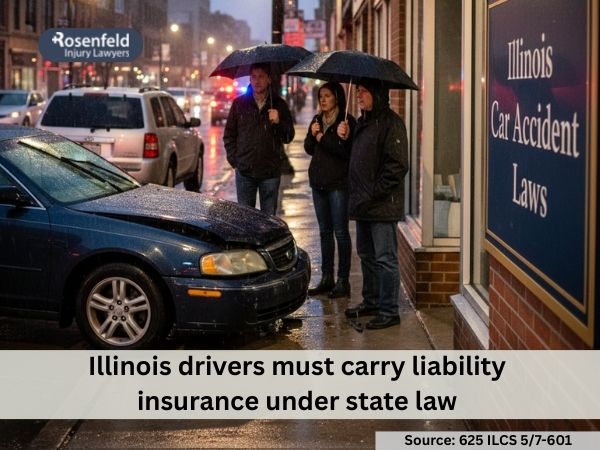
Yes, Illinois is an at-fault state, meaning the at-fault driver is legally responsible for paying for medical expenses, vehicle damage, and other losses. Through their liability insurance, the at-fault party’s insurance pays for the damages they caused.
When we build a vehicle accident lawsuit, our personal injury lawyers focus on proving the other driver was legally responsible through evidence, expert review, witness statements, and police reports.
Under 625 ILCS 5/7-601 of the Illinois Vehicle Code, every Illinois car must carry minimum:
This is why liability insurance pays when the insured driver is responsible for a crash. These limits apply in every standard vehicle accident in the state.
Most drivers also maintain car accident insurance coverage such as:
We often help clients pursue claims through their own insurer when the other driver is uninsured or lacks enough coverage to compensate the injured party.
Under Illinois’ modified comparative negligence rule (735 ILCS 5/2-1116), an injured person may recover damages as long as they are 50% or less at fault. Once their share of fault reaches 51%, they are barred from recovering compensation.
When two or more drivers admit fault, fault is divided proportionally. For example:
Comparative fault affects nearly every serious car accident claim, especially when multiple parties or commercial drivers are involved.
Understanding the statute of limitations is critical in any Illinois car accident case. These deadlines control how long after an injury or death legal action must commence, and missing them permanently bars your ability to file a personal injury claim, no matter how strong the evidence may be. Illinois courts enforce these timelines strictly, so acting promptly protects your rights and strengthens your claim.
Because these statutes of limitations vary by claim type, and because additional tolling provisions may apply to minors or legally disabled individuals, we monitor every applicable deadline carefully. Our firm ensures that our clients never lose their right to seek compensation because too much time passed before filing.
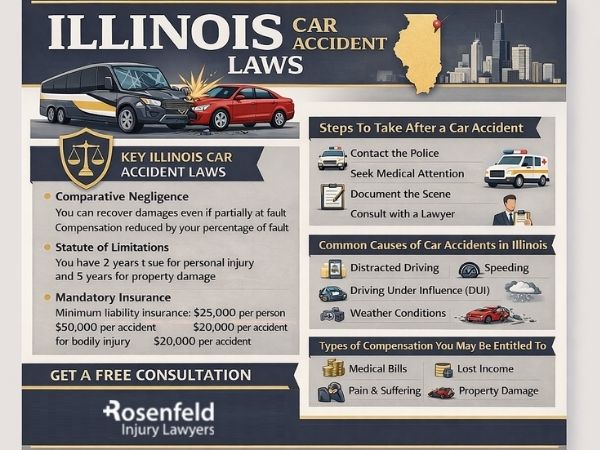
As a Chicago car accident attorney team, we guide clients through every stage of the legal process, from the moment the crash occurs to settlement or litigation. Our services typically include:
We stand with you through every step of the process. You’re not alone, and we believe in your case.
Victims may recover:
A “salvage vehicle” cannot be legally driven on public roads until it is repaired, inspected, and issued a “rebuilt” title by the state.
A “rebuilt vehicle” is a formerly salvaged car that has passed state inspection and is now permitted for legal operation.
If you or a loved one was injured in an auto accident, we’re here to support you every step of the way. Speaking with an experienced lawyer can help you understand your rights under Illinois car accident laws, navigate the insurance recovery process, and protect your future.
We handle all cases on a contingency fee basis, meaning you owe no upfront costs and no attorney fees unless we recover compensation for you. Contact us today for a free consultation with a motor vehicle accident attorney in Chicago.