
100% Focus on Your Recovery,
Chicago Auto Accident Lawyer
Chicago Auto Accident Lawyer
Our Team of Attorneys Are Committed to Maximizing the Value of Your Case






When a bus crash in Chicago turns your life upside down, the uncertainty can feel overwhelming. From CTA routes downtown to school buses in neighborhood corridors and private shuttle services near O’Hare and Midway, buses are part of daily life across the city. If you’re considering whether you can sue if injured in a bus accident, we want you to know that you’re not alone.
As a Chicago-based law firm, we stand with victims and families as they navigate medical bills, lost income, and the legal process after a serious bus crash. If a government transit agency like the CTA or Pace was involved, your filing deadline may be much shorter than the standard two years, so acting quickly is essential.
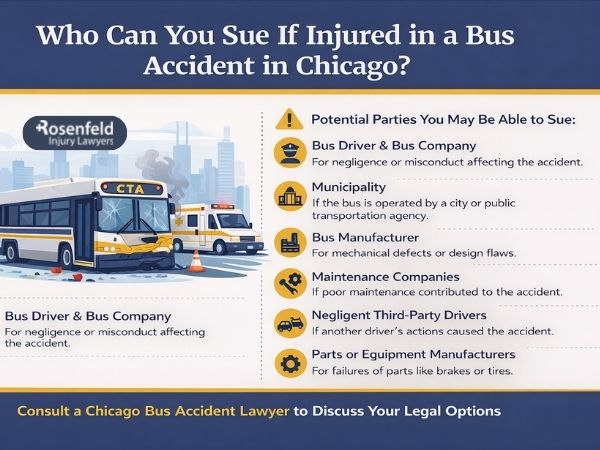
Who Can You Sue If Injured in a Bus Accident? A bus crash victim can generally sue the bus driver, the bus company, the transit authority such as the CTA or Pace, other negligent motorists, or the party responsible for maintaining the vehicle. Depending on the facts, one or more of these parties can be held liable:
Bus collision cases often involve multiple parties, and identifying all who are potentially liable is one of the most important steps in protecting your rights. Our experienced Chicago bus accident attorneys carefully investigate every vehicle involved, the accident scene, and the relationships among drivers, companies, and government agencies.
Depending on the facts, potentially liable parties may include:
Bus drivers and bus companies are treated as common carriers under Illinois law, which means they owe passengers a higher standard of care than an ordinary driver owes other motorists. Conduct that might be considered merely careless in a typical car accident, such as a hard stop or a distracted moment behind the wheel, can be enough to support a bus accident injury claim once a common carrier is involved.
Because bus collision lawsuits are rarely simple, we focus on identifying all other involved parties to ensure injury victims are not left bearing the burden alone.
Who can you sue if injured in a bus accident? For that, evidence plays a key role. The evidence you and your attorney gather in the hours and days after a bus collision often determines who can be held liable. We guide our clients through each step, but the following evidence carries the most weight in proving fault:
Once this evidence is secured, the next step is filing correctly. You need to understand how to file a bus accident claim to gain insight on the full process behind a bus passenger injury claim.
Our experienced bus accident lawyers in Chicago support clients from the first phone call through resolution. Our legal team understands the unique challenges involved in claims against government agencies and private carriers.
Our role often includes:
We believe in your case, and we approach every matter with care, preparation, and respect. Our goal isn’t pressure or promises, it’s clarity, accountability, and advocacy for injured victims.
Deadlines matter. Missing a filing deadline can permanently bar recovery, even in strong cases, including a bus passenger accident claim.
Key Illinois laws include:
Our Chicago bus accident attorneys carefully evaluate timelines under Illinois law to protect our clients’ rights.
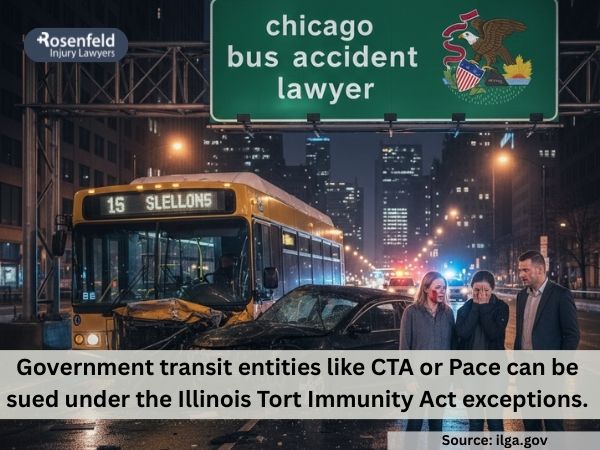
Whether you can bring a public bus accident lawsuit against the CTA or Pace, or a standard claim against a private bus company, changes both your deadline and your legal path. Riders searching for a bus injury lawyer near me in Chicago are often surprised that the same crash can follow two different sets of rules depending on who was driving. Suing the CTA for an accident follows a different notice and filing path than suing a private operator, which is why identifying the correct defendant matters immediately.
| Public (CTA / Pace) | Private Bus Company | |
| Defendant | The Chicago Transit Authority or Pace Suburban Bus, a government transit agency | The charter, shuttle, tour, or party bus company itself |
| Notice requirement | Varies by agency; the CTA’s prior pre-suit notice requirement was repealed in 2009, though other public entities may still require early notice | No special pre-suit notice requirement |
| Filing deadline | Generally one year (CTA: 70 ILCS 3605/41; Pace and Metra: 70 ILCS 3615/5.03) | Generally two years under 735 ILCS 5/13-202 |
| Immunity and damages | Tort immunity protections can limit certain claims, and the agency is typically self-insured | No government immunity applies, and damages are pursued through the company’s commercial insurance |
A public transit accident lawyer in Illinois has to weigh which set of rules applies before a claim is even filed, since suing the wrong entity under the wrong deadline can cost a valid case. For a deeper breakdown of public and private bus accident claims, including real Cook County settlement examples, see our full comparison guide.
Bus collision victims may file a personal injury claim when they can show duty, breach, causation, and can justify damages. In other words, a bus driver or company owed a duty of care, breached that duty, caused the crash, and resulted in harm. These principles apply across most bus accident claims in Cook County.
Every case is unique, but based on Cook County filings, bus accident lawsuits show wide variation:
Case value depends on factors like the presence of serious injuries, medical expenses, pain and suffering, lost wages, and whether wrongful death damages are involved, which typically settle for maximum compensation. Claims against public entities such as the CTA or Pace can also be affected by procedural rules and available insurance coverage, so public-entity cases do not always track these general averages.
According to the Illinois Department of Transportation’s 2023 Chicago Crash Report, there were 3,146 bus collisions, resulting from a wide range of contributing factors. Common bus accident causes include driver error, distracted driving, fatigue, unsafe turns, failure to yield, speeding, and poor vehicle maintenance. Congested traffic, construction zones, and weather conditions across Chicago increase risk when safety rules are ignored.
Passengers generally have a claim regardless of which driver caused the crash. If another motorist forced the bus to stop suddenly or collided with it, the claim simply shifts toward that driver’s insurance, or toward underinsured motorist coverage if their limits are too low to cover the injuries. Bus passengers are almost never found at fault themselves, since they have no control over the vehicle’s operation.
It depends on the agency. The CTA’s earlier six-month pre-suit notice requirement was repealed in 2009, so filing suit within the one-year deadline is generally what matters most for CTA claims. Other public entities, including school districts and municipalities, may still have their own notice steps, and missing one can weaken or end a claim regardless of its merits. Because these rules vary by defendant, confirming the exact requirements for your case with an attorney is strongly recommended.
If you or a loved one was harmed in a bus-related accident, we’re here to listen. Our Chicago motor vehicle accident lawyers offer a free consultation, and we handle cases on a contingency fee basis, so there are no upfront costs and no attorney fees unless we recover compensation for you.
Whether your case involves the Chicago Transit Authority, a private bus, or multiple parties, we stand with victims through every step of the legal process. Contact us today to speak with an experienced lawyer and learn how we can help you move forward with confidence.