
100% Focus on Your Recovery,
Chicago Auto Accident Lawyer
Chicago Auto Accident Lawyer
Our Team of Attorneys Are Committed to Maximizing the Value of Your Case



Driver fatigue significantly increases the risk of crashes on busy highways like I-90, which is why the Federal Motor Carrier Safety Administration strictly enforces truck driver hours-of-service regulations.
If failure to comply with truck driver regulations resulted in your truck crash injuries, our attorneys can help. Contact us today for a free consultation about how HOS regulations may influence your personal injury claim.
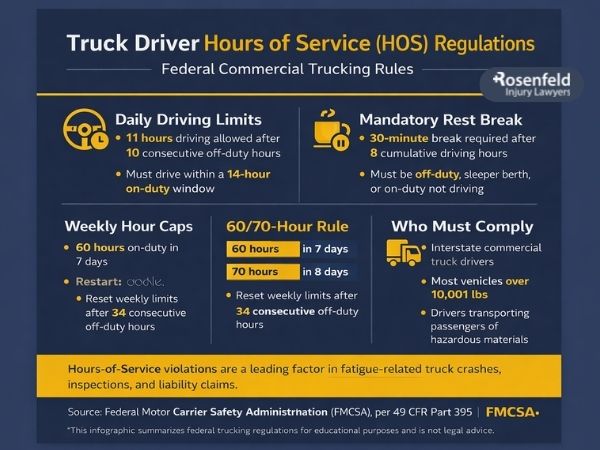
Hours-of-service (HOS) regulations strictly control driving hours, on-duty and off-duty time, and rest periods. These federal guidelines apply to most commercial motor vehicle drivers engaged in interstate commerce, including those on Illinois highways (49 C.F.R. Part 395).
There are some state-specific HOS rules, including exemptions for utility drivers during emergency conditions (625 ILCS 5/18b-106.2) or on short-haul driving. Additionally, there are separate service regulations for property-carrying and passenger-carrying drivers.
There is a 14-hour driving window that begins as soon as the driver comes on duty and does not stop for mandatory breaks. An operator cannot continue driving after 14 hours of service, even if they only completed a few hours of driving time during that period (49 C.F.R. § 395.3(a)(2)).
Driver fatigue accumulates over days, not just during a single shift, and can have serious repercussions. To prevent fatigue, truckers may not complete more than 70 hours of service in 8 days or 60 hours in one week (49 C.F.R. § 395.3(b)).
On-duty status includes time driving, performing pre-trip inspections, loading vehicles, or waiting for tasks to be completed. When off duty, truckers are prohibited from performing any work-related responsibilities to ensure adequate rest (49 C.F.R. § 395.2).
Missclassifying duty time is a common compliance violation that can result in serious fines.
Operating a motor vehicle for extended periods without breaks can lead to fatigue, slower reaction times, and reduced focus. This is especially dangerous for truck drivers, who have massive vehicles that can cause catastrophic injuries during a crash. As such, trucking industry service rules require mandatory rest periods, which ensure safety for everyone on the road.
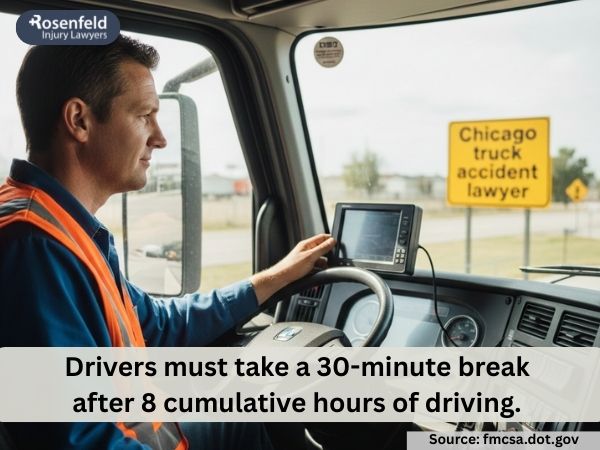
Safety regulations require drivers to take a 30-minute break after at least 8 consecutive hours of driving (49 C.F.R. § 395.3(a)(3)). This rest time can be spent in the sleeper berth, off-duty, or on-duty but not driving, such as managing paperwork or refueling.
Non-compliance with these limits on consecutive hours of service can lead to serious crashes, but many companies pressure drivers to skip breaks to stay on schedule with deliveries.
The Illinois Department of Transportation’s truck accident statistics show that there were 2,278 Chicago crashes involving trucks with semi-trailers in 2023, and an additional 3,427 crashes involving single-unit trucks. According to the National Transportation Safety Board, driver fatigue is a contributing factor in 30 to 40% of large commercial motor vehicle crashes.
Fatigue impairs driver reaction times, decision-making, and judgment, meaning that drivers may make poor operating decisions that could result in crashes. For example, they may fail to signal a lane change and sideswipe a smaller vehicle, resulting in catastrophic injuries. Not only would they have violated Chicago municipal codes (9-16-020), but they also violated federal guidelines.
Transporting hazardous materials is inherently more dangerous, even in vehicles with a lower gross combination weight rating than other trucks. Fatigue among these operators can not only cause serious injuries, but also create severe environmental hazards. While hours-of-service regulations are the same, the penalties for violating them are significantly higher for these drivers.
Truck accident negligence extends beyond the driver. In the Illinois Supreme Court case McQueen v. Green, the court determined that employers can be both vicariously and directly liable. In other words, companies can be held responsible for their drivers’ negligence and for their own. This ruling reaffirms that trucking companies are held to a high standard of care, given the severe consequences of negligence.
Trucking companies are required to track hours of service for their drivers and set limits on how long each driver can operate. Additionally, they must swiftly intervene if they identify any driver breaking rules (49 C.F.R. § 390.11). If the company is found to have pressured drivers to ignore HOS regulations, it could face severe penalties.
HOS records are a key component of a truck accident investigation because they can help determine whether fatigue contributed to the crash. A Chicago truck accident lawyer can then use this finding to hold both the driver and their employer liable for failure to comply with federal guidelines.
Our team will review truck driver log books to see whether the driver took their breaks in the hours before the crash. We can also examine the truck DQ file, which serves as a permanent record of the driver’s violations and medical history. If the driver was diagnosed with a condition like sleep apnea or insomnia, but was not following their treatment plan, this could demonstrate negligence.
These records strengthen our bargaining position, making it easier to ensure that a settlement covers all your medical needs.
Our Chicago traffic crash attorneys have secured more than $450 million in verdicts and settlements over the past 25 years, thanks to our meticulous investigation process and aggressive legal advocacy. We will thoroughly evaluate all contributing factors to the crash and ensure that all liable parties are held accountable for their failures to protect others on the roadways. Most importantly, we handle all third-party communications so that you can prioritize recovery.
We work on a contingency fee basis: no legal fees unless we win. Contact us today to schedule a free consultation with our award-winning attorneys.