
100% Focus on Your Recovery,
Chicago Auto Accident Lawyer
Chicago Auto Accident Lawyer
Our Team of Attorneys Are Committed to Maximizing the Value of Your Case



After a truck accident on Chicago highways such as the Edens Expressway or the Tri-State Tollway, it is crucial to understand Illinois trucking laws. A truck driver qualification file is a key piece of evidence that our truck crash attorneys can use to examine a CDL driver’s safety performance history and demonstrate negligence.
If you’ve been in a commercial motor vehicle accident, you’re not alone. We can help you review the evidence, prove liability, and secure fair compensation for your injuries. Contact us today for a free consultation about your legal rights.
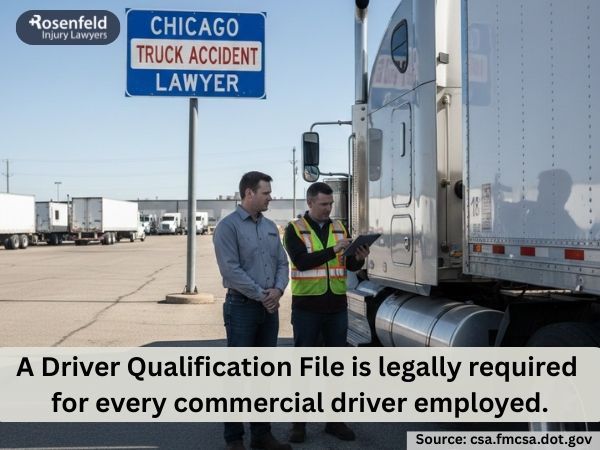
A driver qualification file (DQ) is a collection of documents that proves a truck driver is qualified to operate a commercial motor vehicle. All CDL drivers must have a DQ, and some non-CDL drivers who operate commercial vehicles must also have this record.
The Federal Motor Carrier Safety Administration (FMCSA) requires all motor carrier employers to maintain these employee records (49 C.F.R. § 391.51). The driver’s employer is responsible for this, not the driver. As such, issues with the driver file constitute negligence on the employer’s part.
A driver qualification file includes multiple documents that provide a comprehensive view of the driver’s employment and safety performance history. These include the following documents:
Driver’s Commercial Driver’s License (CDL): Employers must retain a copy of the driver’s CDL to verify they are authorized to operate in interstate commerce.
Motor Vehicle Record (MVR): The driver’s MVR, provided by the Illinois Department of Motor Vehicles, reflects all interactions with the DMV. This could include violations such as exceeding the Chicago 30 mph speed limit (9-12-070), at-fault accident citations, parking tickets, or driving under the influence (625 ILCS 5/11-501).
Original Motor Vehicle Record at Hire: The employer must obtain a driver’s record at the time of hire. This original document provides a snapshot of prior driving history and can show a history of negligence. It can also demonstrate negligent hiring if the employer hired the driver despite a history of violations.
Medical Examiner’s Certificate: The medical certification confirms that the driver has the required level of fitness to operate a semi-truck or tractor-trailer. It must be issued by an individual on the National Registry of Certified Medical Examiners.
Medical Variance Document: Some drivers may have disabilities, such as limb loss. They can submit a skill performance evaluation certificate demonstrating they have the necessary skills to operate a commercial motor vehicle. In other cases, they may have a medical exemption document that allows them to drive despite a diagnosis.
Driver’s Employment History: This document lists all the driver’s previous employers, who can be contacted for further details about their driving record.
Safety Performance History Records: All DOT-registered companies must maintain records of their drivers’ safety performance history and compliance with all standards for up to three years. This shows if the person has any moving violations, disciplinary actions, or other concerning behaviors.
If the driver is a multiple-employer driver, each company must have a copy of the driver’s DQ file. Failure to maintain these records in accordance with federal regulations raises serious safety concerns and can constitute negligence.
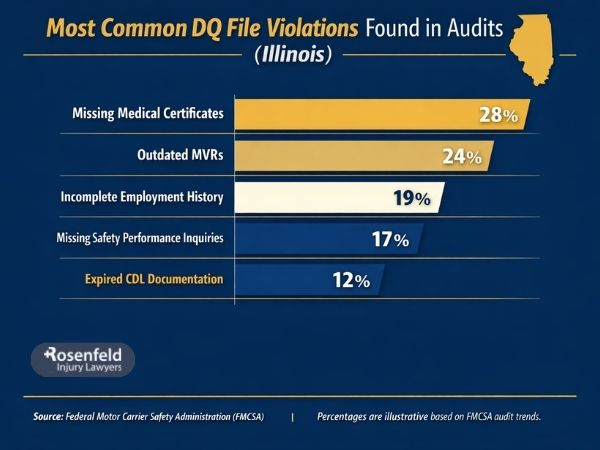
A valid motor vehicle operator’s license is the most crucial element of a DQ file (49 C.F.R. § 383). It demonstrates that the operator meets commercial driver’s license standards and holds the proper endorsements for certain dispatches, such as if the driver operates a longer combination vehicle or transports hazardous materials.
Prospective employers are required to retain a CDL holder’s application for employment for up to three years (49 C.F.R. § 391.23). This application should include specific disclosures, including employment history, a list of previous employers, and the driver’s record (49 C.F.R. § 391.21).
Incomplete applications for employment or failure to verify prior employers are common compliance issues that may prove negligence.
A driver qualification file must include proof that the individual has completed a training program covering all aspects of safe vehicle operation. These are typically provided by private companies, and then the CMV driver undergoes a test by a DOT-approved examiner.
Additionally, this file should have a driver’s road test, issued by the motor carrier. This test must be done on the vehicle that the employer has issued to the driver, showing that the individual can safely operate this specific make and model (49 C.F.R. § 391.31).
An individual with a disability, such as a loss of a limb, must have a skill performance evaluation certificate. These are completed by a medical examiner, listing the specific loss of function and demonstrating that it would not impair the person’s ability to safely operate a vehicle (49 C.F.R. § 391.49). The document must be retained for at least three years.
All DOT-regulated employers must have a drug and alcohol testing program, and they must retain all drug and alcohol testing records (49 C.F.R. Part 382). These tests are completed regularly at all stages of the driver’s employment.
Pre-Employment Drug Testing: Before approving new CDL drivers, the employer must test them. They cannot use a previous employer’s tests as proof.
Post-Accident Testing: When a driver is issued a citation for an accident, their employer must prove they were not under the influence at the time of the crash.
Random Testing: Trucking businesses are required to perform alcohol testing on 10% of their workforce and drug testing on 25% of their workforce every year. These tests should be conducted immediately after a person has performed safety-sensitive functions.
Reasonable Suspicion: If there are any signs of impairment, employers should immediately require testing.
Return-to-Duty: Any drivers required to undergo a rehabilitation program must be tested as part of their return-to-duty process.
Testing is mandatory, and any driver who refuses a test may be disqualified from performing safety-sensitive functions, including interstate commerce and vehicle maintenance.
All motor vehicle carriers must conduct an annual review of each driver qualification file to ensure drivers maintain a clean driving record (49 C.F.R. § 391.25). This will include an updated motor vehicle record (MVR), a review of any violations, and a written statement about the employee’s driving record.
If an employer fails to complete this and the driver is involved in an accident, it could be considered negligent supervision.
CDL drivers are held to much higher standards than the typical motorist because of the size and weight of commercial trucks. They must have a valid driver’s license, be at least 21 years old, and demonstrate competency through a written and practical exam (49 C.F.R. Part 391). There are additional certifications required for transporting hazardous materials or operating longer combination vehicles.
For the most part, the qualifications are the same regardless of whether the driver is operating intrastate or interstate. However, Illinois allows drivers to operate intrastate at age 18, though they must be 21 to operate interstate (625 ILCS 5/18c-1104).
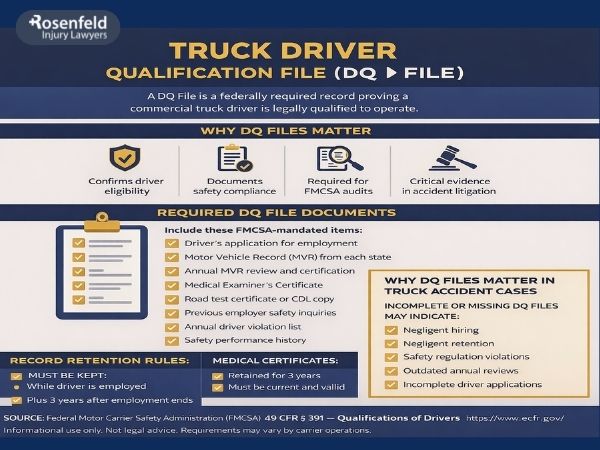
A Chicago truck accident lawyer must prove liability and negligence on behalf of both the driver and their employer. Typically, we establish truck accident negligence starting with the driver. We’ll review their motor vehicle record to determine whether they have a history of speeding, distracted driving, or failure to yield.
We’ll then conduct truck accident investigation into the employer’s negligence. According to the Illinois Supreme Court case McQueen v. Green, an employer can be both directly and vicariously liable for a trucking accident. This means they can be liable because their employee caused the injury and failed to prevent it due to negligent hiring, training, or supervision.
For example, if the employer’s drug testing records are incomplete, this would suggest negligent supervision and violation of federal regulations. We’ll demonstrate that this failure to comply with testing standards caused the crash.
Our Chicago traffic crash attorneys are Super Lawyers®, nationally recognized for our passionate legal advocacy and 98% success rate. We will thoroughly investigate your claim and ensure negligent drivers are held liable for failing to prevent harm. With over 5,000 satisfied clients, we are considered the best truck crash attorneys in Chicago.
We work on a contingency fee basis: no fees unless we win. Contact us today for a free consultation about your legal claim.