
100% Focus on Your Recovery,
Chicago Auto Accident Lawyer
Chicago Auto Accident Lawyer
Our Team of Attorneys Are Committed to Maximizing the Value of Your Case



Commercial truck drivers diagnosed with severe sleep apnea can cause fatal accidents, especially on busy Chicago highways like the Stevenson Expressway or the Tri-State Tollway. Department of Transportation (DOT) sleep apnea trucking regulations require that drivers diagnosed with this disorder must be medically qualified to drive, or they may have their commercial driver’s license revoked.
If you were in an accident with a sleepy truck driver, we can help you explore your legal options. Contact us today for a free case review about a sleep disorder-related truck crash.
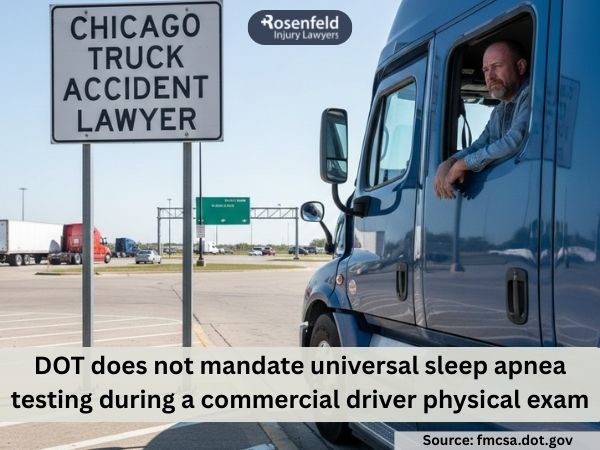
According to the Federal Motor Carrier Safety Administration, the FMCSA regulations do not address sleep apnea. A sleep apnea diagnosis does not automatically disqualify a driver, especially as this condition can be successfully treated.
However, every driver is required to have a yearly DOT physical exam, performed by a qualified medical examiner (49 CFR 391.41). Illinois CDL requirements echo this, mandating that all drivers have a valid medical examiner’s certificate (Ill. Admin. Code tit. 92, § 1030.22).
The DOT physical assesses a driver’s medical fitness, including sleep quality. Anything that could impact the driver’s ability to operate a commercial motor vehicle safely may lead to their disqualification, including untreated sleep apnea.
Not every driver receives a sleep apnea test during their DOT physical. Rather, the examiner will order further testing for those who have increased risk factors, symptoms of major sleepiness, a family history of obstructive sleep apnea, or a medical history of severe fatigue.
The medical examiner may order any tests they deem necessary to ensure the driver can safely meet all physical requirements of the job (49 CFR 391.41).
The DOT physical is a comprehensive exam that evaluates medical conditions that may interfere with safe driving (49 CFR § 391.43).
It begins by reviewing the applicant’s personal medical history and physical condition, such as a history of heart disease, high blood pressure, or obesity. The healthcare provider may also ask about the driver’s mood, sleep quality, and smoking habits. Other clinical signs, like a neck width larger than 17 inches or a small upper airway, may also prompt the clinician to order a sleep apnea test.
If the provider suspects sleep apnea, they will order sleep apnea tests to confirm the diagnosis. According to the Mayo Clinic, an at-home sleep test often does not provide a clinical diagnosis, so many clinicians order a sleep study at a hospital instead.
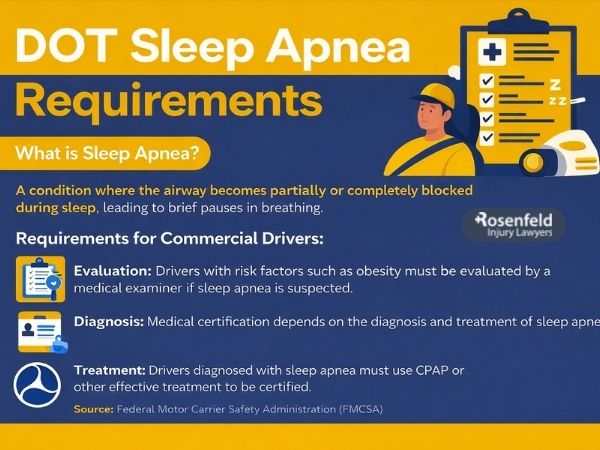
Commercial vehicle operators prove they have been treated successfully before they can be medically qualified to drive.
Continuous Positive Airway Pressure (CPAP) machines are the primary treatment for sleep apnea. CPAP therapy uses a mask with higher air pressure than the surrounding environment, which keeps the airway open and can lead to better sleep. This device must be used every night to treat the condition properly.
Unfortunately, many patients find PAP devices cumbersome, which may lead to treatment discontinuation. Drivers must discuss treatment options with their provider and select the option that is right for them.
Some cases of sleep apnea are caused by poor jaw alignment, which is more common among people with smaller neck sizes who still snore. Oral device treatment uses a mouth guard to move the jaw forward, keeping the airway clear. Many with milder sleep apnea find these devices less invasive and are more likely to continue treatment.
Because CPAP machines are considered the gold standard of sleep apnea treatment, drivers who choose oral devices must prove that their medical examiner approved the device and that their condition is being effectively treated with this intervention.
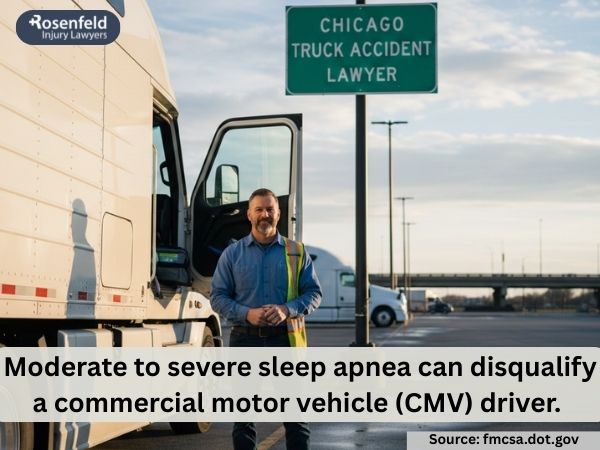
Even if a driver passes their first DOT physical, they must maintain their fitness and continue to undergo exams. The typical DOT medical card expires every 24 months, but those with health conditions like sleep apnea may need yearly physicals instead.
Concentra notes that drivers with sleep apnea must prove that they use a CPAP for at least 4 hours a night on 70% of all nights to maintain compliance. They may receive a 3-month conditional certification, extended to a 1-year certification if they continue treatment. If they have maintained compliance over the past few years, they may be able to graduate to a biannual DOT physical.
Sleep apnea is a disorder that causes a person to stop breathing for up to 10 seconds at a time. In severe cases, a person can stop breathing up to 400 times during their sleep.
The FMCSA reports that up to 28% of commercial drivers are diagnosed with sleep apnea. The National Sleep Foundation reports that obstructive sleep apnea (OSA) is the most common form of sleep apnea, which includes truck drivers.
OSA occurs when the muscles at the back of the throat relax, narrowing or collapsing the airway. The brain then sends an alarm signal, forcing the person to wake up briefly. The other form is central sleep apnea, in which the brain stops sending signals to breathe, and it is much less common.
Both forms of sleep apnea can severely increase the risk of a motor vehicle accident because they cause excessive sleepiness. When a person is being woken up dozens of times at night, they will have delayed reaction times, and they may even fall asleep while driving. Concerningly, over half of commercial drivers report falling asleep while driving at least once.
Drowsiness can mean a lack of fine motor control, sound judgment, and alertness. These are crucial for managing the constantly changing conditions on busy motorways such as the Eden Expressway, or navigating complex lane changes around areas like O’Hare Airport.
An experienced truck accident lawyer in Chicago will conduct a comprehensive investigation, including identifying any conditions that may have contributed to the crash.
The trucking company’s driver qualification file includes details on the driver’s medical certificate, treatment plans, history of moving violations, and any disciplinary actions that the company may have taken for non-compliance. We can show that the driver was aware of a condition that prevented safe driving, but refused to follow their treatment plan. We’ll also work with experts who can explain how sleep apnea increases the risk of accidents.
The Illinois Supreme Court ruled in McQueen v. Green that a trucking company can be held vicariously and directly liable for truck accident negligence, a decision that has significantly affected the Illinois trucking industry. This means it is possible to sue the company for its driver’s role in the accident and for its knowledge of the driver’s poor sleep apnea test results.
During our truck accident investigation, we will use personnel files and internal communications to show that the employer was aware of the issue but chose not to enforce treatment plans.
As Illinois has a two-year statute of limitations for personal injury (735 ILCS 5/13-202), contact us immediately for a free initial consultation about your claim.
A Chicago traffic crash attorney from our firm is here to support you after a truck accident through thorough investigations of all potential contributing factors. We will handle all third-party communications on your behalf so that you can focus on healing rather than negotiating with insurance companies.
We have worked with over 5,000 clients across the past 25 years, maintaining a 98% success rate thanks to our compassionate legal advocacy and client-focused approach.
Our firm has an A+ rating with the Better Business Bureau and works on a contingency fee basis: no fees unless we win. Contact us today for a free consultation about your legal claim.