
100% Focus on Your Recovery,
Chicago Auto Accident Lawyer
Chicago Auto Accident Lawyer
Our Team of Attorneys Are Committed to Maximizing the Value of Your Case



In 2023, the Illinois Department of Transportation reported 2,278 tractor-trailer accidents in Chicago, some of which may have been caused by vehicle defects. To improve road safety, all truck drivers are required to complete a CDL pre-trip inspection checklist, and failure to do so may result in civil liability.
If you were in an accident caused by commercial vehicle defects, our attorneys can assist. Contact us for a free consultation about your claim.
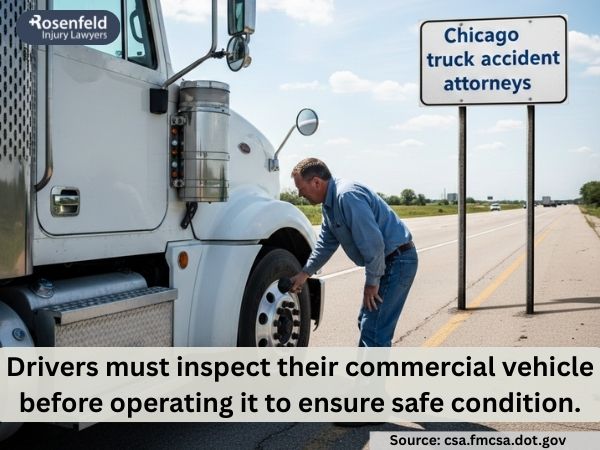
Trucking laws and regulations require every commercial truck driver to complete a mandatory CDL pre-trip inspection checklist before starting to drive (49 CFR 396.13). This ensures everything is working properly and no vital components are missing.
Failure to complete this checklist is a common cause of truck crashes, which are far more likely to result in catastrophic injuries than a passenger vehicle collision. Both drivers and their employers have a legal obligation to perform pre-trip inspections and may be held liable in a Chicago truck crash lawsuit if they do not.
The pre-trip inspection must be filled out with the vehicle’s company number, make, model, serial number, year, and tire size (49 CFR 396.3). The driver should inspect the following elements.
Fluid Levels: Like passenger vehicles, trucks use oil, coolant, and power steering fluid. The fluid levels must be at the proper level before beginning any trip.
Hoses and Lines: The brake hose and air lines should not be cracked, loose, or leaking.
Belts: Truck engines use serpentine and timing belts to ensure power to components like alternators, water pumps, and power steering. Drivers must check that they are not missing, worn, or cracked.
Fire Extinguisher: Truck fires can be devastating due to the huge amount of fuel and the potential for hazardous material leakage. Every driver is required to have a securely mounted and charged extinguisher on board (49 CFR 393.95).
Next, the driver inspects the brakes (49 CFR 393.40), tires, and wheels. Critical elements include the following.
Brake Pads: These slow the vehicle and are highly prone to wear because of a truck’s enormous size. Drivers must ensure they are not excessively worn.
Brake Hoses and Air Lines: Most semi-trucks use air brakes, which use compressed air to push down the brakes. Leaks can force the air brakes to automatically engage, potentially causing pileups. Drivers must ensure there are no visible leaks.
Brake Lights and Turn Signals: These are key for communicating with other drivers. A truck that unexpectedly turns may sideswipe or crush a passenger vehicle, while unexpected stops could result in a rear-end collision. Drivers should turn each one on and verify that it illuminates properly.
Tires: Blowouts are a common factor in truck crashes. They may not be properly pressurized, or they might pick up road debris that shreds them. Before starting, drivers should ensure each one is intact, free of debris, and has the proper tread depth (49 CFR 393.75).
Rims: Rims should be secure, with the correct number of lug nuts tightened. There should be no cracks (49 CFR 393.205).
This system plays a key role in preventing crashes, as broken or missing suspension systems can contribute to rollovers or loss-of-control accidents. Following their checklist, the driver should ensure the following elements (49 CFR 393.207).
Suspension Components: Suspension systems include spring hangers, shock absorbers, and mounts that allow the truck to distribute its massive weight without causing drag. Drivers must check that these elements are intact, or the trailer could suddenly drop.
Landing Gear: These retractable support systems hold a trailer’s weight when it is uncoupled. If they are cracked or missing, the trailer may drop, potentially crushing a cargo loader. Drivers should ensure that they are properly mounted and retracted before starting their route.
Vehicle Frame: A damaged frame might cause structural failure, which can cause the driver to lose control. Operators should visually inspect the frame to ensure there is no rust, cracks, or other damage.
Excessive Play: All moving parts should have a full range of motion without slipping, twisting, or coming loose.
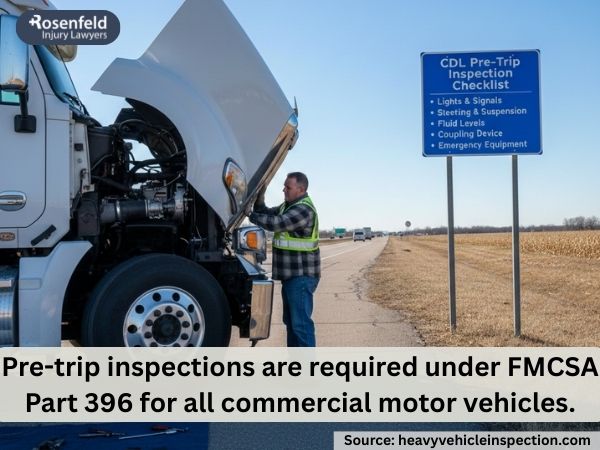
Drivers cannot begin their trip if any part of the vehicle fails the pre-trip inspection (49 CFR 392.7). While this includes mechanical elements, it also consists of the required safety and emergency equipment that must be on board. FMCSA regulations require the following safety equipment to be in working order (49 CFR 393.95).
Seat Belts: There should be one belt for each person on board, and it should fit snugly over the occupant. Each belt should retract properly and have no frays or tears.
Windshield: Because trucks often operate in hazardous conditions, cracks from flying debris are common. The trucker should check for any visible damage before starting the trip.
Windshield Wipers: The rubber blades should be intact during inspection so that they can clean debris without leaving streaks.
Side Mirrors: Side mirrors are a crucial element of safety, helping drivers see around tight corners and avoid collisions with other motorists. Each one should be correctly adjusted.
Spare Fuses: If the truck uses fuses, there should be a full set of spares on board to enable quick maintenance if necessary.
On-Board Items: All items inside the cab should be secured to prevent interference with safe operation. The lights in the cab should also be working, and all on-board devices should be operational.
Lights and Reflective Tape: Trucks are required to have lights and reflective tape to improve safety during overnight trips. Truckers should check that all tape is securely attached, all lights are working, and that
In addition to conducting inspections, drivers must comply with HOS regulations, which govern the number of consecutive hours they may drive per day and per week (49 CFR Part 395). This is tracked by electronic logging devices, which are mandatory for all commercial drivers as part of the 2016 truck ELD mandate (RIN 2126–AB20).
Pre-trip inspections are considered part of on-duty time, but some drivers may rush them in order to complete their routes faster. Negligent safety inspections can be extremely dangerous, especially for components such as brakes, lights, and suspension. Failure to identify and address these issues may contribute to fatal crashes, potentially making both drivers and their employers liable.
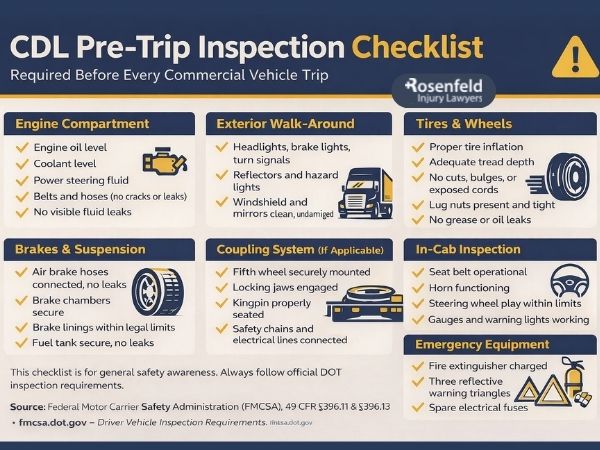
The inspection checklist is required by both state and federal law. Falsifying, skipping, or failing to fully complete the checklist can constitute truck accident negligence.
Our Chicago truck accident attorneys will subpoena these records as part of our truck accident investigation, then compare them with crash reports or reconstruction expert testimony to identify discrepancies. For example, if an investigation found that the air brakes failed, but the driver claimed the pads were functional during the inspection, this could suggest the driver breached regulations by operating an unsafe truck.
According to McQueen v. Lavonta M. Green, a trucking company can be both directly and vicariously liable in a personal injury case. This means that we could hold the company liable both for its employee’s actions, but also for negligent supervision.
We’ll review previous inspection reports to see if there was a history of falsifying records or sending out malfunctioning trucks. If the report documented these issues and the company required the driver to complete the route regardless, this could be strong evidence of negligence.
Proving liability strengthens your case and provides us with a solid foundation from which to negotiate for a fair settlement. We will carefully evaluate your damages, including medical expenses, lost wages, and property damage, and then consider non-economic damages such as loss of normal life and emotional distress. With clear evidence of negligence, we can seek higher compensation.
While many truck crash cases are settled out of court, we are proud members of the Illinois Trial Lawyers Association with a 98% success rate. Our team will present the inspection reports to a judge and jury, explaining how the evidence supports a finding of negligent inspection and maintenance.
Our Chicago traffic accident attorneys have a combined 100 years of legal experience and have helped over 5,000 clients get justice over the past 25 years. We are members of the Million Dollar Advocates Forum, having secured over $450 million in positive settlements and verdicts for injury victims.
We understand that a truck crash is overwhelming for victims, which is why we handle all third-party communications and investigations on your behalf. We will thoroughly examine all records, coordinate with the trucking company, and manage all documentation so that you can focus on recovery.
We work on a contingency fee basis: no fees unless we win. To schedule your free case evaluation with a caring Chicago truck crash lawyer, contact us today.