
100% Focus on Your Recovery,
Chicago Auto Accident Lawyer
Chicago Auto Accident Lawyer
Our Team of Attorneys Are Committed to Maximizing the Value of Your Case



If you’re wondering what to do at the scene of a truck accident in Chicago, especially a collision involving a large commercial truck and your passenger vehicle, what you do in those first moments can have meaningful impact on your health and future truck accident case.
At the accident scene, we know you’re likely feeling shaken, worried about serious injuries or property damage, and unsure where to begin. We stand with you and want you to feel supported and informed so you can protect yourself, your loved ones, and your legal rights.
Our Chicago-based team of attorneys understands how overwhelming a truck crash can be, from dealing with emergency services, insurance companies, and insurance adjusters to worrying about your medical care and mounting medical bills.
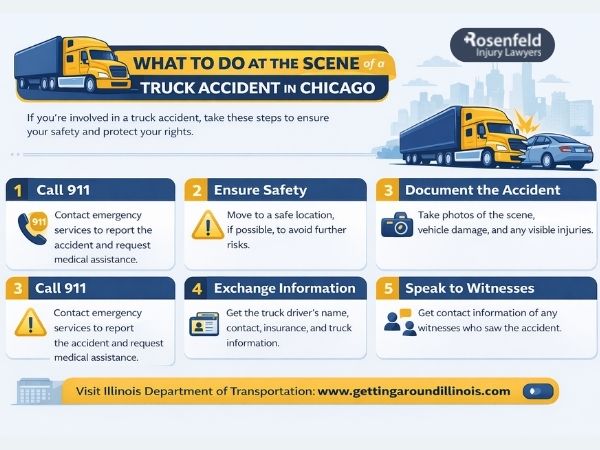
Below is a step-by-step guide to help you stay safe, comply with legal requirements, and lay the groundwork for a potential civil lawsuit.
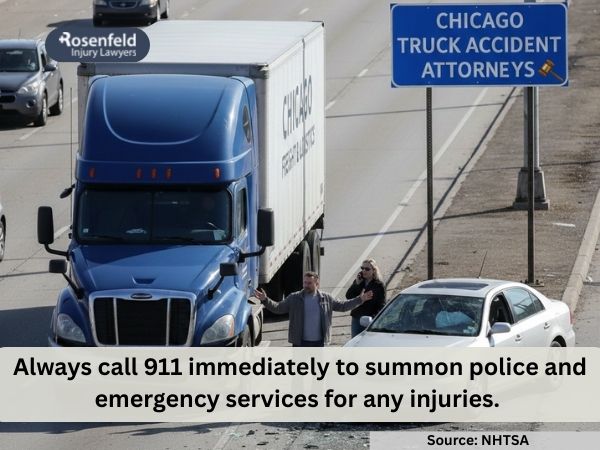
First and foremost, make sure you and everyone else at the accident scene is safe. If anyone is injured or you suspect injuries, even if they seem minor, call emergency services immediately and seek medical attention without delay.
Many injuries from truck collisions, including internal bleeding, head trauma, burn injuries, and spinal injuries, may not be immediately obvious. A prompt medical evaluation with a trusted medical professional ensures you get the care you need and creates a critical record of your injuries, which is essential if you later pursue legal action.
Once medical treatment is secured, call the police so that an official accident report can be taken. Police involvement ensures that the collision is documented independently, and the police report may contain crucial facts such as statements from the truck driver, observations about the crash, and details about all vehicles involved.
In serious crashes, police typically conduct a truck accident investigation at the scene, collecting preliminary evidence and documenting conditions that might help establish fault later on.
If you are able, start gathering evidence at the scene. This includes:
This critical evidence helps your legal team reconstruct what happened and can make a substantial difference in assessing fault and liability. Promptly gathering physical and digital evidence also protects against loss or degradation of information that may be crucial to your claim.
At the scene, exchange insurance information and contact details with other drivers, including the truck driver and any occupants of other vehicles. Be sure to get:
If there are witnesses, get their names and phone numbers, too. Their accounts can bolster your credibility later when insurance companies and adjusters review the claim.
It’s very important at the accident scene, and in communications with any insurance companies, that you avoid admitting fault or make statements that could be interpreted as taking blame. Even well-meaning comments like “I’m sorry” can be used by insurers to minimize or deny your insurance claim.
Insurance companies often look for any reason to discount your injuries or argue contributory negligence. Instead, stick to the facts and let your legal team handle sensitive negotiations on your behalf. Do not speculate about what caused the crash or accept blame, even if you are unsure.
Soon after the accident, it’s wise to consult a qualified truck accident lawyer. Truck accident liability is a complex area that often involves multiple parties, such as the driver, the trucking companies, and sometimes equipment manufacturers, maintenance contractors, loaders responsible for cargo, or other involved parties.
Commercial vehicle cases are treated differently than car accidents under both insurance policy claim protocols and civil litigation. For example:
An experienced truck accident attorney helps ensure that your rights are protected, your injuries are fully documented, and your legal claim is positioned to recover all appropriate compensation.
We understand that you’re not just another file number, you’re a person who has faced a sudden, often traumatic event through no fault of your own. You and your family deserve compassion, clarity, and strong legal support. As some of the best truck accident lawyers in Chicago , our team brings real results and a supportive approach.
Here’s why other clients trust us with their truck accident cases:
Our Chicago personal injury attorneys have consistently received recognition, memberships, and awards from prestigious organizations, a testament to our commitment to clients and the legal community, including:
After you leave the scene and begin recovery, be sure you understand the legal deadlines that apply to your case. Under Illinois law, the statute of limitations for most personal injury cases, including injuries from a truck accident, requires that a lawsuit be filed within two years after the date your cause of action accrued. This is codified in 735 ILCS 5/13-202. If you miss this deadline, you may lose your right to pursue litigation in court, even if your injuries are severe.
Filing an insurance claim with the trucking company or other insurer is important, but it does not stop or extend the statute of limitations for filing a lawsuit. A claim does not substitute for timely legal action if you later need to file suit to recover compensation.
Speaking with us promptly ensures that we can protect your rights, including monitoring deadlines, preparing paperwork, and pursuing civil action within the required timeframes.
You deserve trusted guidance after a life-altering truck crash. Our dedicated team of traffic accident lawyers is here for you, every step of the way.
From helping you understand your medical records, to negotiating with insurance companies and adjusters, to pursuing a personal injury lawsuit on a contingency fee basis, meaning you pay no attorney fees unless we recover compensation for you.
Contact us for a free consultation so that your voice is heard, your concerns are taken seriously, and your rights are fully represented. We will:
You’re not alone in this process, we believe in your case, and we’re here to guide you toward recovery.