
100% Focus on Your Recovery,
Chicago Auto Accident Lawyer
Chicago Auto Accident Lawyer
Our Team of Attorneys Are Committed to Maximizing the Value of Your Case



Loose items falling from heavy vehicles on major Chicago thoroughfares like Halsted Street or Michigan Avenue can lead to deadly crashes and catastrophic injuries. FMCSA cargo securement guidelines are a cornerstone of trucking industry laws and regulations, and non-compliance could result in civil liability.
If you were injured in a transportation accident caused by negligent securement devices, our truck crash attorneys can help you seek justice. Contact us today for a free consultation about your legal rights.
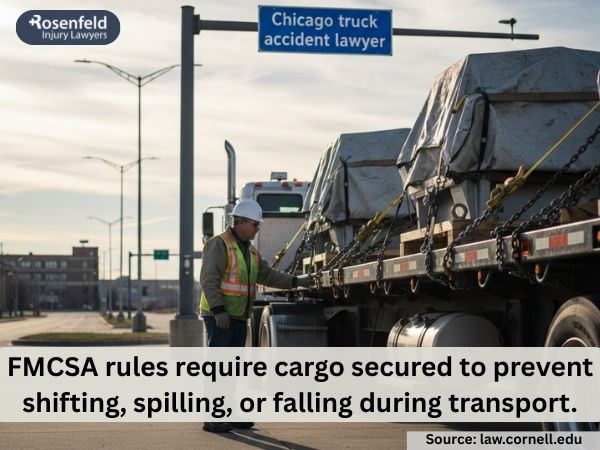
The Federal Motor Carrier Safety Administration requires that commercial motor vehicle loads be adequately secured to prevent cargo from shifting, falling onto the roadway, or injuring other drivers (49 C.F.R. Part 393, Subpart I). These general cargo securement rules apply to any vehicles engaged in interstate commerce, but Illinois applies the same general securement rules for motor carriers operating within its jurisdiction.
The FMCSA requires the proper use of cargo securement devices with properly positioned attachment points and anchor points (49 C.F.R. § 393.104).
The specific configuration depends on the type of cargo being transported. Common devices include tiedowns, chains, wire rope, cargo netting, or synthetic webbing. Cargo securement systems often incorporate several types of devices, which work together to secure cargo.
The working load limit (WLL) is the maximum load that an attachment device can safely restrain. All tiedowns must have sufficient WLL relative to the cargo weight, and exceeding the WLL violates cargo securement laws (49 C.F.R. § 393.106(d)).
The AWLL is the total strength of all cargo securement devices incorporated into the system. It is calculated by adding half the WLL of each tiedown that attaches to the vehicle.
FMCSA regulations require that the AWLL be at least 50% of the cargo’s total weight (49 C.F.R. § 393.106(d)(1)). For example, when securing heavy vehicles weighing more than 10,000 pounds, the minimum AWLL is 5,000 pounds.
There is also a minimum number of tiedowns based on the cargo’s length and weight. According to the FMCSA, there must be one tiedown if the article is less than 5 ft or 1,100 pounds, and two tiedowns if it is between 5 ft and 10 ft.
AWLL miscalculations are common violations that can result in serious accidents.
In addition to these general rules, the FMCSA has additional rules for specific types of cargo, including:
Heavy Vehicles or Machinery: At least four different tiedowns at opposite corners.
Metal Coils: Use edge protection to prevent abrasions on tiedowns. Block and brace the coils to prevent both forward and sideways movement.
Concrete Pipe: Place the pipe as compactly as possible. Prevent cargo from rolling using timber blocks or braces. Run tiedowns lengthwise or through the top pipes (49 CFR § 393.124).
Paper Rolls: Specific securement depends on the manner in which the rolls have been loaded, whether sideways or vertically. Use friction mats to prevent sliding and brace rolls with chocks (49 CFR 393.122).
Light Trucks: Use manufacturer-designed mounting points if permitted, and attach to the trailer at both front and back.
Intermodal Containers: Twist-locks, chains, or wire should be used at all four corners. The container should not interfere with the vehicle’s operation and may not extend more than 5 feet beyond the vehicle on any side (49 CFR § 393.126).
Lumber, logs, and similar building products have more specific cargo securement regulations, which are based on length. Dunnage, such as inflatable bags, must be placed in between logs to prevent cargo from shifting, while padding must be placed between straps and lumber to protect the securement devices from abrasion (49 C.F.R. § 393.118).
Failure to secure logs, pallets, and other materials can cause spills and serious crashes, as nearby vehicles on busy highways like the Tri-State Tollway may not react quickly enough to avoid falling lumber.
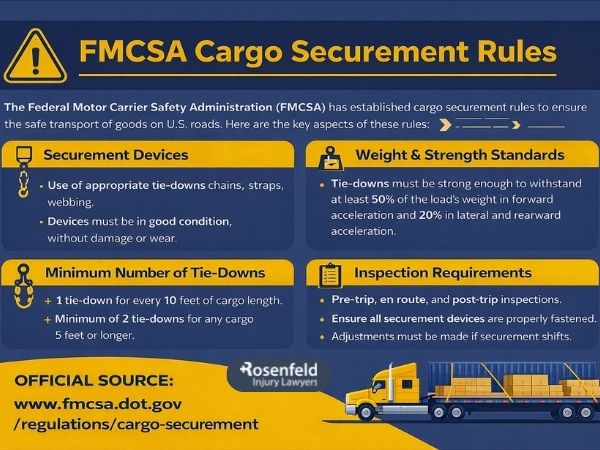
Cargo securement devices are essential for preventing serious accidents caused by shifting equipment and falling cargo. An unstable trailer could tip over on a corner, while a driver’s evasive maneuvers to avoid spilling items may result in a collision.
Each of these scenarios is preventable if drivers and their companies follow safety regulations. Sadly, many companies fail to consider public safety, resulting in serious injuries and long-term hospital stays.
Evidence of violations can establish negligence in truck accident cases. Drivers must verify that loads are secure before beginning their trip and regularly inspect cargo securement systems to ensure nothing has moved during transport (49 CFR §392.9).
Commercial motor vehicle carriers must follow all securement procedures for specific product types and maintain oversight of all vehicles. According to the Illinois Supreme Court case McQueen v. Green, they can be both directly and vicariously liable for a truck accident related to negligent cargo securement.
A Chicago truck accident lawyer from our firm will incorporate cargo securement rules into our truck accident investigation. We’ll determine whether the company used the appropriate securement devices for the load, calculate the WLL for each device, and analyze inspection records to verify that the driver performed the required pre-trip and trip inspections.
FMCSA regulations are complex, and while Illinois law typically harmonizes with federal regulations, there are sometimes exemptions and additional guidelines (Ill. Admin. Code tit. 92, § 558.40). As such, it is crucial to choose an attorney with significant experience handling cases like yours. This gives you the best chance of securing a fair settlement that covers all your medical needs.
If you have been in an accident with falling cargo, a Chicago traffic crash lawyer can help you explore your legal options and handle third-party communications so that you can focus on recovery. We have a 98% success rate and work on a contingency fee basis: no legal fees unless we win. Contact our Super Lawyers®-rated law firm today for a free consultation about your truck accident claim.