
100% Focus on Your Recovery,
Chicago Auto Accident Lawyer
Chicago Auto Accident Lawyer
Our Team of Attorneys Are Committed to Maximizing the Value of Your Case



Chicago’s busy highways, like the Dan Ryan Expressway, require drivers to be fully alert, especially if they are driving a large commercial motor vehicle. The Federal Motor Carrier Safety Administration (FMCSA) cell phone policy for CDL drivers prohibits truck drivers from using any hand-held mobile telephone while driving.
If you were in an accident with a truck driver using his or her mobile telephone, our law office is here to help. We will investigate the accident, determine whether distracted driving played a role, and help you explore your legal options. Contact an experienced truck accident attorney from our firm for a free consultation.
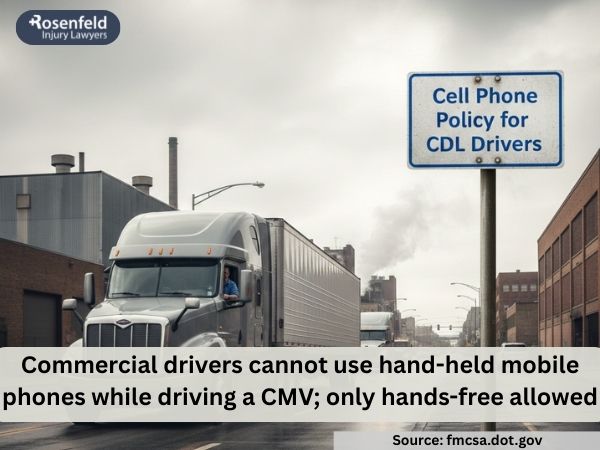
Trucking laws and regulations prohibit drivers from using a hand-held mobile phone while driving (49 CFR 392.82). FMCSA research found that commercial drivers who texted while driving were 23.2 times more likely to experience a safety-critical event, such as a crash, near-crash, or lane deviation. On average, a texting driver’s eyes are off the forward roadway for 4.6 seconds, which is about the length of a football field when driving at 55 miles per hour.
The mobile phone restriction rule is still in place when the truck is temporarily stationary, such as during traffic, at stop signs, or during other momentary delays. However, drivers required to call law enforcement officials or other emergency services may use their mobile phone (49 CFR 392.82).
While these are federal regulations, state and municipal statutes also prohibit the use of any handheld device.
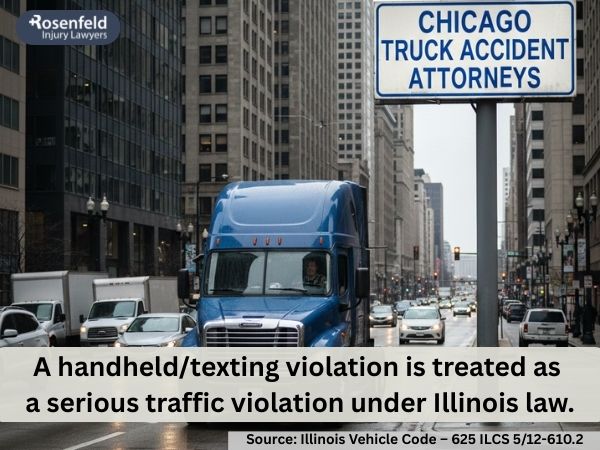
The Illinois Vehicle Code bars mobile phone use while driving for everyone, not just commercial motor vehicle operators (625 ILCS 5/12-610.2). In 2024, the law was updated to include video conferencing software like Microsoft Teams or Zoom, and it directly addresses social media like Facebook and Instagram. The Chicago Municipal Code also prohibits the use of any cellular device or mobile telephone while driving (9-76-230).
The FMCSA’s handheld mobile phone restriction rule covers cell phones, smartphones, and any other device used for communication or data.
The Federal Motor Carrier Safety Administration explains that a hand-held mobile phone is anything that meets the following elements:
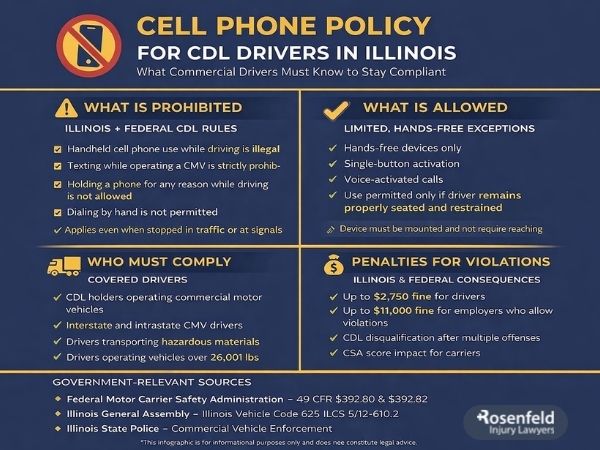
Texting while driving is completely prohibited under the cell phone policy for CDL drivers (49 CFR 392.80). This includes reading, writing, or sending any text-based communication from any device.
Multiple violations of the texting rule may result in driver disqualification, which revokes the offender’s commercial driver’s license. Employers can also face penalties up to $11,000 for allowing their drivers to text and drive. Texting while driving is a separate violation from using a hand-held mobile phone, meaning that drivers may receive multiple violations for the same act.
Commercial motor vehicle drivers can use a hands-free phone while driving only if it meets the following requirements:
Hands-free does not mean distraction-free, especially as pushing a button still requires taking one’s eyes off the roadway. Truckers who talk on the phone while driving can still cause accidents, even if their hands are on the wheel.
A hands-free phone must allow voice communication without holding the device, which is completely prohibited under FMCSA regulations (49 CFR 392.80). It should also require minimal manual interaction, such as pressing a single button.
One example of a hands-free device would be voice-activated tools like Alexa or Siri, which have a trigger word. A driver can engage the device without touching anything or taking their eyes off the road.
Trucking companies and motor carriers are legally required to ensure their drivers comply with cell phone policies. They must enforce written mobile phone rules and discipline those who violate them (49 CFR 390.11). Additionally, employers should train their drivers about federal law and perform periodic reviews to ensure compliance.
Many trucks now have cameras in the cab to monitor their drivers, so if the dispatchers notice distracted behavior, they should quickly intervene. If they fail to identify this dangerous form of distracted driving and the driver causes an accident, then they can be liable.
To prove liability, an experienced truck accident attorney in Chicago must establish negligence. This has four factors: duty of care, breach of duty, causation, and damages.
Duty of care means that the liable party had a responsibility to ensure others on the roadway were safe. This includes not texting or talking on the phone while driving. Breach of duty means that the party failed to uphold their duty, such as by reaching for a mobile phone while driving along the O’Hare-Elgin Tollway or checking the news while stopped on Michigan Avenue.
Causation is a key component of showing truck accident negligence. We must show that this breach of duty directly or indirectly resulted in the accident. In other words, we must not only prove that the individual broke the cell phone policy for CDL drivers, but that the accident would not have happened without this breach. Finally, we must demonstrate that you suffered from economic or non-economic damages as a result of the crash.
During our truck accident investigation, we will gather evidence that the driver and their company violated the mobile phone policy. This can include cell phone records, data logs, dashcams, and witness statements. Cell phone logs are often the most valuable form of evidence, as they can prove the phone was in use right before or during the crash.
Companies can be both vicariously and directly liable when their employees cause an accident, as per the Illinois Supreme Court case McQueen v. Lavonta M. Green. Vicarious liability is established by proving that the driver had a relationship with the employer, but direct liability requires proving that the company created an environment that made an accident more likely to occur.
Common forms of direct liability in truck accident cases include negligent hiring, training, or supervision. We can use company policies and driver qualification files to prove that the trucker had a history of moving violations or had been previously disciplined for the same issue.
By demonstrating that the negligent driver violated federal law, we can pursue a fair settlement that covers all your needs. We will carefully evaluate your damages, such as medical bills, lost wages, property damage, and emotional distress. Insurance companies may be more willing to settle out of court if it is clear that their client violates FMCSA regulations, thereby ensuring prompt compensation.
Under Illinois law, truck accident victims have two years to file a personal injury lawsuit (735 ILCS 5/13-202). Wrongful death claims also have a two-year statute of limitations (740 ILCS 180/). Contact us immediately to ensure we have time to review your claim.
A Chicago traffic crash lawyer from our firm will thoroughly review your case and uncover strong evidence that the driver was violating the cell phone policy for CDL drivers, which improves your chance of receiving the funds you need to heal.
We are a Super Lawyers® firm with a perfect 10/10 AVVO rating, known for our compassionate and client-centered approach. You will receive personalized care from our award-winning attorneys, who will manage all third-party communications so that you can focus on recovery. We work on a contingency fee basis: no fees unless we win.
Contact us today to schedule a free consultation with our personal injury attorneys.