
100% Focus on Your Recovery,
Chicago Auto Accident Lawyer
Chicago Auto Accident Lawyer
Our Team of Attorneys Are Committed to Maximizing the Value of Your Case



Truck accident investigations are one of the most important steps after a serious truck accident in Illinois. When an accident involving commercial trucks occurs on Chicago streets or Illinois highways, the path to answers, accountability, and recovery often begins with a thorough investigation. At our Chicago-based firm, we work closely with victims and their families to understand how the collision occurred, why it happened, and who should be held responsible.
Unlike ordinary traffic accidents, truck accidents often involve severe injuries, extensive property damage, and complex safety regulations. Because of a truck’s size, weight, and stopping distance, even a single mistake can have life-altering consequences. That’s why truck accident investigations must be handled carefully, quickly, and with a deep understanding of trucking operations, federal motor carrier safety rules, and Illinois law.
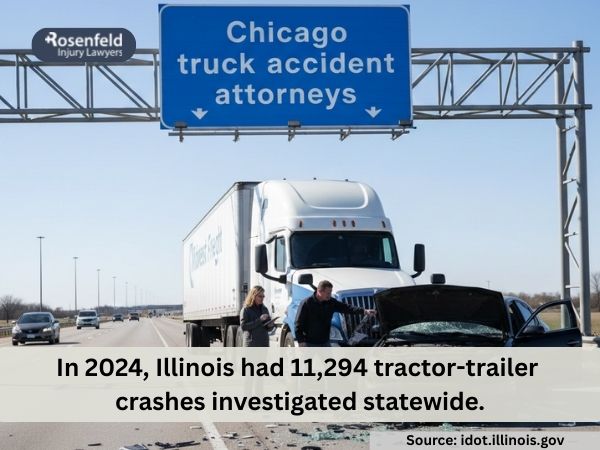
Many people ask how truck accident investigations work and why they feel so different from typical accident investigations. The answer is simple: truck accidents are more complex, involve more evidence, and often include multiple parties trying to protect themselves.
In a standard car accident, law enforcement officers typically respond to the accident scene, write a police report, and insurance companies review statements and vehicle damage. In a truck accident case, that process expands significantly. Commercial vehicles are regulated by both state and federal agencies, and trucking companies often launch their own investigations immediately after a crash.
Truck accident investigations may be conducted by several different entities at the same time, and the scope of the truck accident investigations conducted often depends on who is leading the process and what interests they are protecting.
This can include:
It’s common for multiple accident investigations to happen simultaneously after a collision. While insurance companies and trucking companies often look for ways to minimize payouts or avoid liability, our own investigation is designed to establish truck accident negligence and uncover the truth.
Truck accident causes are rarely limited to a single error. Most truck accidents involve overlapping failures related to drivers, vehicles, maintenance, loading, or truck safety violations. A strong investigation process looks at all of these key factors together.
Below are the core components of a thorough truck accident investigation.
Physical evidence at the crash site often tells the story of how the accident occurred. We work quickly to collect evidence and preserve it before it disappears. This may include skid marks, debris patterns, vehicle damage, and roadway conditions. Evidence collection from the accident scene can help accident reconstruction experts determine how the incident occurred, vehicle speed severity, braking behavior, and points of impact.
Because commercial transport trucks travel long distances, tire marks and other evidence may be spread across a large area. Preserving this information early is crucial.
Most commercial trucks are equipped with an event data recorder, often referred to as a black box. This device records vital information in the moments before and after a crash occurred. The information recorded and included in a truck’s black box data may include vehicle speed, braking input, throttle position, engine RPMs, and seatbelt usage.
Reviewing black box information helps us understand what the truck driver was doing seconds before the collision happened. Trucking companies may try to access or overwrite this data quickly, which is why immediate action is so important.
Witness statements can provide critical insight into how the accident happened. We identify and interview witnesses who saw the crash happen, including other drivers, pedestrians, passengers, and nearby workers or residents. Witness testimony may confirm unsafe driving behaviors, sudden lane changes, speeding, or driver fatigue.
Police officers often collect initial witness reports, but our independent investigations can uncover additional witnesses who were not included in the police report.
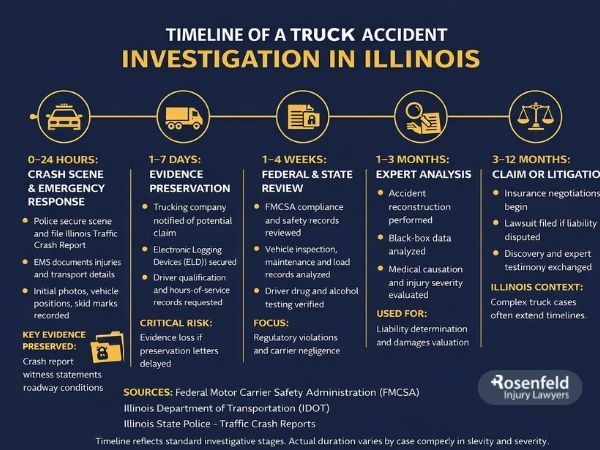
Commercial trucks are subject to regular inspections under mandatory safety regulations. Reports issued after an inspection can reveal mechanical issues, worn brakes, tire problems, or lighting failures that contributed to the crash. We review pre-trip and post-trip reports, roadside inspection records, and maintenance logs to identify safety compliance failures and patterns of neglect.
A truck driver’s records and commercial driver’s license history can reveal prior collisions, safety violations, or alcohol testing issues. We also examine whether the driver was properly licensed to operate the commercial vehicle involved and whether the trucking company allowed unsafe drivers on the road.
Accident reconstruction experts use physical evidence, black box information, vehicle damage, and scene measurements to recreate how the collision occurred. This scientific analysis helps explain what happened, why it happened, and whether the crash could have been prevented.
Reconstruction is especially important when trucking companies dispute fault or attempt to blame other motorists.
Truck accident victims often find themselves dealing with mounting medical bills, missed work, and the need for ongoing treatment or rehabilitation. As part of the investigation process, we assess damages using medical records, treatment plans, and expert opinions. This ensures that the full impact of the crash is documented, not just the immediate injuries.
Truck accident liability is rarely limited to the truck driver alone. Liability may extend to trucking companies, truck manufacturers, cargo loaders, maintenance contractors, or other motorists involved. In some cases, a vehicle manufacturer creates a defective part that contributes to mechanical or brake failures.
Identifying all liable parties is essential to protecting our clients’ rights and pursuing a fair truck accident claim.
Choosing the right legal team matters after a serious truck crash. Our top-rated truck accident lawyers in Chicago bring decades of experience, the firm’s extensive resources, and a client-first approach to every case we handle. We don’t rush investigations or rely solely on insurance company findings. We conduct our own investigation and build each case on detailed documentation and crucial evidence.
Our results and experience speak for themselves:
Our best Chicago personal injury attorneys are consistently recognized for their professionalism, ethics, and advocacy by respected legal organizations, including:
We believe strong cases are built through trust, transparency, and thorough investigation. We stand with our clients from the moment the incident happened through resolution.
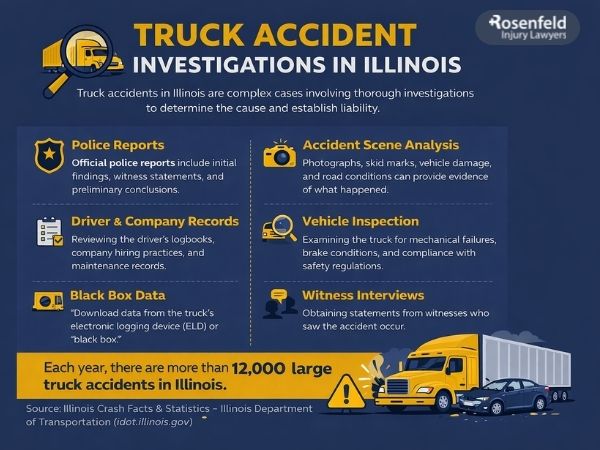
Under 735 ILCS 5/13-202, most truck accident victims have two years from the date the accident occurred to pursue legal action for personal injury. Failing to file within this time limit may permanently bar a claim. Because investigations take time and evidence can disappear, we encourage clients to speak with a truck accident lawyer as early as possible.
Driver fatigue is a common factor in truck crashes. We prove fatigue by examining driving logs, electronic logging data, witness testimony, and delivery schedules. Evidence of HOS violations (hours-of-service violations) can show that a truck driver exceeded legal driving limits, ignored rest requirements, or felt pressure from trucking companies to keep driving.
Under 735 ILCS 5/2-1116, known as Illinois’ modified comparative negligence rule, the law limits how much a truck accident victim can recover based on fault. If a judge or jury finds that your own contributory fault was more than 50% of the proximate cause of the injury or damage, you cannot recover any damages.
If your fault is 50% or less, you can recover damages, but the total award is reduced in proportion to your share of fault. That means if you were found 20% at fault, your recovery would be reduced by 20%. This rule applies to negligence-based injury, death, and property damage claims, including those arising out of truck accidents.
When a truck crash turns your life upside down, you deserve guidance, answers, and support. As experienced traffic accident attorneys, we assist our clients at every stage of the case, from gathering evidence and managing truck accident investigations to negotiating with insurance companies and preparing for litigation if needed.
We offer a free consultation, and we work on a contingency fee basis, meaning there are no upfront costs and no legal fees unless we recover compensation for you. If you or a loved one was injured in a truck accident, contact us today. We’re here to listen, explain your options, and help you move forward.