
100% Focus on Your Recovery,
Chicago Auto Accident Lawyer
Chicago Auto Accident Lawyer
Our Team of Attorneys Are Committed to Maximizing the Value of Your Case



At our law firm, we represent people who’ve been injured in pedestrian crossing accidents in Chicago. Whether the accident occurred near a busy downtown intersection or a quieter neighborhood crosswalk, these incidents often lead to long-term consequences. We’re here to guide you through your legal options with experience and determination.
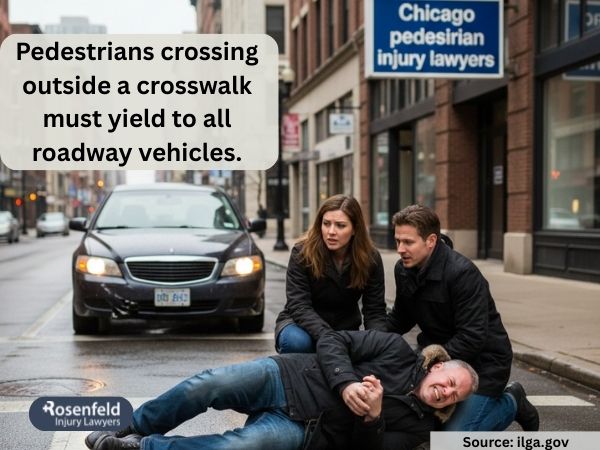
These include continental (zebra-stripe), parallel line, and ladder-style crosswalks. Chicago relies heavily on high-visibility continental markings in high-injury areas.
Legally present at every intersection in Chicago, even when not painted. Pedestrians retain right-of-way protections under Illinois law.
Includes standard pedestrian signals, countdown timers, and Leading Pedestrian Intervals (LPIs), which give pedestrians a head start before vehicles can move.
Intersections governed by stop signs. Common in residential neighborhoods where pedestrian traffic is frequent.
Crossings placed between intersections, often paired with enhanced visibility features when blocks are long or transit stops are nearby.
Raised central islands allowing pedestrians to cross one direction of traffic at a time; widely used in Vision Zero redesigns.
Pedestrian-activated hybrid beacons that remain dark until activated, then cycle through yellow and red phases to halt traffic.
Mid-block or unsignalized crossings with bright flashing yellow lights activated by a pedestrian push button.
Enhanced crossings near schools featuring pavement markings, signage, flashing beacons, and sometimes crossing guards.
Crossings designed to improve access to CTA bus stops, Metra stations, and rapid-transit corridors, often paired with refuge islands or LPIs.
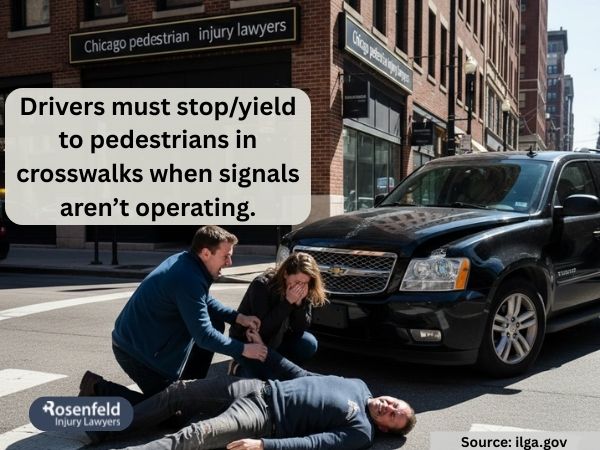
Chicago’s Municipal Code spells out the rules for both pedestrian use of city streets and the responsibilities of drivers. Several sections in Chapter 9-60 directly address pedestrian crossings, especially at intersections and marked crosswalks:
In general, pedestrians must obey walk signals and traffic signs, avoid jaywalking, and use sidewalks where available. At the same time, drivers must remain alert and watch for pedestrians, particularly near crosswalks, intersections, and transit zones.
At the state level, the Illinois Vehicle Code (625 ILCS 5/) reinforces pedestrian safety. Key protections include:
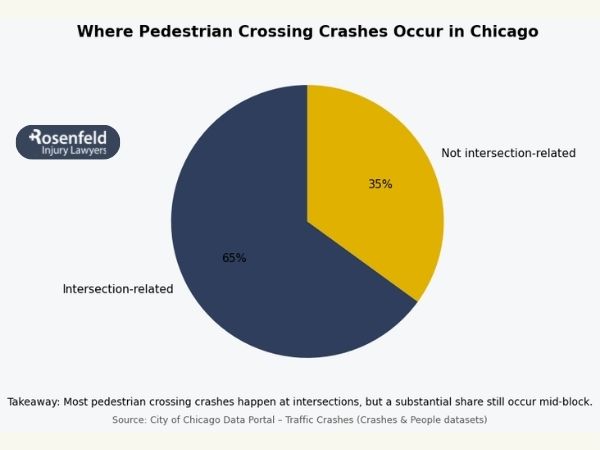
Many pedestrian accidents occur because drivers fail to follow basic traffic laws or pay attention near crosswalks. One of the leading causes of pedestrian crashes is drivers ignoring traffic signals or failing to yield the right of way at marked crosswalks. Left turns at intersections are especially dangerous, as drivers may focus on oncoming cars and miss people in the crosswalk. Other frequent issues include speeding, distracted driving, and poor visibility due to bad weather or darkness. Pedestrians are also at higher risk when drivers don’t slow down in areas with more pedestrians, such as near schools or transit stops. In some cases, pedestrians stepping into traffic outside of a crosswalk can also contribute to the crash.
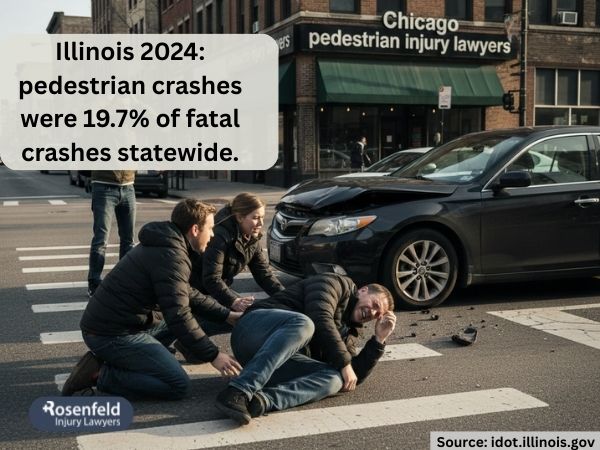
Pedestrian crash injuries often involve broken bones, head trauma, spinal injuries, and internal damage. In more severe cases, victims may face permanent disability or long-term mobility issues. Even when vehicles are moving at lower speeds, the impact can cause severe injuries. Recovery often involves extended medical treatment, physical therapy, and time away from work or daily activities.
Liability for a pedestrian accident often depends on who failed to follow traffic laws or created a hazard. The following parties may be held responsible:
Taking the proper steps after being injured in a crosswalk can make a significant difference in the outcome of your personal injury claim. Here’s how to protect your rights and build a stronger case:
Our Chicago pedestrian injury attorneys focus on representing people hurt in crosswalks throughout the city. From the start, we work to preserve evidence, identify all sources of liability, and pursue full compensation for medical expenses, lost income, and future care needs. Whether the driver ignored a traffic sign, failed to yield the right of way, or wasn’t paying attention, we build strong claims backed by facts. We’re here to guide you through your personal injury claim and help protect your legal rights every step of the way.
According to Law.com’s VerdictSearch, compensation in pedestrian crosswalk accidents in Chicago varies widely, with settlement and verdict amounts ranging from $4,124 to over $22.5 million. The average award is $1,692,633, while the median settlement is $162,298.
Several factors influence the value of pedestrian injury settlements:
These claims often involve severe injuries and clear liability, especially when a vehicle strikes someone who is following the law while trying to cross the street.
$22,583,253 Verdict for Child Struck Outside Snow-Covered Crosswalk in Harvey, IL
Roe Ann Lockhart, a 12-year-old girl, was crossing Dixie Highway near 150th Street in Harvey when she was struck by a YMCA van traveling at 15 to 20 mph. Although the defense argued she crossed outside a marked crosswalk and ignored traffic controls, her attorneys explained the crosswalk was blocked by snow, forcing her to cross nearby. Roe Ann suffered a traumatic brain injury that left her permanently disabled and dependent on round-the-clock care. The jury found the YMCA of Metropolitan Chicago 70 percent liable and awarded $22.5 million in damages, which was later reduced to $15,808,277 due to comparative fault. Her award included compensation for future medical care, lost earning capacity, disability, disfigurement, and pain and suffering.
$11,433,190.33 Verdict for Pedestrian Hit After Exiting CTA Bus on Lake Shore Drive
Francoise Gordon, a 20-year-old college student, was struck by a Cadillac while trying to cross the street in front of a stopped CTA bus at Lake Shore Drive and Waveland Avenue during rush hour. She suffered a severe brain injury, leg fractures, and lasting neurological damage, leaving her with tremors, memory loss, and limited ability to care for herself. Gordon sued the driver and the CTA, alleging the driver failed to yield in a pedestrian-heavy area and that the bus created a visual obstruction by lingering at the stop. The jury found the driver 53 percent at fault and the CTA not liable. Gordon was found 47 percent at fault, reducing her total award of $11.4 million to $6,059,590.87. Her recovery included compensation for medical care, a full-time caregiver, lost income, and permanent physical and cognitive disabilities.
$493K Jury Award for Man Struck in Chicago Crosswalk
Daniel Murga, a 30-year-old ambassador for a catering company, was hit by a left-turning driver while walking through a crosswalk in Chicago. He suffered a concussion, nerve damage, soft tissue injuries, and a crush injury to his foot, which kept him from returning to work and led to a year-long recovery. The defense argued he stepped into traffic while distracted, but Murga maintained he was in the crosswalk and the driver failed to see him. The jury found the driver 100 percent liable and awarded Murga $493,907.67. The award covered medical expenses, lost income, pain and suffering, and loss of normal life.
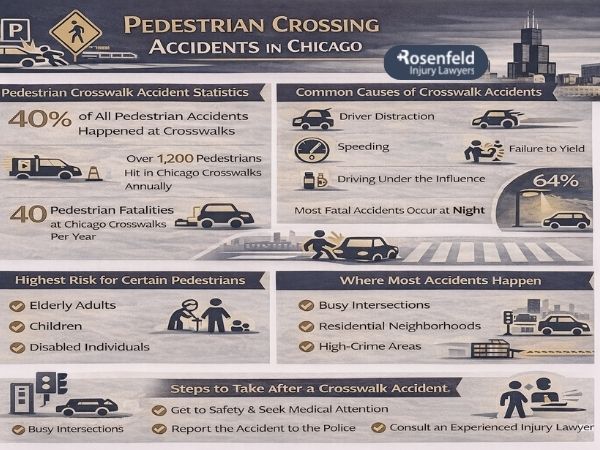
Pedestrians are exposed and unprotected. Even at low speeds, a vehicle strike can result in severe injuries. In many cases, drivers fail to yield the right of way at marked crosswalks, ignore traffic signs, or aren’t alert to pedestrian traffic, especially during poor weather, low visibility, or rush hour. Because pedestrians have little to no physical protection, they face a greater risk of harm in any collision with a vehicle.
Liability is based on four elements: duty, breach, causation, and damages. Drivers have a legal duty to follow traffic laws, yield the right of way, and watch for pedestrians at crosswalks. When a driver breaches that duty–such as by speeding, failing to come to a complete stop at a walk signal, or not yielding at an intersection–and that conduct causes a crash that leads to injuries, they may be held liable for resulting damages. Evidence like traffic camera footage, witness statements, and police reports often help prove fault in a personal injury claim.
Under the Illinois Statute of Limitations for Personal Injury (735 ILCS 5/13-202), injured pedestrians generally have two years from the date of the accident to file a lawsuit. If the injured person is a minor, 735 ILCS 5/13-211 extends the deadline, giving them two years from their 18th birthday to file a claim.
In fatal pedestrian crashes in Illinois, the victim’s family may be entitled to file a wrongful death lawsuit under the Illinois Wrongful Death Act (740 ILCS 180/). This type of lawsuit must also be filed within two years of the date of death and allows surviving relatives to recover compensation for funeral costs, lost financial support, and the emotional impact of the loss.
Our Chicago motor vehicle crash lawyers help victims take legal action against negligent drivers. We offer a free consultation to review your case and explain your legal options. If you were injured in a crosswalk, contact us today to discuss with an attorney who understands what’s at stake.