
100% Focus on Your Recovery,
Chicago Auto Accident Lawyer
Chicago Auto Accident Lawyer
Our Team of Attorneys Are Committed to Maximizing the Value of Your Case



Overweight trucks can result in catastrophic injuries and wrongful death, especially near industrial sites on Chicago’s South Side. Truck weight limits in Illinois are designed to protect infrastructure and public safety, but some motor carriers may attempt to load vehicles above the maximum weight allowed, putting lives at risk.
Our firm’s deep experience with trucking laws and regulations in Illinois ensures that negligent trucking companies and drivers are held liable. Contact us today for a free consultation about your truck accident claim.
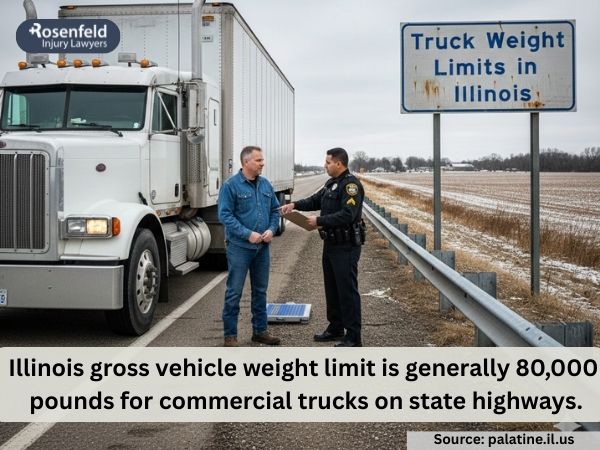
The maximum gross vehicle weight limit on Illinois interstates is 80,000 pounds for standard five-axle configurations (625 ILCS 5/15-111). This is the same as the federal limit for designated state and interstate highways (23 U.S.C. § 127).
The maximum total weight may vary depending on whether it is a straight truck or a combination vehicle, such as a tractor-trailer. There may also be different definitions for certain types of vehicles, such as public utility vehicles or buses.
In special circumstances, trucks may apply for an overweight permit, which requires planning their route and filing it with the Department of Transportation.
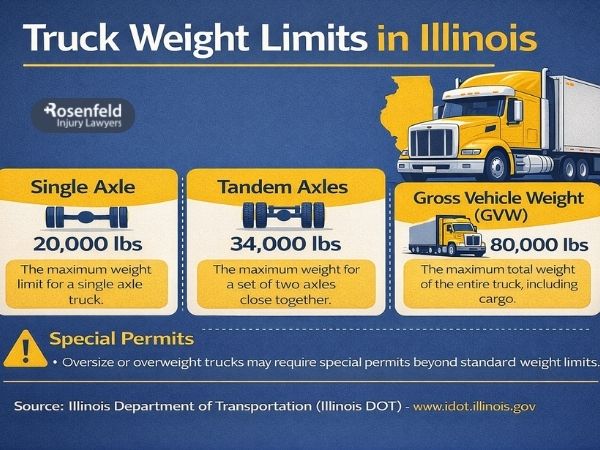
Three universal limits apply to all vehicles. The maximum gross weight is 80,000 pounds. A single axle has a maximum weight of 20,000 pounds.
Tandem axles have two sets of axles set near one another, which helps distribute loads. The consecutive axles are set at least 40 inches apart, with a maximum width of 96 inches. For these, the total limit is 34,000 pounds.
The Illinois Department of Transportation enforces the Federal Bridge Formula, which protects bridges and roadways. While Chicago’s public infrastructure is regularly repaired, concentrated stress at a single point could lead to stress fractures that may put thousands of lives at risk.
The formula is as follows:
W = 500 * [ ( LN / ( N – 1 ) ) + 12N + 36 ]
Here, W stands for weight, L stands for length, and N stands for number of axles.
This formula limits the total weight on any group of consecutive axles. It is based on the overall distance, to the nearest foot, between the first and last axles of the group. A longer truck can carry more weight, as it is more evenly distributed, while a single-axle vehicle would have much stricter limits.
A common example of the Federal Bridge Formula is two consecutive sets of axles, each carrying 34,000 pounds. If the overall distance between the first and last set is 36 feet or greater, then the truck’s movement would not cause damage to the infrastructure, and the semitrailer would pass inspection.
In most cases, drivers are restricted to interstate highways, but there are access exceptions for food, fuel, rest, or emergency repairs. However, drivers must still respect any posted bridge weight limits. This is especially crucial in Cook County, where small, local bridges may not be able to support the weight of a fully loaded tractor-trailer.
The Illinois Department of Transportation states that the standard width, height, and length limitations are as follows.
Width: 8’6″
Height: 13’6″, measured from wheelbase to top
Length: 65 feet for most combinations, but straight trucks may be longer.
Cook County expressways, such as the Kennedy, Dan Ryan, Edens, and Bishop Ford, have strict restrictions. Trucks can be no more than 12′ wide, 13’6″ high, and 120,000 pounds.
Larger vehicles are subject to specific permit operating hours, Monday to Friday, 9 am – 3 pm. These restrictions apply to most counties around Chicago, including Lake, McHenry, DuPage, Kane, and Cook.
Class 3 local roads may have tighter restrictions, such as an 8″ width and a 55″ distance from the wheelbase to the top. Smaller Chicago streets like Parnell Avenue or Paulina Street may not be open to larger trucks.
A Chicago truck accident attorney will investigate all persons or parties who may have been responsible for an overweight truck accident.
Per the Illinois Supreme Court case Laue v. Leifheit, all potentially liable parties must be named in the suit to secure compensation from them, making it essential that we carefully investigate the accident circumstances and the identities of the parties that contributed to this oversight. Some of these parties can include the following.
Truck Driver: In most cases, the driver is directly liable for knowingly operating an overweight vehicle. Drivers are empowered to identify potential liabilities and address them, including checking whether the load is evenly distributed. Drivers are also supposed to visit weigh stations when directed by an officer. If the driver refuses, this could be considered negligence.
Trucking Company: Companies may pressure drivers to increase load weight to deliver shipments faster, even if this exceeds stated limits. This would be considered direct negligence. They are also indirectly negligent for any actions undertaken by their employee.
Cargo Loaders: Many trucking companies work with cargo loading contractors, who are responsible for ensuring each load complies with all applicable regulations. They must carefully balance and secure every load to prevent the risk of tipover or rollover accidents. If they failed to secure, weigh, and balance the cargo, then the company and individual loaders can be liable.
In addition to establishing truck accident liability, our firm will demonstrate how overloaded vehicles directly contributed to the crash. For example, we may show that the driver lost control because there was too much weight on an axle, leading to brake failure or a tipover. Accident reconstructionists can explain to a judge and jury how the accident mechanics demonstrate a weight issue.
Proving violations of federal law provides our firm with a strong bargaining position, making insurance companies more willing to settle out of court. This ensures that you can focus on recovery rather than facing a trial. However, some insurance companies will refuse to cooperate, leading us to file a suit with the Circuit Court of Cook County. Our attorneys are members of the Illinois Trial Lawyers Association with a 98% success rate in negotiation and at trial, ensuring you have the best possible chance of holding negligent parties accountable.
The Illinois personal injury statute of limitations is just two years, making it crucial that you initiate your case immediately (735 ILCS 5/13-202). Contact us for a free case review.
A Chicago motor vehicle crash attorney is an essential ally in these complex legal claims. We will handle all documentation, investigation, and negotiation so that you can focus on healing rather than third-party communications. With a 10/10 AVVO rating and the prestigious Super Lawyers designation, our compassionate legal advocates are here to ensure you receive full compensation for your accident.
We work on a contingency fee basis: no legal fees unless we win. We’re ready to fight for your rights and ensure that irresponsible trucking companies are held accountable for putting money over safety. Contact us today for a free consultation about your claim.