
100% Focus on Your Recovery,
Chicago Auto Accident Lawyer
Chicago Auto Accident Lawyer
Our Team of Attorneys Are Committed to Maximizing the Value of Your Case



On dark nights along Chicago’s major roadways, such as Western Avenue or the Jane Byrne Interchange, the Department of Transportation (DOT) reflective tape requirements can be the difference between a safe trip and tragic accidents. Trucking industry laws and regulations require that commercial vehicles have proper reflective tape to make them highly visible in fog or rain.
If non-compliance with DOT regulations contributed to your truck crash, we can hold trucking companies accountable for negligent maintenance or supervision. Contact us today for a free consultation about your truck accident.
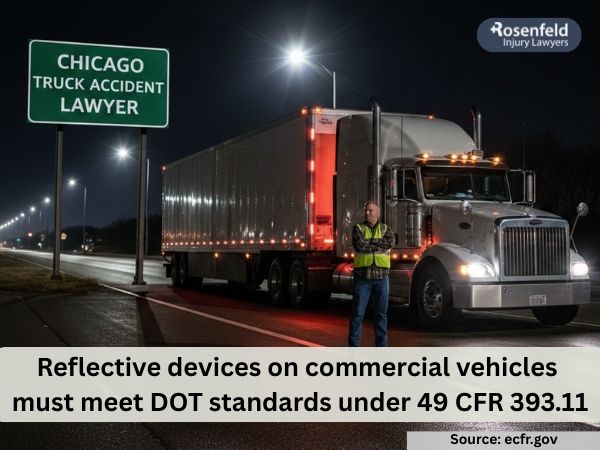
DOT reflective tape is a safety feature on commercial vehicles that makes the truck highly visible to other motorists, preventing accidents (49 C.F.R. § 393.11).
All vehicles, including passenger vehicles, are required to have a certain number of reflex reflectors (49 C.F.R. § 571.108). The material’s reflective properties are due to tiny prisms embedded in the device, which reflect light from headlights back to the source and improve visibility. Similar materials are used on the road and street signs, though in different colors.
Retroreflective sheeting on large vehicles operates on the same principle, but because these trucks are much larger, they require reflective tape to fully illuminate their length and width. It is typically called DOT C2 or DOT tape in the industry.
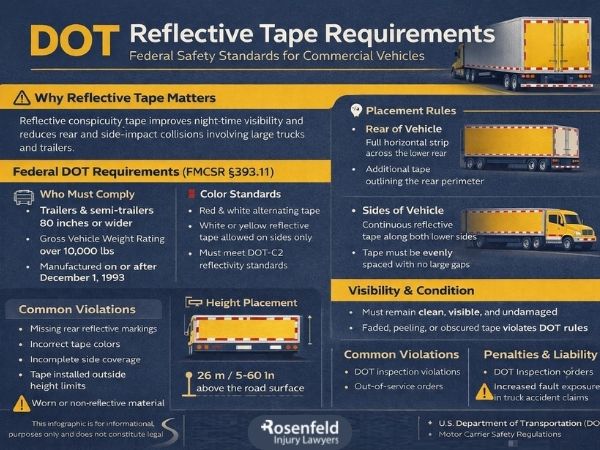
Commercial vehicles with a gross vehicle weight rating (GVWR) of 10,000 pounds or more must comply with the DOT reflective tape requirements. This includes semi-trucks, straight trucks, and trailers that are more than 80 inches wide. However, there are exceptions for commercial trailers designed exclusively for living or office use (49 C.F.R. § 393.11).
DOT requires a specific size and color on tractor-trailers manufactured after 1993. These vehicles must have alternating red and white tape on the sides and rear of the vehicle, and white strips on the upper rear corners in an “L” shape.
DOT rules require that all tape carry the DOT C2 certification mark to verify compliance with standards. The tape measures 2 inches in width; hence the “C2” designation.
It is typically 6/6-inch or 7/11-inch patterns. All tape strips must be durable enough to withstand road debris and weather.
The entire lower rear bar of the trailer must be covered in alternating red and white tape. Trailers and box trucks must have two white strips, oriented in an L shape, on the upper rear corners, as close to the edge of the vehicle as possible. They must also have another white strip in the center.
On the sides, the strips must cover half of the total length or more. Truckers must ensure the tape is maintained and replaced if damaged.
Low visibility makes reflective tape a safety-critical intervention. Failure to equip DOT tape significantly increases the risk of a serious crash, especially in Chicago. The city’s climate often results in heavy cloud cover, blizzards, and fog, particularly on Lake Shore Drive and other roads near Lake Michigan. During whiteout conditions, the reflective tape may be the only means by which motorists can determine that a white truck is ahead of them.
A Chicago truck accident lawyer will examine the truck to determine whether it meets the full requirements outlined by the DOT reflective tape regulations. This includes checking the reflectivity, adherence, and pattern.
For example, if the trucking company used unauthorized tape, lower durability could mean it was too faded for other motorists to see, which is a clear example of truck accident negligence. Failure to fully cover the lower rear area could cause a rear-end collision and catastrophic injuries.
We’ll demand that the company preserve all evidence to prevent common tactics such as replacing missing tape before a full investigation. Other sources, such as driver witness statements and surveillance footage, can also verify that the vehicle lacked the required reflective tape at the time of the crash.
Our team will retain expert witnesses who can explain to a judge and jury why the DOT requires reflective tape and how the absence of tape could result in a crash. Additionally, accident reconstructionists can demonstrate whether conditions at the time of the accident, when combined with the lack of tape, contributed to the collision. This can be an invaluable way to protect injured drivers from being held unfairly liable for their actions.
Truck accidents are more complex due to the range of potentially liable parties. Truck drivers, companies, cargo loaders, and maintenance companies may all be incorporated into a lawsuit under the Illinois Joint Tortfeasor Contribution Act (740 ILCS 100/2). Before a truck is dispatched, any professional involved in maintaining, loading, or operating the vehicle should ensure there are no issues that may cause an accident, including missing tape.
The Illinois Supreme Court case Laue v. Leifheit held that each liable party must be named in the lawsuit before filing, making it essential that we thoroughly investigate all potential avenues for compensation. We’ll then negotiate with each party to ensure you receive fair compensation.
Insurance companies will fight to avoid liability, including dismissing the tape’s role in the crash or insisting that the truck was in compliance. Through our aggressive negotiation, we can push for the highest possible compensation and ensure that negligent parties are held accountable.
It is crucial to consult with an attorney as soon as possible. The Illinois personal injury statute of limitations is only two years (735 ILCS 5/13-202), and a significant portion of this time will be spent in negotiations.
Our Chicago motor vehicle crash lawyers have over 100 years of combined legal experience and are deeply familiar with all elements of DOT reflective tape requirements. We have secured over $450 million in positive verdicts and settlements for our clients, earning us a place in the Million Dollar Advocates Forum.
We understand that a truck accident can cause significant financial stress and hardship, which is why we operate on a contingency fee basis: no fees unless we win. Contact us today for a free consultation about your claim.