
100% Focus on Your Recovery,
Chicago Auto Accident Lawyer
Chicago Auto Accident Lawyer
Our Team of Attorneys Are Committed to Maximizing the Value of Your Case



DOT drug test requirements apply to employees who perform safety-sensitive functions across regulated transportation industries. These rules are enforced by the U.S. Department of Transportation and are designed to protect public safety by ensuring that drivers and other covered employees are not impaired by drug and alcohol use while on duty.
Employers, drivers, and service agents must understand how DOT drug testing works to remain in compliance and avoid serious consequences.
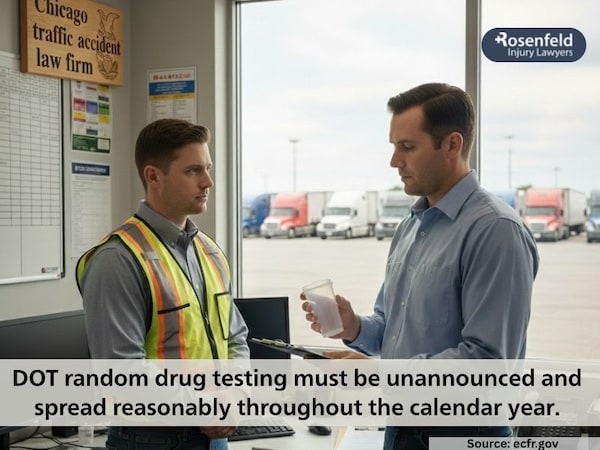
Drug and alcohol testing is mandatory for covered employees in safety-sensitive roles. As part of trucking regulations, DOT requires both a drug test and alcohol testing at specific points during employment. Testing is conducted under strict federal procedures to ensure accuracy, integrity, and fairness.
DOT drug testing screens for specific controlled substances, while alcohol testing measures breath alcohol concentration. Both types of testing are governed by federal regulations and must be conducted using approved equipment and trained personnel.
The DOT drug testing program establishes when testing must occur and how results are handled. A pre-employment drug test is required before a driver can perform safety-sensitive duties for the first time. This applies to drivers holding a commercial driver’s license and operating commercial motor vehicles meeting gross vehicle weight rating or gross combination weight rating thresholds.
Beyond pre-employment testing, DOT drug testing also includes random, reasonable suspicion, post-accident, return to duty, and follow-up testing. Each test type serves a specific safety purpose and follows defined testing procedures.
An alcohol testing program runs parallel to DOT drug testing and applies to the same employees. Alcohol testing is required in pre-duty situations such as post-accident testing, reasonable suspicion, random selection, and return-to-duty scenarios.
Alcohol testing must be conducted by trained technicians using approved devices. A positive result or refusal to test can immediately remove a driver from duty and trigger additional requirements under DOT regulations.
DOT regulations are primarily found in 49 CFR Part 40, which outlines the testing process, roles of employers and service agents, and laboratory standards. These regulations apply across all DOT agencies, including those overseeing transportation, motor carrier operations, and aviation.
The department sets uniform rules so that every drug test, alcohol test, and return to duty process is consistent nationwide.
DOT drug testing must be performed at approved collection sites using standardized procedures. These sites work with laboratories certified by federal authorities to analyze samples and report results. Only laboratories certified under DOT standards may produce a verified negative result or confirm a positive test.
The testing process includes chain of custody documentation, specimen handling, and medical review before results are finalized and reported to the employer.
Post-accident testing is required after certain accidents involving commercial motor vehicles, especially when there is disabling damage, a fatality, or an injury requiring immediate medical treatment. Reasonable suspicion testing occurs when trained supervisors observe behavior suggesting drug or alcohol use.
Both situations require prompt action, and failure to conduct testing within the required timeframes can result in compliance violations for the employer.
A positive drug test removes the employee from safety-sensitive duties immediately. The individual must complete an evaluation with a substance abuse professional, who determines appropriate education or treatment. This is part of the return to duty process.
Before resuming work, the employee must pass a return to duty test with a verified negative result. Afterward, follow-up testing is required over a set period, often extending through the calendar year or longer, depending on the evaluation.
Failure to comply with drug test requirements can lead to serious consequences, including fines, out-of-service orders, and loss of operating authority for a motor carrier. For drivers, non-compliance can affect employment, licensing, and long-term career opportunities.
Understanding the testing program, conducting tests properly, and following procedures protects safety, ensures compliance, and supports a fair process for all employees subject to DOT oversight.
Drug testing plays a direct role in preventing serious accident risks across the transportation industry. When employers fail to follow DOT regulations or allow a driver to perform duties without proper testing, the consequences can include devastating accidents and life-altering injuries.
Our Chicago traffic accident law firm represents individuals harmed in crashes involving commercial vehicles where drug and alcohol compliance is in question. We believe accountability matters, and we work to uncover whether testing failures, improper return to duty decisions, or ignored warning signs contributed to an accident.
If you were injured and suspect drug testing requirements were not followed, we stand with you and are ready to help you understand your legal options.