
100% Focus on Your Recovery,
Chicago Auto Accident Lawyer
Chicago Auto Accident Lawyer
Our Team of Attorneys Are Committed to Maximizing the Value of Your Case



Motorcycle vs car accident claims raise many of the most complex and misunderstood issues we see in personal injury law. While both motorcycle accidents and car accidents involve collisions on Chicago roads, the legal, medical, and insurance realities are often very different.
Chicago’s traffic density, constant construction, and mix of passenger vehicles, motorcycles, buses, and delivery trucks create real risk for everyone on the road. From Lake Shore Drive and the Kennedy Expressway to neighborhood streets on the South and West Sides, motorcycle and car accidents happen every day. But when a crash compared to a typical car collision involves a motorcycle, the injury outcomes, insurance disputes, and proving liability can look very different.
As Chicago personal injury attorneys, we work with injured people across the city who are trying to understand their rights, their options, and what comes next after a serious crash.
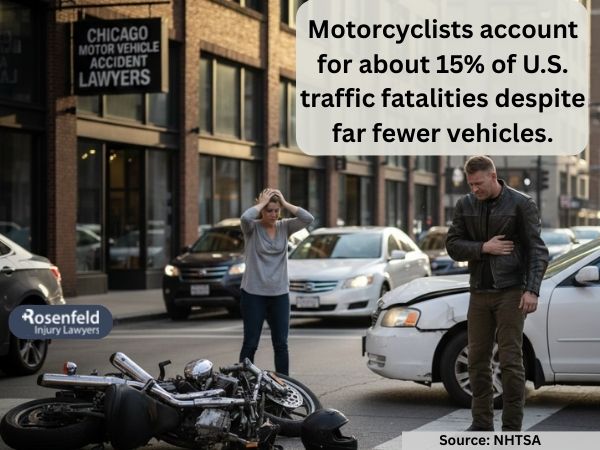
Motorcycle accident claims are not simply “car accident claims without seat belts.” The differences between motorcycle vs car accident cases affect how injuries occur, how fault is argued, how insurance coverage applies, and how juries view the people involved.
Before breaking this down further, it’s important to understand why motorcycle and car accidents are treated differently under the law and by insurance companies. Motorcycles represent a much smaller share of registered vehicles and vehicle mile traveled, yet motorcycle accidents tend to result in more serious injuries and a higher risk of a fatal crash. At the same time, car accidents remain far more common overall, simply because there are more passenger cars on the road.
Below, we explain how these distinctions play out in real cases involving motorcycle and car crashes.
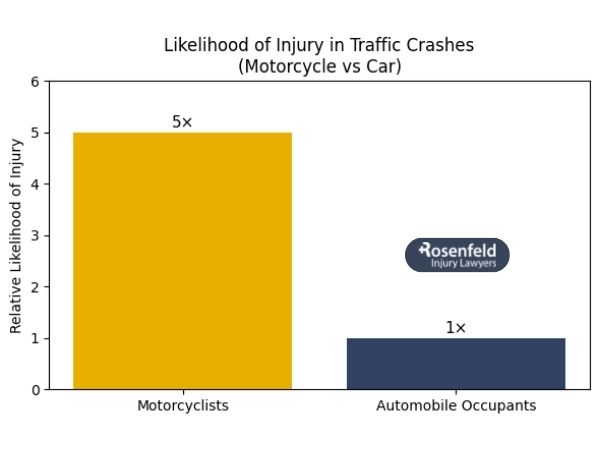
Claims involving motorcycle riders often focus on vulnerability, visibility, and severity of harm. Unlike cars, motorcycles lack enclosed cabins, airbags, and many modern safety features designed to protect car occupants. Even at relatively low speeds, a motorcycle’s speed combined with impact forces can cause riders to lose control and suffer catastrophic injuries.
Injuries suffered by motorcyclists frequently include traumatic brain injuries (TBI), spinal injuries, internal trauma, and severe road rash. Protective gear like helmets and armored clothing can help, but in contrast to cars, motorcycles cannot rely on safety restraints, crumple zones, or reinforced frames. As a result, motorcycle collisions tend to produce more serious injury and fatal injuries than most car crashes.
Motorcycle injury claims also face unique challenges. Insurance companies may unfairly blame motorcycle riders by pointing to lane splitting, alleged speeding, or stereotypes about risk-taking behavior. Police reports, witness statements, and car accident statistics are often used selectively to argue that car drivers were not at fault, even when driver inattention, areas of limited visibility, or driver error played a major role.
As a motorcycle accident lawyer, part of our job is pushing back against these assumptions and focusing on the facts: road hazards, traffic laws, visibility issues, and the actions of other drivers and passenger vehicles that contributed to the crash.
Claims involving car drivers usually look different because the occupants of passenger vehicles benefit from built-in safety features. Seat belts, airbags, reinforced doors, and crash-avoidance technology often reduce the severity of injuries in car accidents, especially in lower-speed collisions.
That said, car accidents can still result in serious injury, including TBIs, spinal cord injuries, and organ damage, particularly in high-speed impacts or multi-vehicle crashes involving other vehicles. Car occupants may also face lost wages, mounting medical expenses, and long-term recovery challenges.
In car accident claims, insurance companies often focus on fault percentages, vehicle damage, and compliance with motor vehicle laws. While establishing fault is sometimes more straightforward in rear-end or intersection crashes, disputes still arise over driver inattention, failure to yield, or whether one driver could have avoided the collision.
In motorcycle and car accident cases, these differences matter because the same crash can have dramatically different consequences for a motorcyclist versus someone inside a car.
Motorcycle collisions with passenger cars are among the most dangerous scenarios on Chicago roads. These crashes often occur when drivers fail to see motorcycles or misjudge a motorcycle’s speed and distance. While motorcycle and car accidents share some common causes, there are also important differences.
Many crashes stem from overlapping factors, such as road conditions, traffic congestion, and human error, but the consequences are often far more severe for motorcycle riders.
Common causes of motorcycle accidents include:
Common causes of car accidents include:
While more car accidents occur overall because cars dominate vehicle mile traveled, causes of motorcycle collisions are often tied to visibility failures and driver assumptions about motorcycles. These differences shape how claims are investigated and argued.
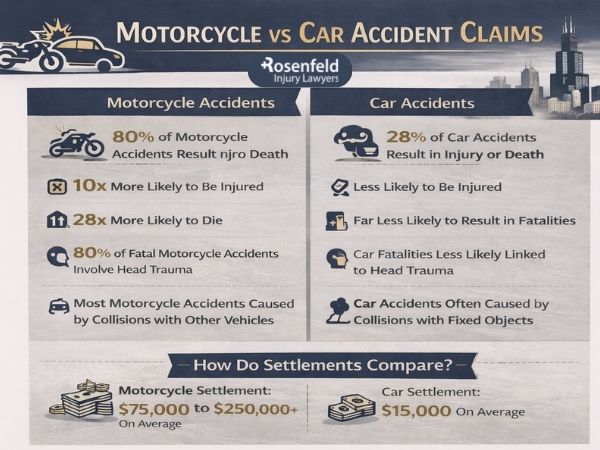
Both motorcycle and car accidents can cause serious harm, but the injury patterns often differ significantly due to the lack of physical protection for riders.
Injuries suffered by motorcyclists are often more severe because riders absorb the force of impact directly. Car occupants, while still at risk, are partially shielded by vehicle structures and safety systems.
Common motorcycle accident injuries include:
Common car accident injuries include:
In car accidents motorcyclists are involved in, the contrast can be stark. Occupants of passenger vehicles may walk away while the motorcyclist suffers life-altering harm. These injury outcomes play a major role in evaluating damages, medical expenses, and long-term needs.
Motorcycle safety remains a serious concern on Chicago streets. Unlike cars, motorcycles provide no external protection in a crash, leaving riders exposed to other vehicles, dangerous road conditions, and sudden changes in traffic.
Motorcycles account for a small percentage of registered vehicles, yet they account for a disproportionate share of fatal crash statistics. Fatal motorcycle accidents often occur when passenger vehicles turn left, merge without checking blind spots, or fail to notice a rider until it’s too late.
Protective gear can reduce harm, but even experienced riders following motor vehicle laws can be seriously injured due to the actions of other drivers. Lane splitting, while debated, is often misunderstood and used unfairly against riders during claims, even when it was not the cause of the crash.
Understanding these risks is essential when evaluating motorcycle vs car accident claims and determining responsibility.
When we represent clients in motorcycle and car crashes, our role is to guide them through every stage of the process with clarity and care. As Chicago personal injury lawyers, we focus on building strong cases rooted in evidence, accountability, and respect for what our clients are going through.
Our work often includes:
Whether a case involves motorcycle vs car accident scenarios or complex motorcycle insurance coverage issues, we stay focused on protecting our clients’ interests. We believe every injured person deserves to be heard, treated fairly, and supported throughout the legal process.
If you were injured in traffic accidents or are unsure how motorcycle vs car accident claims work, we’re here to help. We offer a free and confidential consultation and handle cases on a contingency fee basis, meaning there are no upfront costs and no attorney fees unless we recover compensation for you.
As Chicago motor vehicle accident lawyers, we’re committed to standing with injured riders and drivers across the city. Contact us today to learn how we can help you move forward with confidence and support.