
100% Focus on Your Recovery,
Chicago Auto Accident Lawyer
Chicago Auto Accident Lawyer
Our Team of Attorneys Are Committed to Maximizing the Value of Your Case


Rideshare services are part of daily life across Illinois, but accidents involving Uber drivers raise questions that don’t come up in typical auto accidents. If you’re wondering what happens if an Uber driver gets in an accident in Illinois, you’re not alone. Whether you were a passenger, another driver, or a pedestrian, the legal process can feel overwhelming. Our law firm helps people throughout Illinois hold negligent drivers and insurance companies accountable after an Uber crash. We handle rideshare accident claims with focus and experience, always fighting to recover compensation for medical expenses, lost income, and other damages.
Responsibility after an Uber accident isn’t always clear-cut. In Illinois, fault is determined under the Comparative Negligence Law (735 ILCS 5/2-1116). This means more than one party can be held legally responsible for the accident, including the Uber driver, other drivers involved, or even the rideshare passenger in rare cases.
If the Uber driver caused the crash, they could be considered the at-fault driver. However, if another vehicle was involved and that driver’s actions led to the accident, their car insurance would typically take the lead in covering damages. If both drivers share blame, liability is split based on the percentage of fault. A person who is less than 51 percent responsible can still seek compensation, though their recovery may be reduced based on their share of fault.
The Uber driver’s activity at the time of the accident also matters. Were they off the app? Waiting for a ride request? Transporting a passenger? These details affect which insurance policy applies: Uber’s insurance, the driver’s personal insurance, or both.
Whether you were a passenger, another driver, or a pedestrian, sorting out who pays for medical bills, lost wages, and other damages can be complicated. An experienced personal injury lawyer can help determine fault, gather insurance information, and make sure the liable parties are held accountable.
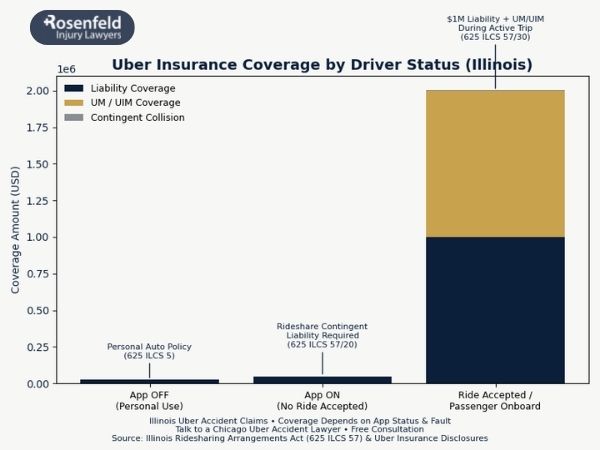
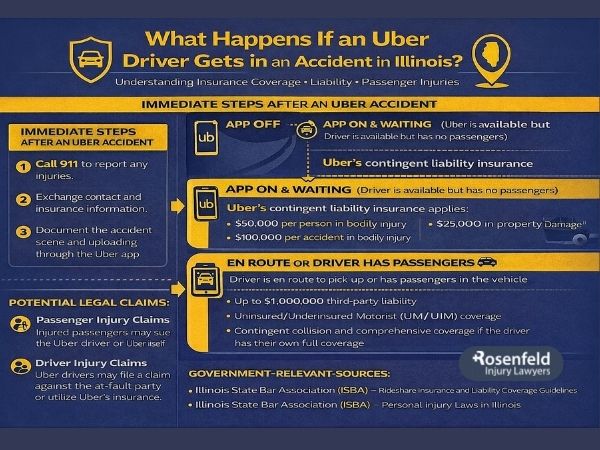
Uber is required to provide different levels of insurance coverage based on the driver’s activity at the time of the crash. Under the Transportation Network Providers Act (625 ILCS 57/), coverage shifts depending on whether the Uber app is off, on with no active ride, or in use during an accepted trip. Understanding these tiers helps determine what coverage applies in an Uber accident and who may be financially responsible for the suffered injuries, property damage, and other losses. Below is a breakdown of how Uber insurance requirements work in Illinois based on the driver’s activity at the time of the accident.
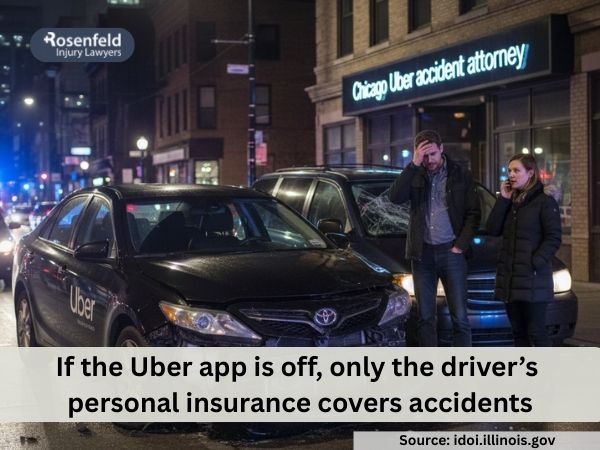
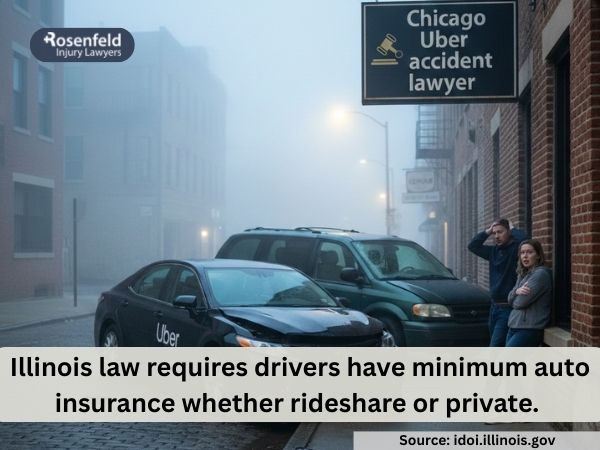
When the Uber driver is not logged into the app, Uber provides no insurance coverage. At this stage, the driver is considered to be using the vehicle for personal reasons, so only their personal auto insurance or personal car insurance policy applies. If the driver gets in an accident, the claim must be filed through their own insurance. If the driver lacks sufficient insurance, injured parties may face challenges recovering damages unless another liable party is identified. Uber will not step in unless the driver is actively using the app or has a ride request. This is why all Uber drivers are legally required to carry their own auto insurance that meets Illinois’ minimum coverage limits. However, many standard policies exclude rideshare activity unless the driver has optional coverage in place.
If the Uber driver is logged into the app but hasn’t yet accepted a ride, Uber provides contingent liability insurance coverage. This includes up to $50,000 per person for bodily injury, $100,000 per accident, and $25,000 for property damage. However, this coverage only applies if the driver’s insurance denies the claim or doesn’t provide enough to cover the losses. It acts as a backup. This tier of Uber’s insurance coverage is triggered when the driver is actively available for ride requests but hasn’t picked anyone up yet. It does not include personal injury protection or comprehensive coverage, so claims for medical expenses or vehicle repairs may still be limited. If another party was at fault, their insurance provider would typically be pursued first.
Once the Uber driver accepts a ride request or has a passenger in the vehicle, Uber provides its highest level of liability insurance coverage. This includes up to $1 million in liability coverage, which may cover the passenger’s injuries, property damage, and other losses. Uber also provides uninsured/underinsured motorist coverage during this phase, which protects passengers and drivers if the at-fault driver lacks sufficient insurance. This tier applies from the moment a ride is accepted until the passenger exits the Uber vehicle. Whether you’re a passenger injured in the crash or another driver hit by an Uber, this coverage can be key in helping you seek compensation. Uber’s insurance covers medical expenses, lost wages, and even wrongful death claims, depending on the facts.
Uber drivers can purchase optional coverage through their own auto insurance provider to fill in the gaps between Uber’s tiers of coverage. This may include individual injury protection, comprehensive coverage, or rideshare-specific endorsements. These additions are especially helpful during the period when the app is on, but no ride has been accepted. Without such coverage, the driver’s insurance may exclude any rideshare-related activity, leaving them personally responsible. Some insurers now offer rideshare policies that integrate with Uber’s structure, ensuring that the driver has sufficient insurance in all phases of a trip. For drivers, understanding and purchasing such coverage can help protect their finances, and for injured parties, it can affect who is liable and how much compensation is available.
If you were hurt in a rideshare crash, a Chicago Uber accident lawyer can guide you through each step needed to protect your rights and financial recovery. We focus on identifying the liable parties, working with insurance companies, and helping you secure the compensation you need for medical bills, lost income, and more.
We offer a free case evaluation to discuss the details of your Uber crash. This initial conversation helps us understand what happened, answer your questions, and explain your legal options. There’s no pressure and no obligation, just straightforward, honest guidance from a legal team with experience handling insurance claims.
Strong claims start with solid evidence. We gather and review all available details from the accident scene, including police reports, medical records, photos of vehicles involved, and witness statements. Our team also analyzes rideshare data and app activity to determine the Uber driver’s status at the time of the crash.
Identifying the at-fault driver is essential in any insurance claim. We examine every factor–from traffic laws to driver behavior–to determine liability. We also review the insurance details, including Uber’s coverage and any personal insurance policies, to find out which providers are financially responsible.
We handle the entire process of filing an Uber accident claim with all relevant insurance companies. Whether it’s the Uber driver’s personal auto insurance or Uber’s insurance coverage, we submit the proper documentation and demand payment for your medical care, property damage, and other losses.
Our legal team works directly with insurers to pursue fair Uber accident settlements. We present strong evidence, clearly outline your damages, and push for the full value of your case, including medical expenses, property damage, lost wages, and other losses. We don’t settle for lowball offers.
$4,000,000 Settlement – Jasmine was killed as a passenger when her driver ran a red light at Western and Addison, colliding with cross traffic. Her family filed a wrongful death claim. The case’s value reflected clear traffic violations, expert economic loss reports, and the emotional impact on her surviving son and parents.
$2,855,000 Settlement – Teresa was crossing Michigan Avenue in the Loop when a rideshare vehicle turned into the crosswalk, knocking her to the ground. She broke her leg and required two surgeries. The settlement reflected strong pedestrian right-of-way laws, eyewitness support, and long-term physical limitations that affected her ability to work.
$1,680,000 Settlement – Carlos, a motorcyclist, was sideswiped by a driver pulling away after dropping off a passenger near Wrigleyville. He suffered a mild traumatic brain injury. A formal rideshare accident lawsuit was filed, with GPS data and helmet cam footage playing a significant role in resolving the case before trial.
$945,000 Settlement – Andre was waiting in a pickup zone at O’Hare Airport when a rideshare driver veered too close to the curb and struck him. He sustained back and knee injuries. Airport camera footage, along with reports from emergency responders, helped establish fault and secure a favorable settlement for his serious injuries.
$350,000 Settlement – Darius, a backseat passenger, suffered a herniated cervical disc when his rideshare driver rear-ended another vehicle at high speed on the Kennedy Expressway. The case was resolved before formal litigation. Medical imaging, along with expert analysis, helped link the crash to Darius’s injury and justified the settlement amount.
If negotiations fail, we’re ready to represent you in court and pursue an Uber accident lawsuit. Some cases require formal litigation to force insurance providers to take your injuries seriously. From filing the complaint to presenting your case at trial, we protect your rights and fight for full recovery.
Taking the proper steps immediately after a rideshare accident can protect your health and your legal claim. First, seek medical attention, even if you have minor injuries. Not all injuries are visible right away, and medical records are key to supporting your case. Next, call the police and make sure a crash report is filed. This document can help clarify who the at-fault driver was and preserve facts from the accident scene.
If you’re able, take photos of the vehicles involved, any visible injuries, and the surrounding area. Get names and contact details of witnesses and all parties involved. Be cautious when speaking to insurance companies, and avoid giving recorded statements without legal guidance.
Finally, speak with a personal injury lawyer familiar with rideshare accident claims. An attorney can help identify all available insurance policies, gather strong evidence, and file claims correctly to pursue maximum compensation for your injuries and losses.
Responsibility for an Uber driver’s medical bills depends on who caused the crash and the driver’s status at the time. If another driver caused the collision, their auto insurance may cover the driver’s medical care, lost income, and property damage. If the rideshare driver was actively using the app, they may be covered under Uber’s insurance, which could include personal injury protection or liability insurance coverage. If the driver was offline, their personal auto insurance or their own insurance would apply. In cases where no party has sufficient insurance, compensation may be limited unless optional coverage for personal injury is in place.
Under the Illinois Statute of Limitations for Personal Injury (735 ILCS 5/13-202), most victims have two years from the date of the car accident to file a claim. For fatal crashes, the Wrongful Death Act (740 ILCS 180/) also allows two years from the date of death to file a wrongful death claim. Waiting too long can bar your right to seek compensation.
If you were injured in a rideshare crash, our traffic accident law firm is here to help you understand your rights and options. We offer a free consultation to review your case, answer your questions, and help you explore every available path to recovery. Our team has experience handling rideshare injury cases across Illinois and knows how to deal with difficult insurance companies. Contact us today to schedule your free case review. There’s no risk and no upfront cost.