
100% Focus on Your Recovery,
Chicago Auto Accident Lawyer
Chicago Auto Accident Lawyer
Our Team of Attorneys Are Committed to Maximizing the Value of Your Case



When different types of truck accidents occur on Chicago roads, the consequences can be life-changing. From Lake Shore Drive and I-90 to busy surface streets like Western Avenue, Cicero Avenue, and Ashland Avenue, truck accidents place drivers, passengers, cyclists, and pedestrians at serious risk. As a Chicago-based firm, we work closely with truck accident victims and their families during some of the most difficult moments of their lives.
Chicago’s dense traffic, heavy freight corridors, rail yards, distribution hubs, and constant construction zones make collisions involving large commercial vehicles, tractor-trailers, and semi-truck traffic especially dangerous. Understanding the common types of truck crashes helps explain why these cases often involve severe injuries, complex liability issues, and substantial long-term losses.
Accidents involving trucks rarely happen without warning signs. In many cases, they stem from overlapping failures involving the truck driver, the trucking company, vehicle maintenance, cargo handling, and the conduct of other motorists sharing the road. The causes of trucking accidents often include driver fatigue, distracted driving, speeding, poorly secured cargo, mechanical failures, and adverse weather conditions.
These crashes are governed by a combination of Illinois law and federal rules, including the Illinois Vehicle Code (625 ILCS 5/) and the Federal Motor Carrier Safety (FMCSA) regulations. Understanding the laws and regulations related to trucking accidents is critical, because their violations frequently form the foundation of successful truck accident claims.
Below are the most common types of truck accidents we see on Chicago streets and highways.
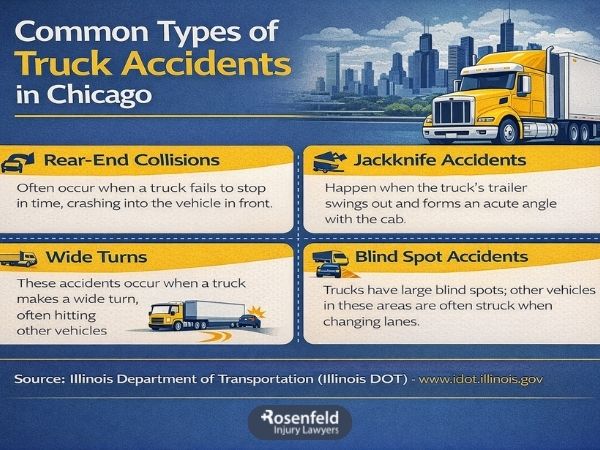
Jackknife accidents occur when a truck’s trailer swings outward, forming a sharp angle with the cab. A jackknife truck accident often happens when a driver brakes suddenly on wet pavement, icy roads, or construction zones common throughout Chicago winters. When a truck driver makes an abrupt maneuver or loses traction, the truck’s trailer can swing into nearby vehicles, striking multiple passenger cars at once.
Because jackknifing trucks can block several lanes of traffic, these crashes frequently involve multiple cars and even fatal crashes. Passenger vehicles and other smaller vehicles are especially vulnerable when caught between a trailer and a median barrier.
Rollover accidents are among the most violent truck accidents we encounter. Truck rollovers often occur on curved ramps, uneven pavement, or during sudden evasive maneuvers near busy interchanges like the Circle Interchange or I-294.
Fatal rollover crashes are frequently linked to improperly secured cargo, speeding, or abrupt lane changes. When a trailer shifts or becomes unbalanced, the entire vehicle can overturn, crushing cars and causing catastrophic injuries. These crashes often involve extensive investigations into load distribution and company safety practices.
Rear-end collisions involving large trucks are especially dangerous due to the weight and stopping distance of big rigs. Rear-end truck accidents frequently occur in stop-and-go traffic on I-290, I-55, and congested arterial roads throughout the city.
When a negligent truck driver is distracted, fatigued, or following too closely, the impact can push passenger vehicles into other lanes or into oncoming traffic. Victims of rear-end collisions often suffer neck injuries, spinal injuries, traumatic brain injuries, and other serious injuries that require immediate medical attention and ongoing care.
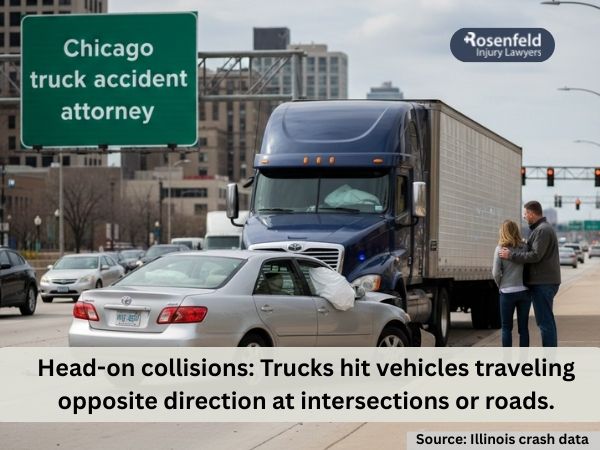
Head-on collisions with semi-trucks or tractor-trailers are often devastating. These crashes may occur when truck drivers fail to stay in their lane, cross the center line, or enter one-way streets incorrectly, an issue we see in industrial corridors and poorly marked construction zones.
Because of the extreme force involved, head-on collisions frequently result in loss of life or permanent disabilities for occupants of smaller vehicles involved in the crash.
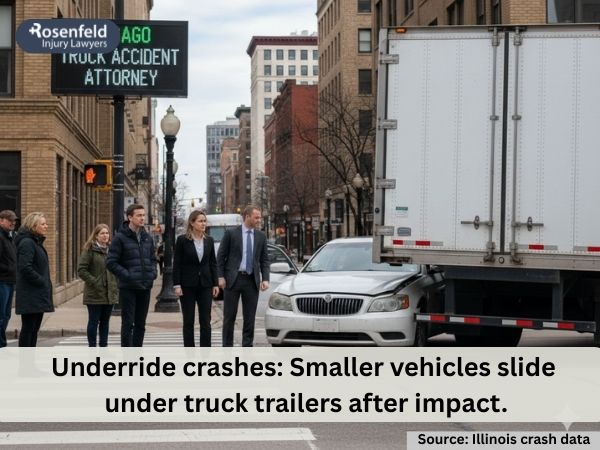
Underride accidents happen when a passenger car slides beneath the rear or side of a truck. Despite safety requirements, underride guards are sometimes missing, damaged, or inadequate. In dense Chicago traffic, sudden stops at a red light or unexpected braking can cause a smaller vehicle to wedge beneath a trailer.
These crashes are especially dangerous and often result in devastating injuries, including spinal injuries and fatal head trauma, even at relatively low speeds.
Tire blowouts can cause a truck to instantly lose control, sending debris into surrounding vehicles or causing the driver to veer across lanes. In some cases, tire falls from a moving trailer strike other motorists directly.
Blowouts are often linked to poor maintenance, overloading, or failure to conduct proper inspections. Reviewing truck maintenance records is essential when determining whether a trucking company failed to meet safety standards.
T-bone accidents typically occur at intersections when motorists fail to yield or run a stop signal. When a truck strikes the side of a passenger vehicle, the lack of side protection can result in crushing injuries to occupants.
These crashes are common at busy Chicago intersections where delivery trucks, buses, and cars converge. Victims often suffer spinal trauma, internal organ damage, and other severe injuries.
Blind spots around large commercial trucks are extensive. Blind spot accidents frequently happen when trucks are changing lanes without seeing other vehicles traveling alongside the cab or trailer.
Passenger cars caught in no-zones may be sideswiped or forced off the roadway, leading to sideswipe accidents, secondary collisions, or rollovers. These large truck crashes often involve multiple vehicles and complex liability issues.
Cargo accidents happen when freight is poorly loaded, unsecured, or shifts while a truck is in motion. In Chicago, these crashes often occur near industrial areas, warehouses, and major expressways where trucks routinely transport heavy or uneven loads. When cargo shifts suddenly, a truck may lose balance, jackknife, or roll over, putting nearby vehicles at risk of serious injuries.
Cargo-related crashes raise complex liability questions. Responsibility may rest with the truck driver, the trucking company, or third parties involved in loading the trailer. Reviewing loading practices and shipping records is often critical to determining what went wrong and who should be held accountable.
The specific type of truck accident can play a major role in how a claim is evaluated and resolved.
The type of collision can directly influence:
Establishing liability for the truck accident often depends on how the crash occurred. Jackknife accidents, underride accidents, and rollover crashes may point to different liable parties, including the truck driver, the trucking company, maintenance contractors, cargo loaders, or vehicle manufacturers.
Each factor shapes how truck accident cases are investigated and valued.
Truck accident litigation is not the same as standard car accident cases. Working with an experienced truck accident lawyer in Chicago ensures that critical evidence is preserved and responsible parties are held accountable.
We support our clients from the first call through the resolution of their truck accident claims. We take the time to understand what happened, how the crash has affected your life, and what you need in order to move forward and heal.
Our role includes:
We approach every case with care, respect, and determination. Our goal is to build a strong claim and guide our clients through a complex process with clarity and support. We stand with our clients at every stage.
The average truck collision settlement varies widely depending on the injuries, liability, and long-term impact. Reported outcomes range from $2,961 to $35,129,371, with an average of $2,620,278 and a median of $603,265. Each case is unique, and results depend on the specific facts involved.
Head-on collisions with large commercial vehicles often result in brain injuries, spinal trauma, internal organ damage, neck injuries, and other catastrophic injuries. These crashes frequently require immediate medical attention and long-term care.
Distracted driving is a significant factor in many large truck accidents, but it is rarely the only cause. Fatigue-related mistakes, driver error, mechanical failures, poor weather conditions, and improperly secured cargo often combine to create dangerous situations.
If you or a loved one has been injured in any type of truck accident, speaking with an experienced personal injury attorney handling traffic accidents can help you understand your options.
We offer a free and confidential consultation and handle personal injury claims on a contingency fee basis, meaning there are no upfront costs and no attorney fees unless we recover compensation for medical bills, lost wages, and other damages for you.
We believe every client deserves respect, clarity, and support. Contact our truck accident lawyers today to learn how we can help you move forward.