
100% Focus on Your Recovery,
Chicago Auto Accident Lawyer
Chicago Auto Accident Lawyer
Our Team of Attorneys Are Committed to Maximizing the Value of Your Case



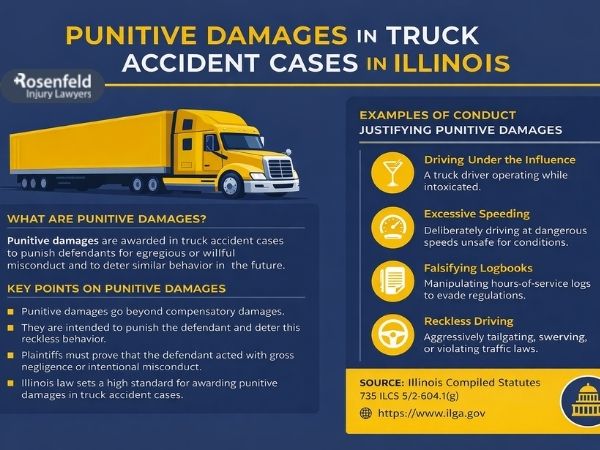
Punitive damages in truck accident cases punish truck drivers and trucking companies for reckless disregard of safety regulations, meant to deter similar behavior in the future. For example, if a driver was intoxicated at the time of a collision along the Stevenson Expressway, a jury might award punitive damages in addition to compensatory damages.
Having a skilled truck accident attorney on your side can significantly increase the possibility of recovering punitive damages. We can provide clear and convincing evidence of intentional misconduct or gross negligence through careful investigation. Contact us today for a free consultation about your truck accident case.
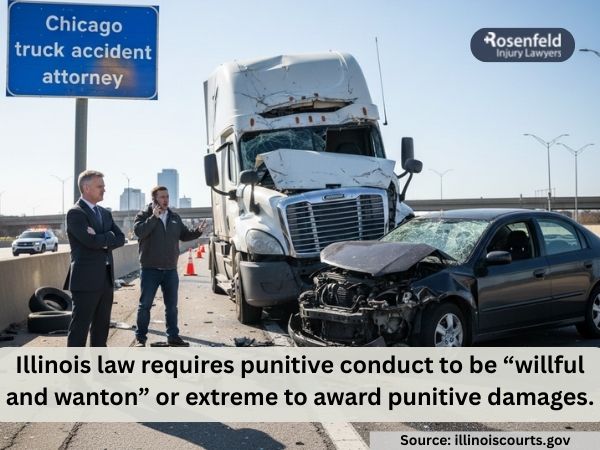
Compensatory damages in truck accident cases are meant to provide financial compensation for economic and emotional losses due to the accident. They include economic damages, like medical expenses or lost wages, and non-economic damages, such as emotional distress or physical pain and suffering.
Unlike compensatory damages, punitive damages are not meant to reimburse the victim for actual losses. Instead, they are designed to punish the defendant and prevent them from repeating misconduct in the future, as noted in Illinois Supreme Court cases like Kelsay v. Motorola, Inc.
Not all truck accident lawsuits will warrant punitive damages. The Illinois court system has held that juries may award punitive damages only if the defendant acted with willful disregard for human life or safety.
Illinois allows accident victims to seek punitive damages if they can provide compelling evidence that the defendant’s conduct was with “evil motive” or showed an extreme disregard for the victim’s well-being (735 ILCS 5/2-1115.05).
However, both federal and state legal systems disfavor these damages. The Illinois Court jury instructions reference State Farm v. Campbell in noting that punitive awards should be proportionate to the harm caused, and thus should only be considered in cases involving catastrophic injuries or wrongful death.
Gross negligence is different than ordinary negligence in that the defendant’s actions appear to be a conscious violation of other people’s right to safety.
Negligent hiring practices is a common example. If the trucking company failed to ensure a driver had the proper endorsements to haul hazardous materials and an accident occurred that exposed others to dangerous chemicals, that would constitute gross negligence. We can review the company’s records to determine whether it dispatched a driver who did not have the correct endorsements.
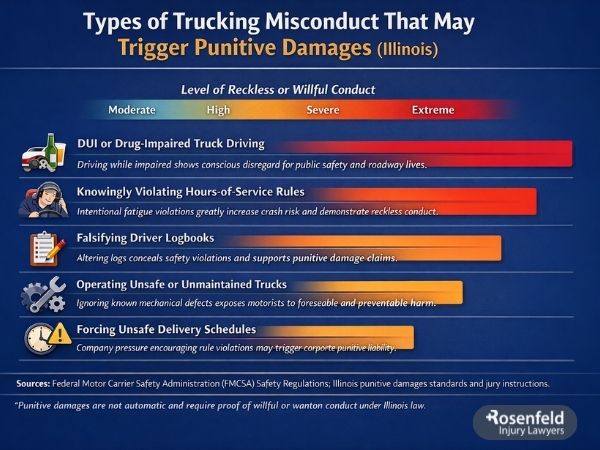
Willful misconduct means that the person knew their conduct could endanger someone, but chose to do it anyway.
Driving under the influence is one common instance. This is not only illegal under federal (49 CFR Part 382), Illinois (625 ILCS 5/11-501), and Chicago laws (7-24-226), but also widely understood through decades of public safety policies.
To qualify, a lawyer must demonstrate that the driver’s actions were willful conduct, not accidental. For example, if a driver had an adverse reaction to a new medication, they would technically be considered intoxicated under state law, which has a wide interpretation of DUI (625 ILCS 5/11-501). However, they weren’t aware of this before the accident, so they may not be held liable for punitive damages.
This egregious conduct indicates that the defendant knew their actions were dangerous but chose to act in this manner for personal gain. One common instance is when the accident happened because of severe driver fatigue.
The industry has strict federal regulations around hours of service (49 CFR Part 395). If a trucking company failed to log driver hours or pressured drivers to exceed their hours of service, that would constitute a conscious disregard. Another example would be falsifying safety records, which involves intentionally hiding safety violations.
Juries rarely award punitive damages in car accident cases because the duty of care is lower. The average motorist needs only to comply with the Illinois Vehicle Code.
In contrast, trucking companies must comply with federal safety regulations, which are much stricter than general rules of the road, and must ensure that their employees follow these regulations. They can face automatic vicarious liability for a driver’s actions while operating within the course and scope of employment.
Trucking companies can face higher exposure if it can be proven that the safety violations were systemic, such as ignoring drunk driving, falsifying logs, or negligently hiring multiple unqualified employees.
More than one party may be found to be contributarily negligent, meaning each is responsible for the damages. This makes truck collision cases more challenging to manage than car crash cases, where it is typically only the negligent driver who is considered liable.
Financial recovery of punitive damages requires a much more thorough investigation than for other damages. We must collect clear and convincing evidence that the truck driver and trucking company intentionally disregarded safety rules. Some of that evidence can include the following.
Inspection Reports: If mechanical failures caused the crash, we’ll review safety logs to prove the trucking company knew their truck was unsafe.
Employment Records: We can show the driver had a history of DUIs, reckless driving, or distracted driving, which would prove negligent hiring.
Witness Testimony: Employees could share information about the company culture surrounding safety or whether they were pressured to ignore standard industry guidelines.
Expert Testimony: Accident reconstructionists can explain whether intoxication, reckless driving, or distracted driving played a role.
Truck Data: Trucks are equipped with several logging devices, such as GPS, hours of service logs, and black box data. These can show evidence of willful misconduct, such as driving above the Chicago speed limit of 30 mph (9-12-070).
Dashcam and Surveillance Footage: Many trucks have two cameras: one that faces the driver and one that faces the road. These enable companies to check that their drivers are not distracted and prove liability in an accident. We can subpoena for this footage to see the driver’s behavior before and after the crash.
Cell Phone Data: Illinois has strict laws around distracted driving, prohibiting drivers from using cellular devices while operating a vehicle. These are echoed by the FMCSA. We can subpoena the driver’s cell phone to see if they were using any applications, sending text messages, or talking on the phone at the time of the crash.
Company Records: Trucking companies are required to meticulously log driver hours, training times, and drug testing. However, some companies may fail to keep these records, which is a sign of negligence that could result in tragic accidents. We will review their records to ensure that they comply with federal standards and highlight any failures.
Private Communications: Internal communications may reveal management discussions regarding safety compliance and regulations, indicating a disregard for other drivers’ well-being.
Many commercial trucking insurance policies have exclusions for punitive damages or limit coverage for certain types of misconduct, which could mean the trucking company or truck driver has to pay punitive damages themselves.
The maximum recovery for punitive damages in truck accident cases is capped at three times the compensatory damages (735 ILCS 5/2-1115.05). Compensatory damages include medical bills, property damage, lost income, pain and suffering, and loss of normal life. As such, retaining an attorney who can accurately evaluate your damages is crucial to securing a greater award of punitive damages.
As punitive damages are awarded only if there is proof of gross negligence, a Chicago truck accident attorney is a valuable ally in securing this compensation. We will meticulously gather evidence of the driver’s willful and reckless disregard for human life, ensuring it meets the Illinois standards for these claims.
Even if the case does not proceed to trial, the potential for punitive damages can significantly affect settlement negotiations. We will demonstrate that a jury would likely award this compensation based on the available evidence, thereby pressuring the insurance company to pay more.
In addition to helping you recover compensation, we can also help you understand the tax implications of punitive damages. These awards are treated differently from other damages, such as medical costs, and may be taxable (735 ILCS 5/2-1115.05).
Jonathan Rosenfeld is widely regarded as the best traffic accident attorney in Chicago, surrounded by a team of award-winning attorneys. We have secured over $450 million in jury awards and settlements for our clients over the past 25 years, earning us a 98% success rate in negotiations and trial verdicts.
We are a Super Lawyers®-rated firm, meaning that our peers recognize our top-notch legal representation. Our firm works on a contingency fee basis: no fees unless we win. Contact us today for a free consultation about your truck crash case.