
100% Focus on Your Recovery,
Chicago Auto Accident Lawyer
Chicago Auto Accident Lawyer
Our Team of Attorneys Are Committed to Maximizing the Value of Your Case



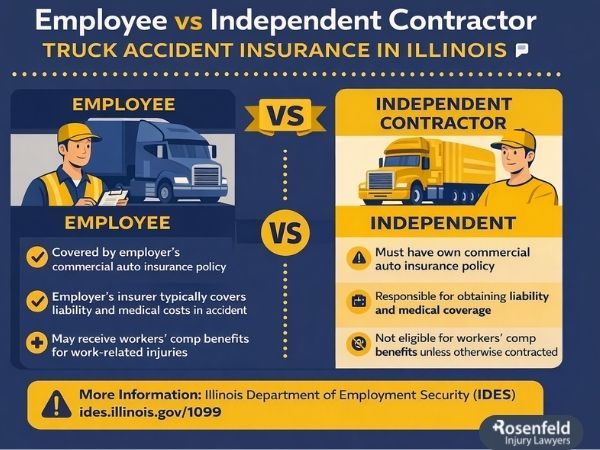
Truck drivers who get into an occupational accident along the Kennedy Expressway or Chicago Skybridge must know the difference between employee vs. independent contractor truck accident insurance. Understanding which insurance policy you have ensures your lost wages and medical expenses are covered promptly.
Our legal team will help you understand your insurance coverage, guide you through the workers’ compensation claim process, and pursue legal action if necessary. Contact us today for a free consultation about your legal rights.
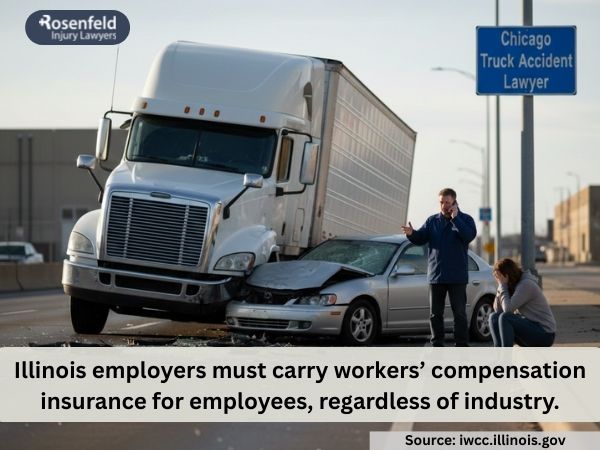
Several factors determine whether you are an employee or an independent contractor. First is the level of control exercised by the trucking company.
Owner-operator truck drivers do not have lease agreements with the trucking agency and operate their own equipment, instead contracting with companies to deliver loads. Truck drivers who lease their rigs may be considered employees, as the company has more control over their operations.
Self-employed truck drivers are not employees and carry their own insurance policies for accidents, often referred to as occupational accident insurance. They may operate as a separate business entity and pay self-employment taxes.
On the other hand, employees have workers’ compensation benefits through the company. They do not pay for this insurance out of pocket, and it is illegal for the employer to make them pay for workers’ compensation coverage (820 ILCS 305/).
When a truck driver is classified as an employee, the trucking company’s commercial liability insurance will cover medical expenses and lost wages. These coverage limits are typically higher than those of independent contractors.
If a truck accident occurs, both the trucking company and the individual driver can be held accountable by third parties, like injured passenger vehicle drivers.
The Illinois Workers’ Compensation Act (820 ILCS 305/1 et seq.) focuses on the working relationship between the driver and the trucking company. This means that even if a person is not classified as a company driver by the employer, state workers’ compensation laws may still apply.
Independent drivers may carry occupational accident insurance, but the policy limits are generally lower than workers’ comp. They may cover medical expenses, but only provide partial wage replacement rather than full compensation.
Additionally, this insurance may exclude certain types of crashes, such as those involving alcohol or reckless driving.
Illinois law allows courts to look beyond independent contractor agreements when determining liability, meaning that companies may still be liable. In such cases, the company’s liability is determined based on the driver’s work responsibilities rather than contract language.
The Illinois Workers Compensation Act (820 ILCS 305/1 et seq.) and Illinois Wage Payment and Collection Act (820 ILCS 115/) use a fact-based analysis, not titles, to determine whether a person is an independent contractor or a company driver.
This is called the ABC Test and comprises three factors.
A (Absence of Control): An independent driver must be free to set their own performance metrics, choose assignments, and schedule their working hours.
B (Usual Course of Business): The driver is not completing work within the usual course of the company’s business. For example, a driver who runs regular deliveries for the same client would be considered a company driver.
C (Independent Trade): Independent contractors operate their own businesses, allowing them to take on multiple clients without conflicts of interest. If a truck driver has their own corporate identity, they are not a company driver.
If any of these “prongs” are missing, then the driver is considered an employee. This was used in Prokhorov et al. v. Kazniyenko et al.to establish that IIK Transport wrongfully classified its drivers as independent contractors under Prong B, which opened a range of misclassification lawsuits.
Trucking companies may falsely claim that a driver is an independent contractor, despite controlling their performance, contracting with them regularly, and imposing non-compete clauses, in an attempt to avoid paying workers’ compensation benefits that only cover employees. We can use the ABC Test to prove employee status and recover compensation.
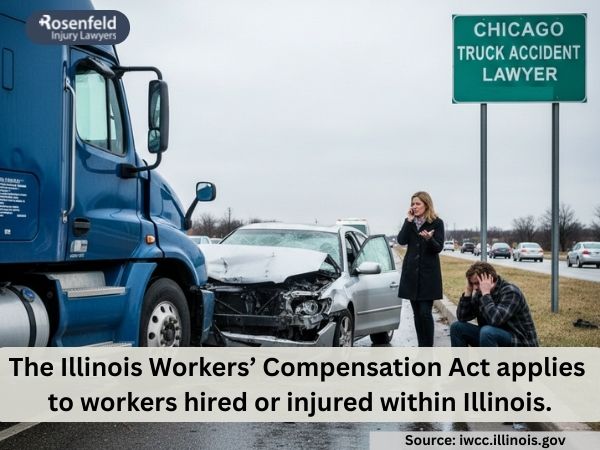
The Federal Motor Carrier Safety Act (FMCSA) applies to all commercial vehicle drivers, regardless of their employment status. These regulations cover hours of service (49 CFR Part 395), vehicle inspections (49 CFR 396.3), vehicle requirements (49 CFR Part 392), and other safety aspects crucial to the trucking industry, like hazardous material hauling.
However, the FMCSA notes that it only preempts state regulations when federal guidelines are more restrictive than state guidelines (49 CFR 390.9). In other words, since Illinois law provides greater legal protections to truck drivers than the FMCSA, trucking companies are required to extend workers’ compensation insurance to a greater range of workers.
Under FMCSA regulations, interstate trucking companies cannot avoid paying workers’ compensation benefits to Illinois truck drivers simply by classifying them as independent contractors.
Understanding whether you are self-employed or an employee is crucial after work-related accidents. This determines which insurance company is required to cover your medical expenses and lost wages, and it also determines whether multiple policies may apply.
For example, if you are classified as self-employed and carry insurance, but you may also be classified as an employee, the workers’ compensation insurance may insist that they cannot be held liable. This would mean you would not receive disability payments. We will utilize Illinois law to push for fair compensation based on the type of work you perform.
Insurers may claim you are ineligible for workers’ compensation insurance based on your contracts or argue that the trucking company is not liable for your injuries, despite the fact that Illinois law entitles certain contractors to the same benefits.
This is why it is crucial to work with a workers’ comp attorney who can ensure that your work-related injuries are fully covered by the appropriate policy and that you are not required to pay for them out of pocket.
Heavy commercial traffic along major routes like I-90, I-294, or the Elgin-O’Hare Expressway significantly increases the risk of serious accidents.
Those delivering loads along busy terrestrial routes like Western Avenue, State Street, or Ashland Avenue can also find themselves suffering from serious injuries due to blind-spot crashes or wide-turn collisions.
Multistate trucking companies may attempt to employ different state regulations in Chicago cases, even though Illinois law clearly extends employee benefits to certain self-employed workers. The interplay of federal, state, and municipal rules, along with multiple insurance agencies, creates complex liability arguments and makes claim processing difficult.
A Chicago truck accident lawyer is a crucial advocate who can ensure you receive a fair settlement from the right insurance agency.
We will investigate your status under federal and Illinois law, using the ABC test and employment records to challenge unfair self-employment classifications. This will help us identify which policies apply to your claim.
Many truck accident cases have multiple policies, especially if the trucker is an independent contractor. Through our careful case evaluation, we will calculate your damages, such as time off work and future medical needs, then negotiate with all the applicable insurance agencies to have all your needs covered.
While a majority of cases settle out of court, some have complex legal questions, disputed liability, or large claims due to catastrophic injuries. We are part of the Illinois Trial Lawyers Association with a 98% success rate in personal injury claims. Our attorneys will manage case documentation, share evidence with other parties during the discovery process, and retain expert witnesses who can demonstrate negligence.
Our team is a member of the Million Dollar Advocates Forum, recognized for securing multi-million-dollar settlements. Some of our truck accident claims include the following.
$6,000,000: Jose, a truck driver, was resting in his sleeping compartment near the Lake Forest Oasis. Another semi-truck slammed into the back of his trailer, knocking him out of the compartment. He suffered a fatal head injury. We filed suit on behalf of his grieving family, demonstrating the other driver’s negligence and the vehicle manufacturer’s failure to design a safer sleeping compartment.
$750,000: Al was helping to unload electronic equipment at a warehouse in the Auburn-Gresham neighborhood when a forklift operator accidentally backed up. He was pinned between the forklift and the wall, resulting in serious crush injuries. We demonstrated that the forklift operator had not followed OSHA regulations, and the forklift did not have the appropriate backup warnings.
$699,500: Susan was having her tractor-trailer reloaded at a South Shore depot before completing a delivery to Gary, Indiana. While waiting, another driver backed up into a spot near her trailer, pinning her in and resulting in a crushed pelvis. She was forced to undergo months of rehabilitation before returning to work. The company attempted to label her as self-employed but we used the ABC test to prove they were liable.
If you’ve been injured in a trucking accident, insurance agencies will do everything possible to mitigate their liability. A traffic accident lawyer in Chicago is invaluable in having your medical care and lost income covered by your workers’ comp benefits. We have secured over $450 million in positive settlements and verdicts over the past 25 years, and we work on a contingency fee basis. Our legal fees are deducted from your settlement, ensuring that everyone can afford top-notch legal representation.
Contact us today to schedule a free consultation about your legal rights.